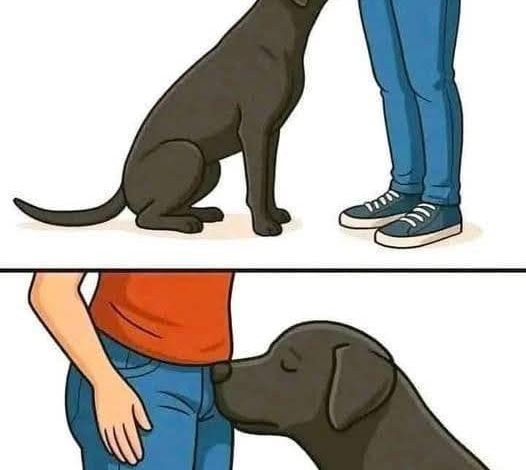
Why Dogs Sometimes Sniff People’s Private Areas and What the Behavior Really Means
A Common Dog Behavior That Often Surprises People
Few interactions with a dog create as much awkwardness as the moment it suddenly walks up and begins sniffing someone’s genital area.
Whether it happens at home, while visiting friends, or during a public outing, the behavior can leave people feeling embarrassed and unsure of how to react.
Despite the discomfort it may cause, animal behavior experts generally view this action as completely natural. For dogs, it is not considered rude, inappropriate, or unusual.
Instead, it is part of the way they gather information about the world around them.
Understanding why dogs behave this way can help owners better interpret their pets’ actions and respond appropriately when the situation occurs.
Dogs Experience the World Through Their Noses
Humans primarily rely on sight and hearing to understand their surroundings. Dogs, however, process much of the world through scent.
The canine sense of smell is extraordinarily powerful and far exceeds human capabilities.
While people often recognize familiar faces or voices first, dogs are more likely to identify individuals through their unique scent signatures.
Every person carries a combination of odors that can reveal a surprising amount of information.
To a dog, scent functions almost like a detailed profile, offering clues that humans cannot easily detect.
This ability explains why dogs spend so much time sniffing objects, people, and other animals whenever they encounter something unfamiliar or interesting.
How Human Body Odors Provide Information
The human body contains specialized sweat glands known as apocrine glands.
These glands produce stronger and more distinctive scents than ordinary sweat glands.
They are concentrated in specific areas of the body, particularly the armpits and the genital region.
For a dog, these locations contain valuable scent information.
The odors released from these areas can communicate details about an individual’s identity, physical condition, and other biological factors.
What humans perceive as a subtle or barely noticeable scent can be highly detectable to a dog.
As a result, certain areas of the body naturally attract more attention from a canine nose.
Why Dogs Often Target the Crotch Area
Many people wonder why dogs seem especially interested in sniffing the genital region rather than other parts of the body.
The answer is largely practical.
Although apocrine glands are present in the armpits, those areas are usually difficult for a dog to reach comfortably.
The genital region, on the other hand, is often positioned closer to the dog’s nose level.
Because it contains strong scent information and is easily accessible, it becomes a natural point of interest.
To a dog, approaching this area is simply an efficient way to learn more about the person standing in front of them.
There is no intention to embarrass, offend, or invade personal space.
The dog is simply following its instincts.
A Human Version of Canine Greetings
To better understand this behavior, it helps to look at how dogs interact with one another.
When dogs meet, they commonly sniff each other’s rear ends.
This greeting behavior allows them to collect information through pheromones and scent markers.
Within seconds, a dog can learn details about another animal that humans would never recognize through smell alone.
The process serves as a form of communication and identification.
When a dog sniffs a person’s crotch area, it is often performing a similar social assessment.
From the dog’s perspective, it is simply gathering information and becoming familiar with someone new.
What feels awkward to humans is often viewed by dogs as a perfectly normal introduction.
When the Behavior Becomes More Noticeable
Although dogs may sniff familiar people occasionally, the behavior is often more noticeable in certain situations.
One common example involves meeting someone new.
When a dog encounters an unfamiliar individual, it naturally seeks information to determine who that person is.
Sniffing becomes part of that investigation.
Changes in body odor can also increase a dog’s curiosity.
After exercise, physical activity, or time spent outdoors, scent levels may become stronger and easier for dogs to detect.
As a result, a dog may spend more time investigating than it normally would.
Biological and hormonal changes can also alter a person’s scent profile, making it more noticeable to a sensitive canine nose.
Because dogs are highly tuned to scent variations, even subtle changes can attract their attention.
Curiosity Rather Than Bad Behavior
Many people mistakenly interpret this behavior as poor manners or disobedience.
In reality, it is usually driven by curiosity rather than intentional misconduct.
Dogs are naturally investigative animals.
They explore their environment through smell in much the same way humans use their eyes.
When a dog approaches someone and begins sniffing, it is attempting to gather information rather than challenge boundaries.
This distinction is important because it changes how owners should respond.
Punishing a dog for following a normal instinct may create confusion without addressing the underlying behavior.
Understanding the motivation behind the action often leads to more effective training approaches.
Teaching Alternative Greeting Habits
Although the behavior is natural, that does not mean people must tolerate it if it makes them uncomfortable.
Dogs are capable of learning different ways to greet visitors and family members.
Training can help redirect their attention toward more appropriate behaviors.
Simple commands such as “sit” or “stay” can be useful when guests arrive.
Instead of allowing the dog to investigate freely, owners can encourage calm and controlled greetings.
Positive reinforcement often works well in these situations.
When a dog responds appropriately, rewards and praise can reinforce the desired behavior.
Over time, many dogs learn that remaining calm and attentive produces better outcomes than jumping, sniffing, or crowding visitors.
Consistency Makes a Difference
Like most training efforts, success depends on consistency.
If owners allow certain behaviors sometimes but discourage them at other times, dogs may struggle to understand expectations.
Clear and predictable responses help create lasting habits.
Family members should follow similar rules whenever possible.
When everyone responds in the same way, dogs receive a consistent message about acceptable greetings.
This approach can gradually reduce unwanted sniffing while preserving the dog’s ability to interact socially.
Patience is also important, as behavioral changes often develop over time rather than immediately.
Understanding the Canine Perspective
One reason this behavior often causes confusion is the difference between human and canine social norms.
Humans generally rely on conversation, facial expressions, and body language when meeting someone.
Dogs operate according to a very different set of instincts.
For them, scent serves as one of the primary sources of information.
What humans consider a private area may simply represent a location rich in scent data from a dog’s perspective.
Recognizing this difference can make the behavior easier to understand.
Rather than viewing it as intentional misbehavior, it can be seen as a natural extension of how dogs communicate and explore.
A Behavior Rooted in Communication
Dogs do not have language in the way humans do.
They cannot ask questions, exchange personal histories, or introduce themselves through conversation.
Instead, they rely heavily on scent to learn about the individuals around them.
Every encounter becomes an opportunity to gather information through their most powerful sense.
This instinct has been part of canine behavior for generations and remains deeply ingrained today.
Even highly trained dogs continue to use scent as a primary tool for understanding their environment.
The behavior may look unusual from a human perspective, but for dogs it is a routine and meaningful form of communication.
Why Understanding the Behavior Matters
Recognizing the reasons behind a dog’s actions can help strengthen the relationship between pets and their owners.
When people understand that certain behaviors are driven by instinct rather than defiance, they can respond with greater patience and effectiveness.
This does not mean every natural behavior should be encouraged.
Instead, understanding provides a foundation for appropriate guidance and training.
Owners can respect a dog’s instincts while still teaching boundaries that fit comfortably within human social settings.
The goal is not to eliminate curiosity but to channel it into more acceptable forms of interaction.
A Natural Instinct Rather Than an Embarrassing Mystery
For many people, a dog sniffing their genital area feels awkward and unexpected.
For the dog, however, the behavior is usually nothing more than a routine attempt to gather information.
Powerful scent-detection abilities drive dogs to explore the world through odors, and the human body provides a wealth of scent signals.
The genital region happens to be one of the strongest and most accessible sources of that information.
Whether the dog is meeting someone for the first time, responding to a scent change, or simply satisfying its curiosity, the motivation is generally social rather than inappropriate.
With proper training, owners can encourage alternative greeting habits when necessary.
At its core, however, the behavior reflects something simple: a dog trying to understand the people around it using the language it knows best.
In the canine world, scent is communication, and a curious sniff is often just the beginning of a conversation.
