
Old Iron Tool Found in Barn Reveals Its Practical Farming Purpose
A Forgotten Object From an Earlier Farming Era
Exploring an old barn often uncovers more than worn lumber, rusted hardware, and aging equipment. Hidden beneath years of dust are tools that once played an important role in everyday farm life but now appear unfamiliar to many people.
Without the background of traditional farming practices, these objects can be difficult to recognize. Their unusual shapes and heavy construction frequently lead to guesses that they belonged in workshops, factories, or even kitchens.
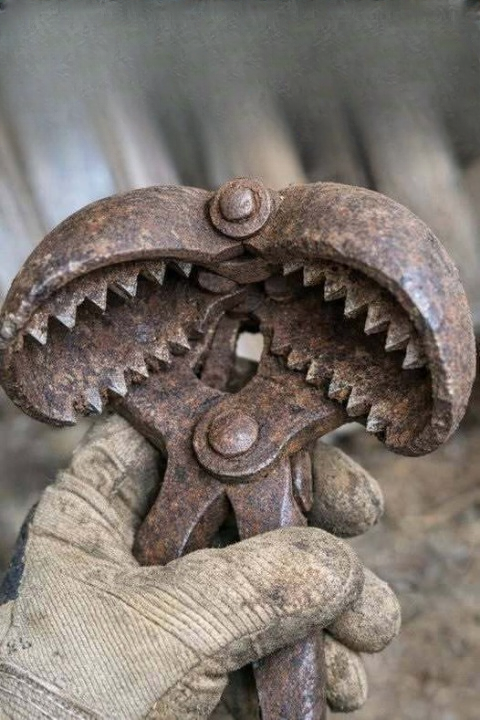
One such discovery is a solid iron device with curved jaws connected by a hinge and lined with jagged teeth. Its sturdy appearance can make it resemble a clamp, trap, or another type of industrial tool rather than an item intended for agricultural work.
Despite its intimidating design, the tool was created for a straightforward purpose. It helped farmers remove kernels from dried corn cobs quickly and efficiently, making it an essential part of crop preparation before modern machinery became widely available.
A Handheld Corn Sheller With a Specific Job
The iron object is a handheld corn sheller, a practical tool developed to simplify one of the most time-consuming jobs on the farm. Before large mechanical harvest equipment became common, much of the work surrounding corn production depended on manual labor.
Corn served as one of the most valuable crops for many farming families. It was used to prepare meals, feed livestock, preserve seed for future planting, and support trade within rural communities.
Once the harvest was complete, the kernels had to be separated from the dried cobs. Accomplishing that task entirely by hand demanded considerable time and effort, especially when large quantities of corn needed processing.
The handheld corn sheller greatly reduced that workload. Its simple mechanical design enabled users to remove kernels much faster than they could with their hands alone, making the harvest season more manageable.
Understanding Its Unusual Design
People unfamiliar with older farm equipment often find the appearance of the sheller confusing. Its cast-iron construction, hinged body, and rough interior give it a rugged look that can easily be mistaken for something intended for a completely different purpose.
Every feature of the tool, however, was designed with efficiency in mind. The curved opening matched the natural shape of a corn cob, allowing it to fit securely inside the device during use.
The jagged teeth inside the sheller were not sharpened to slice or cut. Instead, they were carefully shaped to grip beneath rows of dried kernels and loosen them as the cob moved through the tool.
Applying steady pressure while pulling or rotating the cob caused the teeth to separate the kernels without requiring complicated mechanisms or powered equipment. The design reflected practicality above appearance.
Many tools produced for agricultural work followed the same philosophy. Their value came from accomplishing a specific task as effectively as possible rather than from decorative features or refined styling.
How Farmers Used the Corn Sheller
Successful use of the sheller depended on the condition of the corn. Freshly harvested ears were too soft, making the kernels difficult to remove cleanly from the cob.
Farmers first allowed the corn to dry thoroughly. Drying hardened both the cob and the kernels, making shelling easier while also preparing the grain for storage, livestock feed, or future planting.
After the drying process was complete, a farmer placed a cob inside the sheller’s curved jaws. The position of the teeth aligned naturally with the rows of kernels covering the cob.
By squeezing the handles and pulling or twisting the cob through the tool, the rows of kernels loosened and separated. The kernels then dropped into a nearby sack, bucket, or another container ready for collection.
The remaining cob still had practical uses around the farm. Rather than being discarded, it could serve as bedding for animals, become compost, provide fuel, or fulfill other everyday needs within the household.
An Important Part of Harvest Season
Corn occupied an important place in rural farming because it supported many aspects of daily life. Beyond providing food for families, it supplied feed for livestock and seed for future crops.
Preparing the harvest properly helped ensure that enough grain remained available for both immediate use and the following growing season. As a result, processing corn efficiently became an important responsibility during harvest time.
Large harvests often meant dealing with hundreds or even thousands of dried cobs. Removing kernels individually without specialized tools required significant physical effort and many hours of repetitive work.
The handheld corn sheller reduced that burden by speeding up the shelling process. Although simple in appearance, it allowed farm families to complete essential work more efficiently during one of the busiest periods of the agricultural calendar.
In households where every member contributed to seasonal labor, saving time and energy made a meaningful difference. Even modest improvements in efficiency could help complete demanding tasks before weather or other responsibilities interrupted the harvest.
Built for Years of Dependable Service
Many surviving corn shellers remain in good working condition because they were constructed from durable materials such as cast iron or forged steel. These metals provided the strength needed to withstand repeated use throughout many growing seasons.
Farm equipment was expected to tolerate hard work, rough handling, and regular exposure to outdoor conditions. Reliability mattered far more than appearance or comfort.
Unlike many modern products intended for limited use or easy replacement, these tools were designed to remain dependable year after year. Farmers relied on equipment that could continue functioning through countless harvests.
Even when discovered after decades of storage inside barns or sheds, many shellers still operate despite surface rust or cosmetic wear. Their basic mechanical construction often survives with little damage.
The lasting condition of these tools reflects the practical craftsmanship that characterized much of traditional agricultural equipment. Strong materials and uncomplicated designs helped ensure dependable performance over long periods.
Why Old Farm Tools Are Often Misidentified
As agriculture became increasingly mechanized, many hand-operated tools gradually disappeared from everyday use. Powered equipment eventually replaced tasks that had once required manual effort.
At the same time, fewer people remained closely connected to traditional farming routines. Knowledge that had once been passed naturally between generations became less common as rural life changed.
Because of this shift, objects that were once immediately recognizable now seem mysterious. A tool that earlier farming families identified without hesitation can easily be mistaken today for something entirely unrelated.
The handheld corn sheller is frequently confused with traps, clamps, mechanical parts, or workshop equipment simply because its original purpose is no longer familiar to many people.
Old barns and storage buildings therefore continue to reveal objects whose functions are no longer obvious. Their designs make sense only when viewed within the context of the agricultural work they were created to perform.
Simple Engineering That Solved a Practical Problem
The effectiveness of the corn sheller came from straightforward mechanical principles rather than complicated technology. It required no electricity, fuel, or elaborate maintenance procedures.
Instead, the tool relied on carefully shaped components working together through pressure, leverage, and repeated motion. Those basic ideas proved sufficient to simplify an important agricultural task.
Many traditional farm tools shared the same design philosophy. They were developed to solve everyday problems using practical construction and efficient operation rather than unnecessary complexity.
The corn sheller demonstrates how necessity often inspired innovation in rural communities. Farmers needed faster methods for processing harvested crops, and this durable handheld device answered that need effectively.
Its hinge, curved opening, textured teeth, and solid construction each served a clear function. Every part contributed directly to improving the shelling process.
From Essential Equipment to Historical Collectible
Modern farming now relies on machinery capable of processing corn on a much larger scale and at far greater speed than any handheld tool. As a result, corn shellers are no longer standard equipment on most farms.
Even so, these devices continue to hold historical significance. Many have been preserved by collectors, displayed in agricultural museums, or incorporated into rustic home and barn décor.
Interest in surviving shellers often depends on factors such as their age, overall condition, distinctive markings, or connection to local farming traditions. Others are appreciated simply because they represent an earlier way of working the land.
Beyond their value as collectibles, these tools remind people of the effort once required to process every harvest by hand. They reflect the daily routines of families who depended on practical equipment to prepare food, feed animals, and preserve seed for future seasons.
A Lasting Symbol of Practical Farm Life
What initially appears to be an unfamiliar iron object is actually an important example of traditional agricultural craftsmanship. The handheld corn sheller transformed a demanding task into one that could be completed more efficiently through simple mechanical design.
Its heavy jaws and textured interior may seem unusual today, but every feature was carefully shaped to remove kernels from dried corn cobs with reliability and consistency.
Discoveries like this illustrate how many forgotten tools once formed an essential part of everyday survival. They supported food preparation, livestock care, seed preservation, and the countless seasonal responsibilities that defined rural life.
Although the handheld corn sheller is no longer a common sight on modern farms, it remains a reminder of practical ingenuity. Its straightforward construction reflects a period when durable tools solved real problems through thoughtful design and dependable craftsmanship.
Finding one tucked away inside an old barn offers more than a glimpse into the past. It reveals how ordinary equipment once played an extraordinary role in helping farming families complete the demanding work of every harvest, proving that even the simplest tools could have lasting importance when every kernel counted.

