The $100 Riddle That Confuses Everyone: Why the Store Only Lost $100
A Simple Problem That Triggers Big Arguments
At first glance, this classic riddle appears almost too easy. Most people quickly believe they know the answer within seconds of reading it.
Yet something unusual happens when the scenario is analyzed more carefully. The longer it is considered, the more confusing it seems to become.
Across social media and discussion forums, people frequently disagree about the outcome. Some insist the store lost 200 dollars, others claim 170 dollars, while another group argues for 130 dollars.
The confusion comes not from complex math, but from how the brain interprets the flow of money and goods in the story.
The Scenario Behind the Puzzle
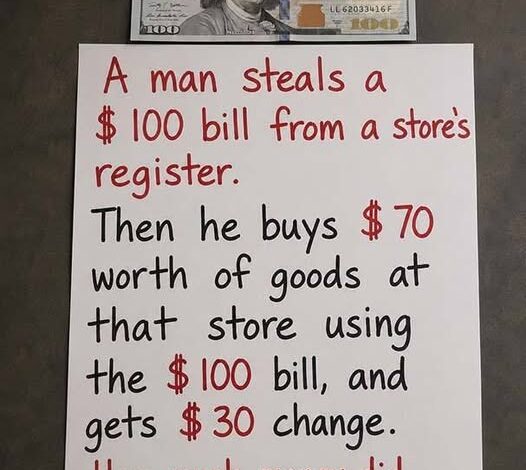
The situation begins with a man stealing a 100 dollar bill from a store’s cash register.
Later that same day, he returns to the store and purchases 70 dollars worth of goods using the stolen bill.
The cashier unknowingly accepts the bill, places it back into the register, and gives the man 30 dollars in change.
This sequence creates the illusion of multiple losses, which is where most of the confusion begins.
Why the Brain Gets Tricked
Many people try to calculate the loss by separating each step without tracking what actually leaves the store permanently.
This often leads to double-counting the same money or mixing up cash flow with inventory value.
The mind tends to focus on individual transactions rather than the final net result.
As a result, the problem feels more complex than it truly is, even though it relies on very basic arithmetic.
Breaking Down the First Step
In the beginning, the thief takes 100 dollars from the cash register.
At this moment, the store is down 100 dollars in cash.
This is the first and most direct loss in the entire sequence.
The Return of the Stolen Bill
When the thief later uses the same 100 dollar bill to buy items, the money is returned to the store.
The register regains the exact 100 dollars that had been taken earlier.
At this stage, the cash balance is restored, meaning there is no longer a cash shortage from the original theft.
However, the transaction is not complete without considering what the thief receives in return.
The Cost of Goods and Change
The store gives the thief 70 dollars worth of goods and 30 dollars in cash as change.
This is where the real loss occurs.
The goods represent physical inventory leaving the store, while the 30 dollars represents additional cash leaving the register.
Both of these elements contribute to the store’s final loss.
Understanding the True Loss
To correctly evaluate the situation, it is important to separate cash movement from total value loss.
Although the stolen 100 dollar bill returns to the register, the store still gives away 70 dollars in merchandise and 30 dollars in cash.
These two amounts together equal 100 dollars.
This is the actual loss experienced by the store.
A Clear Way to Visualize the Outcome
One helpful way to understand the puzzle is to imagine the thief never stealing the 100 dollar bill in the first place.
Instead, he simply walks into the store, takes 70 dollars worth of goods, and receives 30 dollars in cash as change from a legitimate transaction.
In that simplified version, it becomes obvious that the store is down 100 dollars in total value.
The same outcome applies to the original scenario once the flow of money and goods is properly understood.
Tracking What Actually Leaves the Store
The key to solving the riddle is focusing on what permanently exits the store’s possession.
In this case, two things leave the store: merchandise worth 70 dollars and cash amounting to 30 dollars.
When combined, these losses total 100 dollars.
The returned 100 dollar bill does not count as a loss because it ends up back in the register.
Only the final net loss matters in determining the correct answer.
Why Common Answers Are Incorrect
Answers like 200 dollars or 170 dollars often come from adding multiple steps together without considering overlap.
Some calculations mistakenly count the stolen bill and the returned bill as separate losses.
Others confuse temporary cash flow changes with actual value lost by the business.
These errors arise from focusing on movement rather than net change.
The Correct Logical Breakdown
When each step is carefully tracked, the outcome becomes clear.
The store first loses 100 dollars in cash, but that amount is later restored when the bill is used for payment.
What remains is the value given to the thief: 70 dollars in goods and 30 dollars in cash.
Together, these equal a total loss of 100 dollars.
No additional hidden loss exists beyond this amount.
Why This Riddle Feels So Confusing
This puzzle is effective because it challenges how people interpret transactions rather than testing advanced math skills.
The brain naturally tries to assign separate losses to each step instead of viewing the entire sequence as one complete event.
This creates the illusion of multiple losses where only one net loss actually exists.
It is a reminder that careful reasoning often matters more than quick assumptions.
The Final Answer Explained Clearly
After breaking down every part of the scenario, the result is straightforward.
The store loses 70 dollars in goods and 30 dollars in cash.
This totals exactly 100 dollars.
The stolen bill itself does not add extra loss because it is returned during the transaction.
Therefore, the final and correct answer is a loss of 100 dollars.
A Lesson in Logical Thinking
This riddle highlights how easily perception can distort simple problems.
By focusing on net value rather than individual steps, the solution becomes much easier to understand.
It shows that many confusing problems are resolved not through complex calculations, but through clear and structured thinking.
In the end, the puzzle is less about mathematics and more about how the mind organizes information.
