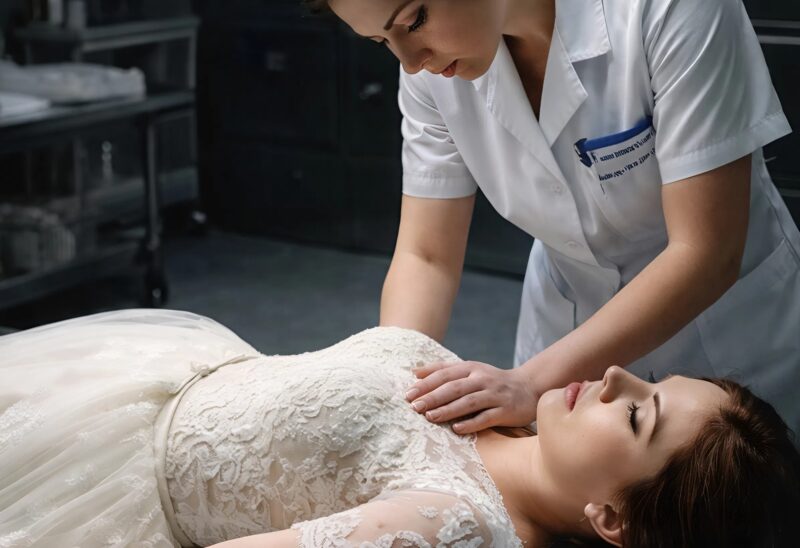
Morgue Attendant Notices Bride’s Warm Skin and Uncovers a Shocking Wedding-Day Deception
A Wedding Day That Ended in Tragedy
What should have been the happiest day of a young woman’s life ended in apparent tragedy when a bride collapsed during her wedding and was later declared dead.
Hours after the ceremony was interrupted, an ambulance arrived at a city morgue carrying the woman’s body. Behind it followed several vehicles still decorated with wedding flowers and white ribbons.
Friends and family gathered outside the building in stunned silence.
Some wept openly while others stood motionless, unable to process how a celebration had transformed into a funeral procession within a single day.
The bride remained dressed in her wedding gown. Her hair had been carefully arranged, and a bouquet still rested across her chest.
Walking beside the stretcher was the groom.
He appeared unusually calm for someone who had supposedly lost the woman he had just married.
Witnesses later remembered the expression on his face. It was not grief or panic. Instead, he seemed focused on something else entirely.
A New Employee at the Morgue
The body was received by a young morgue attendant who had only recently begun working at the facility.
When she first accepted the position, she struggled with fear and anxiety.
The quiet corridors, cold rooms, and constant presence of death had made her uneasy.
Over time, however, she adjusted to the environment.
A senior doctor had once given her advice that stayed with her.
“You shouldn’t be afraid of the dead. The dangerous ones are those who walk around and smile.”
The words had helped her overcome much of her fear.
By the time the bride arrived, she viewed her work with professionalism and calm.
Still, something about this particular case immediately felt different.
Questions About the Official Cause of Death
After relatives were escorted away, the bride was placed in a preparation room to await examination.
The attending physician briefly reviewed the paperwork before leaving.
The documents listed poisoning as the cause of death.
Everything appeared complete and properly signed.
The doctor informed the attendant that the autopsy would take place the following day and advised her not to stay beyond her shift.
At first, she accepted the explanation.
Yet as the room fell silent, her attention returned to the woman lying on the table.
The bride’s appearance did not match what she normally observed.
Her skin retained healthy color.
Her lips were not discolored.
Most unusual of all, her cheeks appeared faintly rosy.
The attendant could not ignore the feeling that something was wrong.
An Impossible Discovery
Curious and increasingly concerned, she approached the table.
She carefully touched the bride’s hand.
The reaction was immediate.
The skin felt warm.
Assuming she had made a mistake, she checked again.
The warmth remained.
In a cold morgue environment, a body typically loses heat quickly.
This woman felt different.
The attendant leaned closer and watched carefully.
For a brief moment, she thought she saw a subtle movement in the chest.
Unable to trust her eyes, she placed her ear against the bride’s body.
In the silence, she detected a faint rhythm.
It sounded like a heartbeat.
The possibility was terrifying.
If she was correct, a living person had been delivered to the morgue.
The Doctor Dismisses Her Concerns
Without hesitation, the attendant rushed to find the physician.
She explained what she had discovered and insisted the bride might still be alive.
The doctor appeared irritated by the interruption.
Nevertheless, he agreed to return to the room and conduct another examination.
He checked the bride’s neck, examined her eyes, and listened to her chest using a stethoscope.
The attendant watched anxiously as he completed the assessment.
When he finished, he dismissed her concerns.
He explained that some poisoning cases can produce unusual physical reactions after death.
According to him, retained body heat and involuntary muscle responses were not uncommon.
He insisted there was no heartbeat.
The woman was dead.
After delivering his conclusion, he left the room.
The attendant remained behind, unconvinced.
Doubts Refuse to Fade
Despite the doctor’s confidence, she could not shake the feeling that she had witnessed something real.
The bride’s appearance continued to trouble her.
The warmth remained unusual.
Her features looked too natural.
At one point, the attendant believed she saw a slight movement in the woman’s fingers.
She leaned closer and whispered softly, hoping for some response.
Nothing happened.
Still, her instincts told her not to ignore what she had observed.
Rather than accept the official explanation, she decided to verify the truth herself.
A Camera Records the Night
Before ending her shift, the attendant secretly installed a small camera in the room.
Its position provided a clear view of the examination table.
She told no one about the device.
The following morning, she arrived early and reviewed the footage in private.
For the first several hours, nothing unusual occurred.
The room remained silent and still.
Then everything changed.
The recording showed the bride taking a sudden deep breath.
Her hands moved.
Moments later, her eyes slowly opened.
The attendant stared at the screen in disbelief.
The woman who had been declared dead was clearly alive.
A Secret Meeting Captured on Video
The footage became even more shocking when two familiar figures entered the room.
The physician returned.
He was accompanied by the groom.
The attendant watched as they approached the bride.
The conversation recorded by the camera suggested that everything had been planned in advance.
The doctor spoke confidently, indicating that the dosage involved had been carefully calculated.
The groom appeared nervous and eager to leave quickly.
Together, they helped the weakened bride stand.
Although unsteady, she was conscious and responsive.
Within minutes, the three of them exited through a service door.
The recording left little doubt that the apparent death had been staged.
The Truth Begins to Emerge
As the attendant reviewed the footage repeatedly, a possible explanation began to form.
The evidence suggested that the bride had not died from accidental poisoning.
Instead, she had apparently been placed into a medically induced state designed to mimic death.
Her heartbeat and vital signs had been reduced to levels that could be difficult to detect during a superficial examination.
Anyone relying solely on limited observations might incorrectly conclude that she had died.
The recording indicated that the doctor and groom were fully aware of the plan.
More surprisingly, the bride herself appeared to be cooperating.
The question was no longer whether she was alive.
The question was why such an elaborate deception had been created.
Financial Motives Surface
Further information pointed toward significant financial incentives.
Only days before the wedding, a substantial life insurance policy had reportedly been established in the bride’s name.
Under its terms, the payout would be directed to her husband if she died.
At the same time, the bride reportedly held an ownership interest in her father’s business.
As long as she remained legally alive, major decisions involving those assets required her involvement.
An official death would dramatically change that situation.
Control could potentially shift to other parties, including individuals connected to the groom.
The combination of insurance money and business interests suggested a powerful financial motive.
The scheme appeared designed to produce benefits on multiple fronts.
A Plan Designed to Erase Questions
The apparent strategy extended beyond merely declaring the bride dead.
The available evidence suggested that the process was intended to move quickly.
Once legal paperwork was completed, the body would have been treated as deceased.
Further scrutiny might have been avoided.
The deception relied heavily on timing.
If no one questioned the initial diagnosis, the bride could disappear while authorities believed she had died.
Meanwhile, financial and legal consequences would unfold based on the official records.
From the perspective of those involved, the plan may have seemed flawless.
Yet one critical detail had been overlooked.
The morgue attendant trusted her observations more than the explanation she had been given.
The Decision That Changed Everything
Many people would have accepted the doctor’s reassurance and moved on.
The attendant did not.
Her refusal to ignore inconsistencies ultimately exposed the truth.
Without her persistence, the bride’s apparent death might never have been questioned.
The secret camera provided evidence that could not easily be dismissed.
The footage documented events that directly contradicted the official narrative.
It transformed suspicion into proof.
Most importantly, it demonstrated that the woman who had entered the morgue as a corpse had later walked out alive.
A Conspiracy Unravels
After securing a copy of the recording, the attendant prepared to take action.
This time, she did not intend to confront the physician alone.
The evidence in her possession was too significant to ignore.
The case had evolved far beyond a simple medical misunderstanding.
It now involved questions of fraud, deception, and possible criminal conspiracy.
The wedding-day tragedy that had shocked relatives and friends was not what it appeared to be.
Behind the scenes, a carefully organized scheme had been unfolding.
Its success depended on silence and unquestioned assumptions.
Instead, it encountered someone willing to trust her instincts.
A Mystery Solved Through Persistence
What began as a routine shift inside a morgue became an extraordinary investigation.
A newly hired attendant noticed details that others overlooked.
Warm skin, healthy color, and a faint heartbeat seemed insignificant when viewed separately.
Together, they revealed a much larger truth.
The bride who was believed to be dead had never truly died.
The official explanation concealed a carefully orchestrated plan involving money, power, and disappearance.
In the end, the entire scheme unraveled because one employee refused to accept what she was told without question.
Her attention to detail transformed a supposed death into the exposure of a deception that might otherwise have remained hidden forever.
