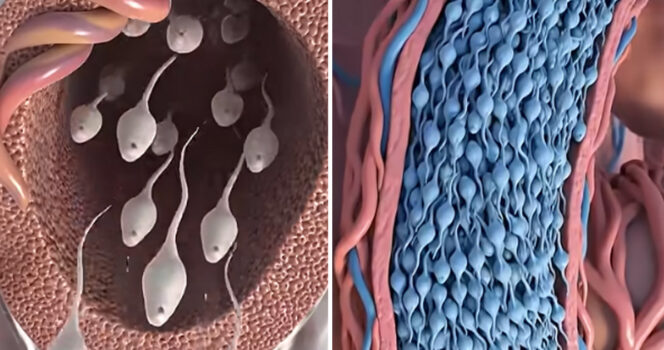
Scientific Simulation Reveals What Happens to Sperm When It Is Not Released From the Body
The human body carries out countless processes automatically, many of which occur without conscious awareness. One of those ongoing functions is sperm production, a biological process that begins during early adolescence and continues throughout a man’s lifetime.
While many people understand the basics of reproduction, fewer are familiar with what happens to sperm when it is not ejaculated. A scientific simulation has helped shed light on the process, illustrating how the body manages sperm cells that are never released.
The explanation highlights the efficiency of the reproductive system and demonstrates that sperm does not remain stored indefinitely inside the body.
How Sperm Production Begins
Sperm production typically starts between the ages of 10 and 13. From that point onward, the body continuously creates new sperm cells as part of its normal reproductive function.
This production process occurs in the testicles, where sperm cells are generated and begin their development.
Unlike many cells in the body that have highly specialized functions limited to specific tasks, sperm cells are produced in large numbers on an ongoing basis.
The body maintains this production regardless of how frequently ejaculation occurs, ensuring a steady supply of mature sperm is available.
Because sperm generation is continuous, the reproductive system must also have mechanisms for dealing with older sperm that is never released.
The Role of the Epididymis
After sperm cells are created in the testicles, they move into a structure known as the epididymis.
The epididymis is a tube that wraps around the testes and serves as a storage and maturation area for sperm.
During this stage, sperm continue developing until they become capable of performing their reproductive function.
When ejaculation occurs, mature sperm leave the epididymis and combine with fluids produced by the seminal vesicles and prostate gland.
Together, these components form semen.
A healthy man typically releases between two and five millilitres of semen during ejaculation.
Sperm Does Not Remain in Storage Forever
A common misconception is that sperm simply accumulates inside the body if it is never ejaculated.
In reality, sperm cells have a limited lifespan.
According to the scientific explanation demonstrated in the simulation, sperm generally remain viable for approximately 74 to 76 days.
After that period, the cells reach the end of their natural life cycle.
Rather than remaining in storage indefinitely, older sperm undergo biological changes that allow the body to manage them efficiently.
This process ensures that the reproductive system continues functioning smoothly without becoming overloaded with aging cells.
What Happens When Sperm Expires?
Once sperm cells reach the end of their lifespan, they do not simply remain dormant.
Instead, they enter a process known as degeneration.
Degeneration involves the breakdown of sperm cells into their component parts.
As this occurs, the body begins recycling valuable materials contained within the cells.
This allows important biological resources to be reused rather than discarded.
The process is a normal and healthy function of the reproductive system.
It reflects the body’s ability to continuously renew itself while minimizing waste.
Recycling Biological Components
Sperm cells contain numerous structural and nutritional elements that can be repurposed by the body.
Among these components are enzymes, zinc, fructose, and various proteins that contribute to sperm function and development.
When degeneration occurs, these materials are broken down and reabsorbed.
The epididymis plays a significant role in this process, helping recover useful substances from expired sperm cells.
Those recycled materials can then contribute to the production of new sperm, creating an efficient cycle of renewal.
Rather than wasting biological resources, the body continually reuses them as part of ongoing reproductive maintenance.
Natural Release Through Nocturnal Emissions
Although many sperm cells are eventually reabsorbed, the body has other ways of eliminating semen.
One of the most common mechanisms is nocturnal emission, often referred to as a wet dream.
Nocturnal emissions occur naturally and involve the involuntary release of semen during sleep.
This process can happen regardless of whether a person is sexually active.
For many individuals, nocturnal emissions represent a normal part of reproductive health.
They provide one of several ways the body regulates sperm and semen levels over time.
Understanding Low Sperm Count
While sperm production generally continues throughout life, some men experience difficulties that affect the quantity of sperm their bodies produce.
Low sperm count can result from a variety of medical and biological factors.
Several conditions are known to interfere with normal sperm production and reproductive function.
One potential cause is varicocele, a condition involving enlarged veins within the scrotum.
Infections may also affect reproductive health and contribute to reduced sperm production.
Tumors and other medical conditions can sometimes interfere with the body’s ability to generate healthy sperm cells.
Additional Factors That Can Affect Sperm Production
Undescended testicles are another condition associated with fertility challenges and lower sperm counts.
Hormone imbalances may also disrupt normal reproductive processes, reducing the body’s ability to produce sperm efficiently.
Changes or damage to the tubes responsible for carrying sperm can create additional complications.
Some individuals may face genetic conditions that influence reproductive health and fertility.
Certain medications have also been linked to reductions in sperm production.
Previous surgical procedures can sometimes affect the reproductive system as well.
Because reproductive health involves multiple biological systems working together, a wide range of factors can influence overall sperm count.
The Impact of Lifestyle and Well-Being
Physical health and daily habits can also play important roles in reproductive function.
Stress is frequently cited as a factor that may affect sperm production and sexual health.
Psychological well-being can influence various hormonal and physiological processes connected to reproduction.
Drug use and excessive alcohol consumption may contribute to difficulties involving sperm count and fertility.
General health status also remains an important consideration.
The body’s reproductive systems function best when supported by healthy lifestyle choices and overall physical wellness.
As a result, reproductive health is often closely connected to broader aspects of health and well-being.
The Debate Around Abstinence
In recent years, discussions about abstinence have gained attention through online trends such as “No Nut November.”
Supporters of the trend often suggest that avoiding ejaculation can increase testosterone levels or significantly improve sperm quality.
However, those claims have frequently been challenged by medical professionals.
Health experts have consistently rejected the idea that prolonged abstinence provides dramatic hormonal benefits.
Instead, discussions about reproductive health generally focus on maintaining normal bodily function rather than pursuing unproven claims.
The scientific simulation and related explanations reinforce the understanding that the body already possesses effective mechanisms for managing sperm production and turnover.
Potential Effects of Prolonged Abstinence
Some medical discussions have noted that extended periods without ejaculation may be associated with psychological effects in certain individuals.
Feelings of anxiety or depression have been mentioned as possible concerns linked to prolonged abstinence.
Because emotional well-being is connected to overall health, these factors can influence how individuals experience and manage their reproductive health.
The effects can vary from person to person, highlighting the complexity of human biology and behavior.
Understanding these connections remains an important part of broader conversations about wellness and sexual health.
Research on Regular Ejaculation
Some scientific research has explored potential health benefits associated with regular ejaculation.
One study found that men who ejaculated 21 times or more each month experienced a 31 percent lower risk of prostate cancer.
The findings attracted attention because they suggested a possible relationship between ejaculation frequency and long-term prostate health.
Researchers noted that the results remained consistent even after considering additional lifestyle factors and differences in PSA testing frequency.
While research in this area continues to evolve, the findings contributed to ongoing discussions regarding reproductive health and disease prevention.
A Continuous Cycle of Renewal
The scientific simulation ultimately highlights how efficiently the human body manages sperm production.
Rather than accumulating endlessly, sperm cells follow a predictable life cycle that includes development, storage, maturation, degeneration, and recycling.
When sperm is not ejaculated, the body naturally breaks down older cells and reuses valuable components to support future production.
Additional mechanisms, including nocturnal emissions, help regulate the reproductive system over time.
This continuous cycle allows sperm production to continue throughout life while maintaining balance within the body.
Far from remaining unused indefinitely, sperm cells are part of a carefully regulated biological process that demonstrates the body’s remarkable ability to renew and maintain itself.
