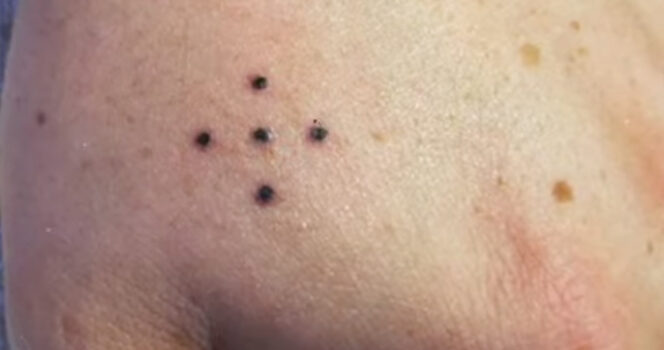
The Hidden Meaning Behind the Five-Dot Hand Tattoo and Why It Continues to Spark Discussion
Tattoos have served as a form of personal expression for thousands of years, allowing individuals to communicate identity, experiences, beliefs, and memories through permanent body art. While many designs are chosen for artistic reasons, others carry meanings that are not immediately obvious to those unfamiliar with their history.
One particular tattoo has recently become the subject of renewed interest online: a simple arrangement of five dots placed in a cross-like pattern on the hand.
At first glance, the design appears minimal and unremarkable. However, for many people, the symbol has a much deeper and darker association rooted in prison culture.
As discussions about tattoo symbolism continue to spread across social media platforms and online forums, more people are discovering the significance attached to this small but widely recognized design.
Tattoos as a Form of Personal Identity
Throughout history, tattoos have carried different meanings depending on the culture, region, and period in which they were created.
For some individuals, tattoos honor loved ones, commemorate important life events, or represent personal values and beliefs.
Others choose designs simply because they appreciate the artistic qualities of a particular image or symbol.
In modern society, tattoos have become increasingly accepted and are often viewed as a normal part of self-expression.
Despite their widespread popularity, discussions continue regarding their purpose and significance.
Some people view tattoos primarily as artistic statements, while others see them as deeply personal markers that become part of an individual’s identity.
Whatever the motivation, tattoos often communicate messages that extend far beyond their visual appearance.
The Long History of Tattooing
The practice of tattooing stretches back thousands of years and has been documented across numerous civilizations.
Evidence discovered on ancient mummified remains has led archaeologists to believe that tattooing existed between 3370 BC and 3100 BC.
Some researchers suggest the practice may be even older, with indications that humans were marking their skin as early as 2100 BC.
Over time, traces of ancient tattoo culture have been found in locations spanning multiple continents.
Discoveries in places such as China, Sudan, Russia, and the Philippines have demonstrated that tattooing was not limited to a single society or geographic region.
Instead, it emerged independently across various cultures, serving a wide range of social, spiritual, and personal purposes.
This long history helps explain why many tattoo designs continue to carry powerful meanings that can vary dramatically depending on context.
Not Every Tattoo Means What It Appears to Mean
Many tattoos are straightforward in their symbolism, making their meaning easy to understand.
A name may honor a loved one. A date may commemorate an important milestone. A portrait may celebrate a person, pet, or historical figure.
Other designs, however, contain messages that are recognized only by specific groups or communities.
These symbols can carry meanings related to cultural traditions, social affiliations, life experiences, or personal histories.
Because of this, tattoo professionals often encourage individuals to research a design carefully before making a permanent decision.
Understanding the background of a symbol can help prevent misunderstandings and ensure that a chosen design accurately reflects the wearer’s intentions.
Warnings From Tattoo Professionals
Tattoo artist Claudio Traina, who works in England and Italy, has emphasized the importance of learning about the history and significance of a tattoo before getting it.
According to Traina, certain designs can carry strong associations that may not be obvious to someone selecting a tattoo purely for its appearance.
She pointed to examples of tattoos that have become closely connected with criminal activity in specific regions.
“Facial tear drop tattoos in North America hold strong meanings linked to criminal activity,” she said.
She also discussed prison tattoo traditions in Russia, where specific designs can carry significant weight within prison culture.
“In Russia, the prison tattoos hold such strong meanings that if you misrepresent yourself through tattoos, you will lose fingers.
Traina noted that some people now choose these designs solely because they like how they look, without fully understanding the symbolism attached to them.
“Nowadays, people do these kinds of tattoos just for the aesthetic, which can make things complicated if you’re in the wrong place at the wrong time.”
The Tattoo That Sparked Online Curiosity
Interest in the five-dot tattoo increased after an online discussion drew attention to the design.
A social media user described noticing the same tattoo on multiple individuals from different backgrounds and locations.
The person explained that the design consisted of five dots arranged in a cross-like formation near the thumb.
Its repeated appearance among unrelated individuals led to questions about whether the tattoo carried a specific meaning.
The user wrote: “I’ve got a new neighbour and noticed he had this tattoo, too – it’s super simple, five dots in a cross shape, kinda like the Portuguese coat of arms near the thumb on his hand. It’s weird because I’ve run into guys with that exact same tattoo a bunch of times; even the waiter on my recent vacation had one. Anyone know what it means? And why do people from such different places have it?”
The question quickly generated responses from people familiar with the symbol and its historical associations.
The Meaning Behind the Five Dots
Several participants identified the design as a quincunx, a pattern consisting of four outer points surrounding a central point.
One explanation linked the tattoo to prison symbolism that has existed for many years.
A respondent explained: “Are you talking about a quincunx? If so, the most common one is a prison tattoo. The four outer dots represent the four walls of the cell and the central dot represents the prisoner.”
According to this interpretation, the tattoo serves as a symbolic representation of incarceration.
The outer dots are said to represent the walls surrounding a prison cell, while the dot in the center symbolizes the individual confined within those walls.
The simplicity of the design allows it to communicate a complex message using only a few small marks.
Despite its minimal appearance, the tattoo has become one of the more recognizable symbols associated with prison culture.
A Design Commonly Found on the Hand
The five-dot tattoo is most often placed on the hand, particularly in the area between the thumb and forefinger.
This location makes the symbol easily visible while remaining relatively small and discreet.
Because the design requires only a few dots, it can be created quickly and without elaborate artistic work.
Its straightforward appearance may also contribute to why some people fail to recognize its meaning.
To those unfamiliar with prison symbolism, the tattoo may appear to be nothing more than a simple decorative pattern.
For those who understand its history, however, the design carries a much more specific message.
Connections to Organized Groups
The symbol has also been linked to certain gang affiliations.
According to discussions surrounding the tattoo, the five-dot design has been associated with the People Nation gang in Chicago and the Nuestra Familia prison gang in Northern California.
These connections have contributed to the tattoo’s reputation and helped strengthen its association with incarceration and criminal organizations.
However, interpretations of tattoo meanings can vary depending on region, culture, and individual experience.
As a result, the same design may not carry identical significance in every setting.
Even so, the prison-related explanation remains among the most commonly cited interpretations of the symbol.
Different Perspectives on the Tattoo’s Meaning
The online discussion also revealed differing opinions regarding why someone might choose to display a tattoo associated with prison life.
Some participants expressed surprise that an individual would want a visible reminder of time spent behind bars.
One commenter wrote: “If I got out of jail, the last thing I’d want to do is get a tattoo to show everyone I’d been inside. But that’s just me, who knows.”
Others suggested that personal pride or a desire to acknowledge past experiences could explain the decision.
Another user responded: “You might be proud of that and want to show it off with a tattoo, who knows.”
A third participant questioned whether the tattoo might sometimes symbolize personal transformation or overcoming difficult circumstances.
That commenter wondered if the design could represent the process of turning “theur life around.”
The Importance of Understanding Tattoo Symbolism
The growing attention surrounding the five-dot tattoo highlights the broader importance of understanding tattoo meanings before choosing a design.
While some symbols are selected purely for artistic reasons, others possess histories and associations that may not be immediately apparent.
A small design can carry decades of cultural significance, personal history, or social meaning.
For this reason, many tattoo professionals encourage careful research and consideration before making a permanent decision.
The story of the five-dot tattoo serves as a reminder that even the simplest body art can have a complex background.
What appears to be a few dots arranged on a hand may, for some people, represent an experience, a history, or a chapter of life that extends far beyond the tattoo itself.
