
A Mother’s Hidden Camera Footage Revealed a Disturbing Nighttime Pattern — What Followed Changed Everything
A Night That Changed How I Saw Everything
I watched the footage with a heavy sense of dread settling deep in my chest, as if something inside me had already begun bracing for what I might see. Each second felt stretched, almost unbearable, while my heart beat so loudly it seemed to fill the silence of the room around me.
The glow from the nightlight in Emma’s bedroom created soft, uneven shadows that moved gently across the walls. What was usually a comforting space now felt unfamiliar, as though I was seeing it for the first time through a lens of fear and uncertainty. The familiar objects in the room—scattered toys, books left open, small traces of a child’s day—suddenly looked like silent witnesses to something I could not yet fully understand.
Emma lay in her bed, small and fragile beneath her blanket patterned with tiny stars. Her breathing was steady, her face peaceful in the way only children can be when they are deeply asleep. At first glance, nothing appeared wrong. Everything looked normal, even calm. But I had learned that appearances can be deceptive, and that instinct often speaks louder than what the eye wants to believe.

The First Signs Something Was Off
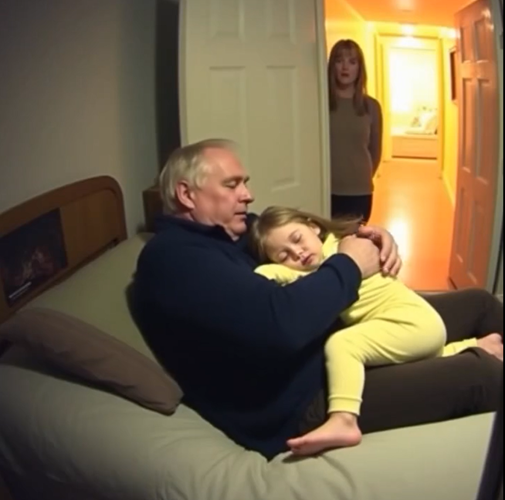
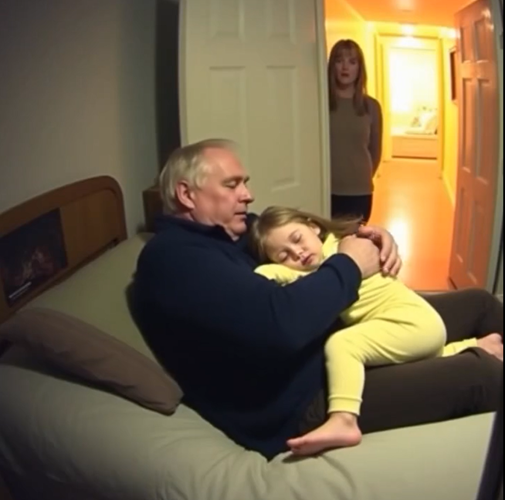
Evan entered the room quietly, his steps so controlled they barely disturbed the stillness of the hallway. He moved with a familiarity that suggested routine, as though this was something he had done before without question. He sat on the edge of Emma’s bed and leaned slightly forward, gently brushing a hand across her forehead.
To anyone else, the gesture might have looked tender or protective. A caring presence checking on a sleeping child. But something inside me tightened as I watched, an instinctive unease I could not easily dismiss or explain away. It was not the action itself, but the feeling behind it that made my stomach knot.
Emma remained still at first, her expression relaxed and peaceful. But gradually, subtle changes began to appear. Her brow tightened slightly, a faint crease forming between her eyebrows. Her fingers moved faintly beneath the blanket, small, restless motions that did not belong to peaceful sleep.
The calmness of the room began to shift, almost imperceptibly at first. A fragile stillness giving way to something uncertain. I leaned closer to the screen, watching more carefully, trying to convince myself that I was misinterpreting what I saw.
What the Footage Seemed to Reveal
Emma’s breathing became uneven. Her face shifted with expressions that suggested discomfort or confusion within her sleep. She stirred, her small hands moving as though reaching for something just out of reach. The peaceful image of a sleeping child was slowly replaced by something more unsettling—restlessness that seemed to come from within.
Evan remained beside her, calm and unmoving, watching. His presence did not change, but the atmosphere around them felt increasingly heavy, as though something unspoken was unfolding in the quiet space between sleep and wakefulness.
Then Emma suddenly sat upright, her eyes open but unfocused. She did not seem fully awake, yet she was no longer entirely asleep either. Her lips moved silently, forming words I could not hear, as if she were responding to something only she could perceive.
Evan leaned closer, speaking in a low voice. The exchange between them felt strange, not in volume but in rhythm, as though there was an invisible conversation taking place that I was not meant to fully understand. Emma responded again in the same unclear way, caught in a state that felt suspended between reality and dream.

Replaying the Moment Over and Over
I rewound the footage repeatedly, trying to convince myself that I had misunderstood what I was seeing. Each replay, however, reinforced the same feeling. Evan was not simply present in the room. He appeared engaged in something deeper, something tied to Emma’s sleep in a way that unsettled me.
My mind searched desperately for explanations that would make the situation less alarming. Perhaps he was trying to comfort her. Perhaps she had night terrors and he believed his presence helped. Parents sometimes stay near their children during difficult nights, offering reassurance in silence.
But even as I tried to rationalize it, the discomfort remained. Something about the interaction felt intrusive, as though a boundary had been crossed without anyone fully acknowledging it.
Sleep is meant to be a protected space for children, a place where the mind can rest without interference. Watching this footage made that idea feel fragile, as though that boundary could be more easily crossed than I had ever considered.
The Confrontation the Next Morning
The following morning, I confronted Evan. My voice trembled despite my effort to remain composed, and I could feel the weight of the footage still pressing heavily on me. I asked him directly why he had been in Emma’s room like that.
He looked genuinely surprised by my reaction, almost as though he had not expected the situation to be interpreted in such a way. He explained that he believed he was helping her, that she sometimes appeared frightened during the night and spoke in ways he could not understand. He said he thought his presence might make her feel safe.
His tone was calm and sincere, but it did not erase the tension I felt. Intentions, no matter how well-meaning, do not always remove the impact of actions. I could understand his desire to help, but I could not ignore the boundary that had been crossed in doing so.

Establishing Boundaries and Seeking Help
After that conversation, I made a decision. Evan would no longer stay in Emma’s room at night. He moved to the guest room, and I made it clear that nighttime was a space Emma needed to experience alone and undisturbed.
The house felt different afterward. Quieter in a more intentional way, as though certain lines had finally been redrawn. I found myself listening more closely at night, not out of fear, but out of responsibility. I needed to be sure Emma was truly at peace.
To better understand what might be happening, I reached out to a child psychologist. I wanted clarity, not assumptions. Sleep disturbances in children can have many causes, and I needed guidance that was grounded and professional.
The approach suggested focused on stability and comfort. Creating a consistent bedtime routine, making the bedroom feel safe and familiar, and encouraging Emma to express her fears during waking hours in ways that felt natural to her. The goal was not to control her sleep, but to help her feel secure within it.
Small Changes and Gradual Improvement
Over time, I began noticing subtle shifts in Emma’s nights. The restlessness that had appeared in the footage no longer seemed as present. She slept more steadily, without sudden movements or visible distress.
The changes were not immediate or dramatic, but they were steady. Each night felt slightly calmer than the last, as though something that had been unsettled was slowly finding balance again.
Evan adapted to the new boundaries as well. During the day, he remained present and supportive, engaging with Emma through play and daily routines. At night, however, he respected the distance that had been established, allowing her space to sleep without interruption.
Trust, Reflection, and Ongoing Awareness
Even as things improved, I could not forget what I had seen. The footage remained a clear reminder of how easily intentions can be misunderstood, and how important it is to maintain awareness when it comes to a child’s emotional world.
Trust, once shaken, does not return instantly. It requires time, consistency, and an understanding that boundaries exist for a reason. I found myself more attentive, more aware of small changes in Emma’s behavior, and more conscious of how fragile childhood comfort can be.
At the same time, I also began to understand that fear alone cannot guide parenting decisions. It must be balanced with communication, reflection, and care. The situation had forced me to examine not only Evan’s actions, but also my own responses and assumptions.
Moving Forward as a Family
As time passed, our home slowly regained a sense of stability. Emma’s sleep became more peaceful, and the anxiety that had once surrounded bedtime began to fade. The changes were gradual but meaningful, and they reminded me that children often respond best to consistency and safety.
Evan remained part of Emma’s life, but within clearer boundaries. Our understanding of each other evolved through difficult conversations and necessary adjustments. What had once been uncertain became more defined through time and effort.
Looking back, I realize how easily concern can blur into overreach, even when the intention is care. What matters most is recognizing when a boundary has been crossed and having the courage to correct it.
Emma’s room is now what it was always meant to be—a place of rest, imagination, and peace. And while I remain watchful, I also remain hopeful, knowing that awareness and love together can create a safer space for her to grow.
In the end, the experience reshaped how I understand protection. It is not only about presence, but also about knowing when to step back, when to observe, and when to trust that silence is sometimes the safest form of care.

