
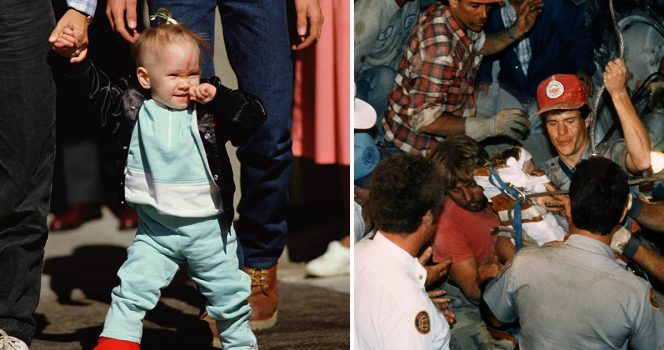
The story of Jessica McClure Morales remains one of the most widely remembered rescue events in modern American history. What began as a sudden accident in a quiet neighborhood in Midland quickly developed into a moment that captured national attention and demonstrated the power of coordinated emergency response.
In October 1987, Jessica was just 18 months old when she was playing in her aunt’s backyard with other children. During that time, she fell into a narrow, uncovered well that had been assumed to be sealed. The shaft was extremely tight—only about eight inches wide—and extended more than 20 feet underground. The situation became immediately urgent, as her family realized what had happened and contacted emergency services without delay.
Local authorities arrived quickly, but the complexity of the rescue became clear almost immediately. The well was too narrow for rescuers to reach her directly, and any attempt to widen it from above carried significant risk. The challenge required a carefully planned operation involving multiple teams and specialized equipment.
A large-scale rescue effort was organized, bringing together emergency responders, engineers, drilling experts, and volunteers. Their approach involved drilling a parallel shaft near the original well and then creating a horizontal tunnel to reach the child. This method required precision, as rescuers needed to avoid causing additional harm while working in confined and unstable conditions.

Throughout the operation, communication with Jessica played an important role. Rescuers lowered devices into the well to determine her position and monitor her condition. At times, they were able to hear her crying or making sounds, which reassured them that she was still responsive. In quieter moments, they spoke to her to provide comfort, using simple words of encouragement. These interactions helped maintain a sense of connection during the long and uncertain process.
As the rescue continued, news of the incident spread rapidly across the United States. Television networks began broadcasting continuous updates, and millions of people followed the developments closely. The event became a shared national experience, with viewers hoping for a successful outcome as each hour passed.
The operation lasted nearly 60 hours. During that time, rescuers worked in shifts, maintaining constant effort despite physical and emotional strain. The drilling process was slow and demanding, but progress continued steadily. Each stage required careful coordination between teams to ensure safety and accuracy.
Eventually, rescuers reached Jessica through the horizontal tunnel. The final stage of the rescue was conducted with extreme caution, as they worked to free her from the confined space. When she was finally brought to the surface, the moment was broadcast live and witnessed by millions. The successful rescue was met with widespread relief and recognition of the effort involved.
Following the incident, Jessica required medical attention due to injuries sustained during the fall. She underwent multiple surgeries, including procedures to address damage to her foot and other areas affected by the prolonged entrapment. Over time, she recovered, though some physical effects remained.
As she grew older, Jessica learned about the event through media coverage and family accounts. Because she was too young to remember the experience directly, her understanding of it came from watching recordings and hearing others describe what had happened. This created a unique relationship with her own story—one that was widely known, yet not personally remembered.

The nickname “Baby Jessica” became closely associated with her identity. Even decades later, many people continued to recognize her by that name. While this connection reflected the significance of the rescue, it also meant that a single early-life event remained a prominent part of how others perceived her.
In the years following the rescue, public support for Jessica was evident. Donations from individuals across the country contributed to the creation of a trust fund intended to support her future. This gesture reflected the collective concern and goodwill that had developed during the rescue effort. Although economic changes later affected part of the fund, it still played a role in supporting her as she reached adulthood.
Jessica eventually built a private life in Texas, where she married and started a family. She and her husband, Danny, have children and grandchildren, marking a life that has moved well beyond the circumstances of her early childhood. Interestingly, her husband had watched the rescue unfold on television as a child, unaware of the personal connection that would develop later in his life.
Despite the passage of time, the story continues to be referenced in discussions about emergency response and public awareness. It highlighted the importance of safety measures related to wells and similar hazards, leading to increased attention on prevention and risk management in residential areas.
From a broader perspective, the rescue demonstrated the effectiveness of coordinated efforts across multiple fields. Engineers, medical personnel, and emergency responders worked together under challenging conditions, illustrating how collaboration can address complex problems. The operation also showed the value of persistence, as progress required patience and sustained effort over many hours.
The emotional dimension of the event remains significant as well. For many people, the story represented hope and unity during a moment of uncertainty. The widespread attention and shared concern reflected a collective response to a situation involving a vulnerable child, reinforcing the importance of compassion and community support.
Jessica’s life today reflects resilience and continuity. While the rescue will always be part of her history, it does not define her entire identity. Instead, it represents one chapter in a life that has continued to develop in its own direction.
Over the decades, the story has maintained its place in public memory not only because of its dramatic nature, but also because of the outcome. The successful rescue provided a rare example of a complex situation resolved through determination and teamwork. It remains a reference point for how communities and institutions can respond effectively in times of crisis.
In conclusion, the experience of Jessica McClure Morales stands as a lasting example of coordinated effort, public awareness, and human resilience. The events of October 1987 brought together individuals from different backgrounds with a shared goal, ultimately resulting in a successful rescue that continues to be remembered today.

