
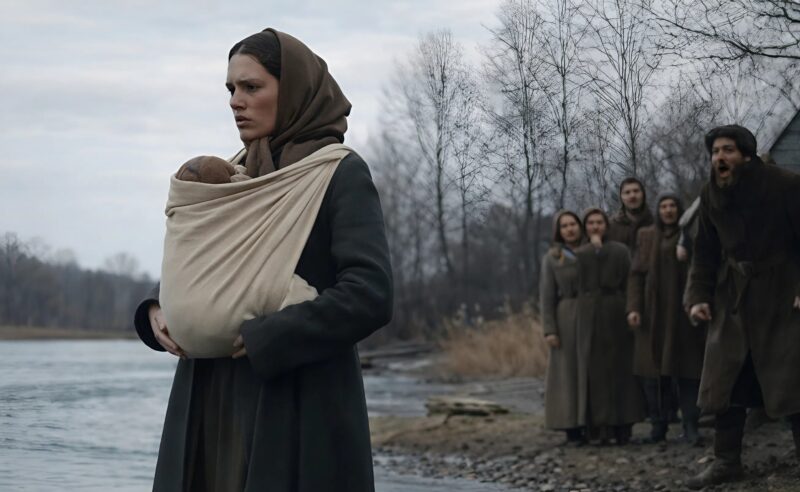
Maria stood on the cold riverbank, water dripping from her clothes, her breath still uneven after the struggle. The baby in her arms stirred weakly, wrapped tightly in the same blanket she had carried out of the only home she had ever known. Behind her lay the village, silent now, its people already turning away as if the scene had never happened.
In front of her, everything felt uncertain.
The man who had pulled her from the river remained a few steps away. Water ran down his face and soaked his dark clothing, but he showed no sign of discomfort. He simply watched her, as if waiting for a decision that only she could make. The scar across his face made him look even more intimidating, yet there was nothing aggressive in his stance. It was steady, controlled, almost careful.
Maria tightened her hold on the child instinctively. After everything that had just happened, trusting anyone felt impossible.
The man slowly lowered his gaze for a moment, then spoke again in a quieter voice.
“You don’t have to go back there,” he said. “But you also don’t have to go forward alone.”
His words hung in the air between them. Maria didn’t answer immediately. Her mind was still caught between fear, exhaustion, and disbelief. Only moments ago, she had been seconds away from drowning. Now she was alive, but everything she had ever depended on was gone.
Behind them, faint voices still echoed from the village shore. No one had followed. No one had tried to help. That silence said more than any argument ever could.
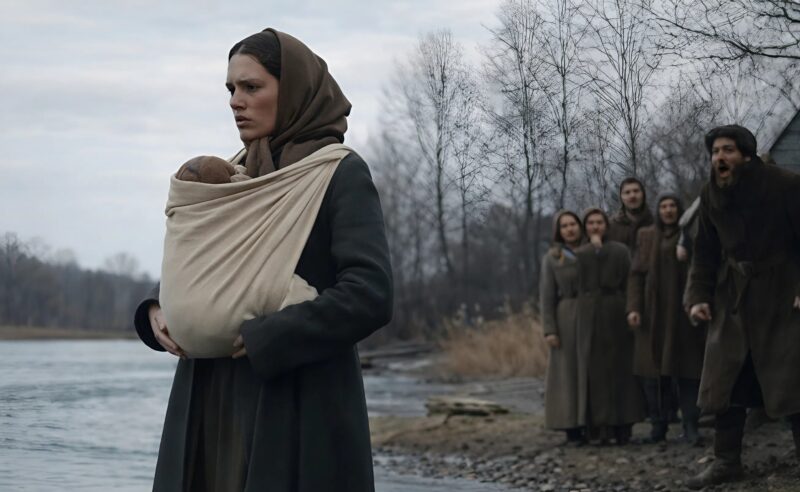
Maria finally looked down at her child. The baby was breathing softly, unaware of how close everything had come to ending. That small, fragile sound grounded her more than anything else.
When she looked back up, her voice trembled slightly.
“Why did you help me?” she asked.
The man did not answer immediately. He seemed to consider the question carefully, as if it had no simple response. Then he glanced briefly toward the river, where the current still moved violently.
“Because I know what it’s like,” he said. “To be treated like you don’t belong anywhere.”
There was no pity in his tone. Only understanding.
For a long moment, neither of them spoke. The wind moved through the trees behind them, and the sound of the river filled the silence again. The world around them felt wide, empty, and uncertain.
Maria shifted her weight slightly, trying to steady herself. Her body was still shaking from the cold and the shock, but she forced herself to stay upright.
“I don’t know where to go,” she admitted finally.
The man nodded once, as if he had expected that answer.
“There’s a small settlement a few hours from here,” he said. “Not perfect. Not safe in every way. But it’s a place where no one asks questions first.”
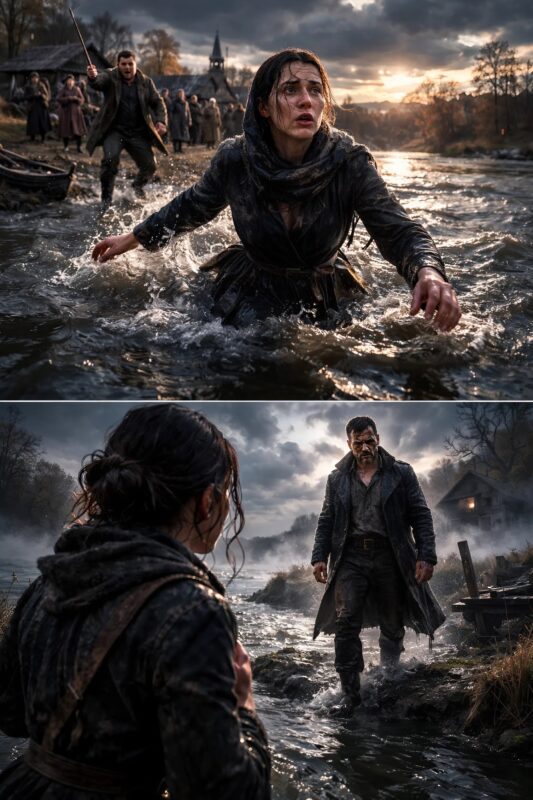
Maria hesitated. Every instinct told her to distrust him, to keep distance, to choose isolation over risk. But the alternative was the same path she had just left behind, one that had almost ended in the river.
She looked at her child again.
Then she made her decision.
“Walk ahead of me,” she said quietly.
The man gave a slight nod and turned toward the path beyond the riverbank. He did not rush, did not look back, simply began walking at a steady pace. Maria followed a few steps behind, keeping her distance, her eyes constantly scanning her surroundings.
The forest around them was dense and unfamiliar. Branches moved with the wind, and distant animal sounds echoed between the trees. Every sound felt sharper after what she had just endured. But step by step, she continued forward.
Hours passed slowly. The journey was difficult, and Maria’s strength faded more than once, but she did not stop. The man did not push her, only slowed his pace when needed, allowing her the space to continue at her own rhythm.
As the sun began to lower in the sky, the landscape gradually changed. The thick forest opened into a quieter stretch of land, where faint signs of human life began to appear in the distance.
Small structures. Smoke rising from chimneys. Paths worn by use.
The settlement was real.
Maria stopped for a moment, uncertainty returning once again. She had no guarantee of safety here, no promise of acceptance. But for the first time since leaving the village, she also had something else.
Possibility.
The man turned slightly, noticing her hesitation.
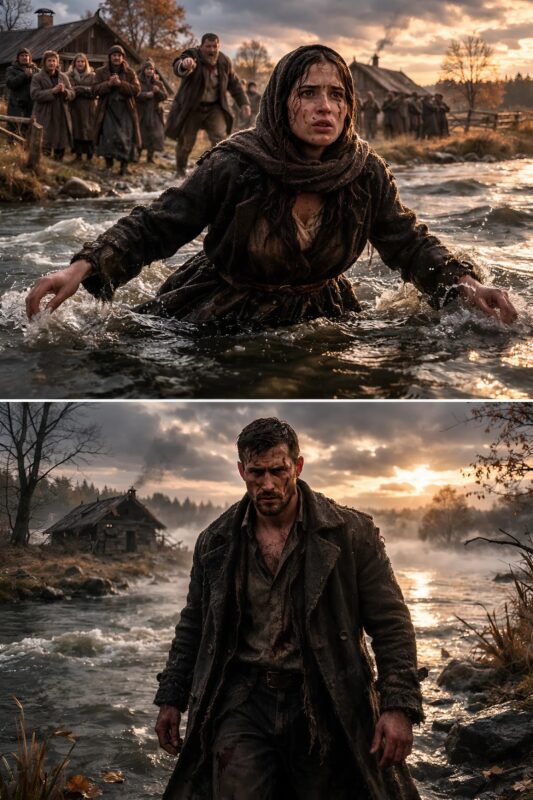
“You decide your next step,” he said simply.
Maria looked at him, then at her child, then toward the settlement ahead. The weight of everything she had lost remained with her, but beneath it, something new had begun to form. Not trust. Not yet. But a fragile sense that her life had not completely ended at the river.
She took a slow breath.
And then she walked forward.

