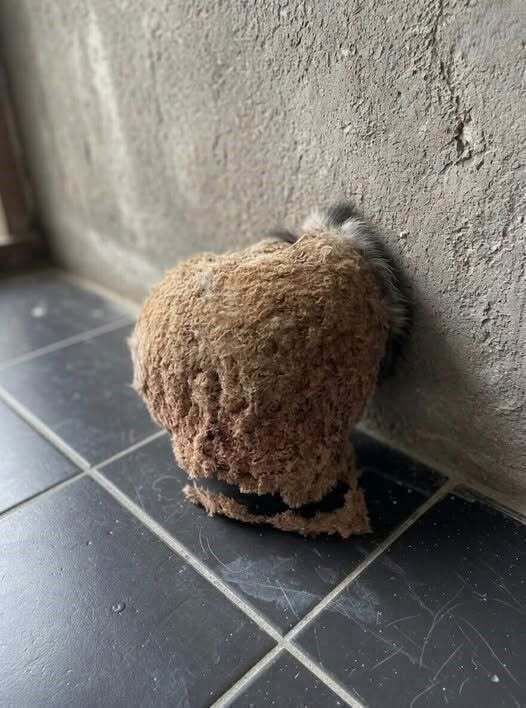
Family Returns Home to Find Mysterious Structure Growing on Bathroom Wall
An Ordinary Homecoming Takes an Unexpected Turn
A family returning from a week-long trip expected to settle back into their normal routine. Instead, they were met with a puzzling discovery that immediately captured their attention and raised concerns.
Inside their bathroom, tucked neatly into a corner of the wall, was a strange layered formation that had not been there before they left. The object stood out instantly because of its unusual appearance and the fact that the space had been completely empty only days earlier.
What should have been a simple return home quickly became an investigation into the identity of an unfamiliar structure that seemed to have appeared without warning.
The discovery transformed a routine evening into a situation filled with uncertainty, curiosity, and caution.
A Structure That Seemed Purposefully Built
The object did not resemble anything the family had previously encountered inside their home. It was firmly attached to the wall and positioned in a way that suggested deliberate construction rather than accidental accumulation.
Its layered design immediately attracted attention. The formation displayed visible ridges and folds, creating an organized appearance that looked remarkably structured.
Unlike ordinary household dust, dirt, or moisture-related stains, the object appeared to have been assembled piece by piece. Its papery texture only added to the mystery.
The more closely the family examined it from a distance, the more unusual it seemed. The object’s shape appeared balanced and symmetrical, giving it a manufactured look despite clearly being something that had formed naturally.
That sense of order made the discovery increasingly unsettling.
The Bathroom Corner Had Changed Completely
The family had little doubt that the corner had been empty before their trip. They remembered the area clearly and could not recall seeing anything unusual there before leaving home.
Now the same corner contained a compact structure firmly attached to the wall.
The change seemed dramatic because it had happened during such a short period of time. The family had only been away for about a week, yet the object appeared developed enough to draw immediate concern.
Its location made it impossible to overlook.
Had it been hidden behind furniture or lying unnoticed on the floor, the discovery might have taken longer to make. Instead, it occupied a visible corner of a room used every day.
The unexpected appearance of the structure altered the atmosphere of the bathroom almost instantly.
Questions Begin to Surface
No one in the household could immediately identify what they were looking at.
The object seemed unfamiliar enough that several possibilities came to mind.
Was it the result of moisture damage? Could it be a type of mold growth? Was it an insect-related structure? Could something be living inside it?
Each question created new uncertainty.
The family examined the visible details without moving closer than necessary. The ridged surface and folded layers seemed to indicate that the structure had developed over time rather than appearing suddenly through a simple household issue.
The inability to identify the object right away became the most troubling aspect of the situation.
A room that normally felt safe and familiar suddenly seemed unpredictable.
Why They Chose Not to Touch It
One decision was made almost immediately. Nobody would attempt to touch the structure.
While curiosity often encourages people to investigate unusual discoveries, the family recognized that interacting with an unknown object could create unnecessary risks.
The papery appearance of the formation suggested that it might be more than harmless debris.
If insects had created it, disturbing the structure could potentially trigger a defensive reaction. If it contained living occupants, a careless attempt to remove it might cause problems that did not currently exist.
The family understood that caution would be more valuable than immediate action.
By resisting the urge to poke, scrape, or pull at the object, they avoided interfering with something they did not yet understand.
That choice would later prove to be one of the most important decisions they made.
A Room Suddenly Avoided
As the evening continued, the bathroom became a place no one wanted to spend time in.
The mysterious formation remained attached to the wall exactly where it had been discovered.
Its stillness did little to ease concerns.
The object did not move or change shape, yet its presence continued to dominate conversations throughout the home.
The family found themselves focusing less on unpacking and more on identifying the strange structure occupying the bathroom corner.
The uncertainty lingered long after the initial discovery.
Even without any visible activity, the formation transformed an ordinary room into a source of ongoing concern.
Searching for an Explanation
Unable to identify the object themselves, the family began researching possible explanations.
They compared photographs and descriptions of various household discoveries with the structure they had found.
The search involved examining images that featured layered formations, insect nests, moisture damage, and other unusual wall attachments.
As they reviewed examples, certain details repeatedly stood out.
The folded appearance.
The papery texture.
The organized layers.
The tucked placement in a corner.
Each of these characteristics appeared increasingly familiar when compared with one particular possibility.
Gradually, a likely explanation emerged.
A Likely Hornets’ Nest
Based on its appearance, the family began to suspect that the formation could be a hornets’ nest.
The possibility immediately changed how they viewed the situation.
What had first seemed like a strange household mystery now carried the potential for real danger.
The layered construction strongly resembled the papery material commonly associated with hornet nest building.
Its shape appeared structured rather than accidental, suggesting purposeful creation over time.
The ridges and folds looked consistent with a nest that had been carefully assembled.
The fact that it had developed while the family was away made the discovery even more surprising.
Although they could not confirm the identification themselves, the resemblance was convincing enough to influence their next decision.
Choosing a Safe Solution
Once the family suspected they were dealing with a hornets’ nest, they decided professional assistance was necessary.
Attempting removal without proper knowledge or equipment no longer seemed like a reasonable option.
The risks associated with disturbing a possible nest outweighed any benefit of handling the situation personally.
Rather than experimenting with removal methods, they contacted professionals who could evaluate and address the issue safely.
The decision eliminated uncertainty about what to do next.
Instead of taking chances, the family chose a cautious and controlled response.
That approach provided peace of mind while reducing the possibility of injury or escalation.
The Structure Is Removed
Professional intervention ultimately resolved the situation.
The mysterious formation was removed, restoring the bathroom corner to its original condition.
With the object gone, the room once again felt like a normal part of the home.
The tension that had surrounded the discovery gradually faded.
The family could finally return to the tasks they had expected to tackle when they first arrived home.
Yet the experience remained memorable because of how quickly an ordinary day had transformed into something unexpected.
A single discovery had altered the atmosphere of the house and shifted everyone’s attention toward a problem they never anticipated.
A Potentially Serious Mistake Avoided
Looking back, the family recognized how easily the situation could have unfolded differently.
Had someone attempted to remove the structure immediately, the outcome might have been far more stressful.
A simple touch or accidental disturbance could have triggered consequences they were not prepared to handle.
Instead, they paused long enough to evaluate the situation carefully.
That brief period of restraint prevented impulsive decisions.
The family allowed themselves time to gather information before taking action.
Their patience proved valuable because it helped them avoid unnecessary risk.
Sometimes the safest response to an unfamiliar situation is not immediate action but thoughtful observation.
Why the Discovery Felt So Unsettling
The emotional impact of the discovery was influenced by more than the object itself.
The location played a significant role.
A bathroom is typically one of the most familiar spaces inside a home. People use it every day without giving much thought to the surroundings.
When something unusual appears in such a routine environment, it can create a strong sense of discomfort.
The family had left home expecting everything to remain essentially the same during their brief absence.
Finding a mysterious structure attached to the wall challenged that expectation.
The speed with which the change seemed to occur added another layer of concern.
The realization that something could develop unnoticed during a short trip made the home feel temporarily less predictable.
The Importance of Remaining Cautious
The experience highlighted the value of caution when encountering unfamiliar situations.
The family did not need immediate answers in order to make responsible decisions.
They simply recognized that the structure appeared unusual and potentially unsafe.
That recognition guided their response.
By maintaining distance and avoiding direct contact, they minimized the possibility of creating a larger problem.
Many household issues encourage quick action, but not every situation benefits from an immediate attempt at removal.
Sometimes patience provides the safest path forward.
In this case, waiting allowed the family to gather information and seek appropriate help rather than reacting impulsively.
Returning to Normal Life
After the structure was removed, life inside the home gradually returned to normal.
The bathroom once again became a routine part of daily life.
The family could focus on unpacking, catching up on household responsibilities, and settling back into familiar routines.
The sense of mystery that had dominated the previous days disappeared along with the formation itself.
Although the incident was resolved, it left a lasting impression.
The experience served as a reminder that even familiar environments can occasionally present unexpected surprises.
It also reinforced the importance of thoughtful decision-making when confronted with something unusual.
A Discovery That Became a Valuable Lesson
What began as a puzzling object on a bathroom wall ultimately became a lesson in patience and caution.
The family encountered something they could not immediately identify, yet they resisted the urge to interfere with it.
Instead, they observed, researched, and evaluated the situation carefully.
The possibility that the structure was a hornets’ nest encouraged them to seek professional assistance rather than attempt removal themselves.
That decision helped ensure a safe outcome.
The incident demonstrated how a calm response can be more effective than a hurried one when dealing with the unknown.
By choosing restraint over impulse, the family avoided unnecessary danger and successfully resolved a situation that initially seemed alarming.
In the end, the most important part of the story was not simply what they discovered, but how they handled it.
Their willingness to step back, gather information, and seek expert help transformed a potentially risky encounter into a manageable experience.
The strange structure may have appeared without warning, but careful decisions ensured that it left behind only a memorable story and an important reminder about the value of caution.
