
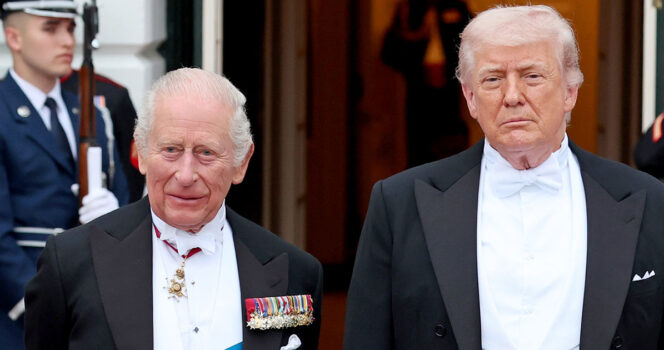
State Visit Highlights as Diplomatic Tensions Shape Discussions
The recent state visit involving King Charles III and Queen Camilla to the United States has unfolded against a complex international backdrop. While the visit was designed to reinforce the longstanding relationship between the United Kingdom and the United States, it has also drawn attention due to ongoing geopolitical tensions, particularly concerning developments in Iran.
Upon their arrival in Washington, D.C., the royal couple was welcomed by Donald Trump and First Lady Melania Trump at the White House. The visit included a series of formal engagements aimed at strengthening diplomatic ties, including meetings, ceremonial events, and a State Dinner.
A Visit Framed by Diplomatic Sensitivity
The timing of the visit is significant. Relations between the two countries have faced strain in recent months, partly due to differing perspectives on international security issues. In particular, discussions around Iran and broader Middle East stability have added complexity to the diplomatic environment.
Within this context, the visit by King Charles III and Queen Camilla has been widely viewed as an effort to reaffirm cooperation and maintain open dialogue between the two allies. The British monarch’s role, while constitutionally neutral in political matters, often includes symbolic gestures that emphasize unity, continuity, and shared values.

Address to Congress Emphasizes Historical Ties
One of the key moments of the visit was King Charles III’s address to the U.S. Congress. Speaking in a chamber rich with historical significance, he reflected on the deep-rooted relationship between the two nations.
He highlighted that the connection between the United States and the United Kingdom spans centuries, noting that their shared history continues to shape present-day cooperation. His remarks underscored mutual respect, democratic values, and the importance of maintaining strong bilateral relations.
The King also referenced his mother, Queen Elizabeth II, recalling her own historic address to Congress in 1991. By drawing this parallel, he emphasized continuity within the monarchy and the enduring nature of the alliance.
Throughout his speech, King Charles maintained a tone consistent with the expectations of his role—measured, respectful, and focused on shared ideals rather than political specifics.
Interpreting Broader Messages
While the King did not directly address specific conflicts, some observers have interpreted parts of his recent public remarks as reflecting concern about global challenges. In a separate speech commemorating his late mother, he spoke about the uncertain nature of current times and expressed hope for a more positive future.
Commentators have offered differing interpretations of these statements. For example, Kinsey Schofield suggested during a television appearance that such remarks might indirectly reflect awareness of ongoing international tensions. However, these interpretations remain speculative, as the monarchy traditionally avoids explicit political commentary.
State Dinner and Public Statements
The State Dinner hosted at the White House served as a centerpiece of the visit, bringing together leaders and distinguished guests for a formal evening of diplomacy. During the event, President Donald Trump made remarks touching on international security, including the situation involving Iran.
In his comments, Trump suggested that King Charles shared his perspective on preventing nuclear weapons development in Iran. This statement drew attention, as the King had not publicly expressed a position on the issue during his visit.
In response, a spokesperson for Buckingham Palace reiterated that the monarch remains aligned with the established policies of the British government, particularly regarding the prevention of nuclear proliferation. This clarification reflects the constitutional principle that the monarch does not independently set or publicly advocate policy positions.
The Role of the Monarchy in Modern Diplomacy
The events surrounding the visit highlight the unique position of the British monarch in international relations. While the role is largely ceremonial, it carries significant symbolic weight. State visits, speeches, and public appearances are carefully structured to reinforce diplomatic relationships without entering into political debate.
King Charles III’s approach during this visit appears consistent with that tradition. His emphasis on shared history, mutual respect, and cooperation aligns with the broader objectives of diplomatic engagement.
At the same time, the interaction between political leaders and ceremonial figures can sometimes lead to differing interpretations of public statements. This dynamic underscores the importance of clear communication, particularly in a global environment where remarks are closely scrutinized.

A Relationship That Continues to Evolve
The relationship between the United States and the United Kingdom has long been considered one of the most significant international partnerships. While it has faced challenges at various points in history, it has also demonstrated resilience and adaptability.
This state visit reflects both the continuity of that partnership and the complexities of maintaining it in a rapidly changing world. Issues such as global security, economic cooperation, and diplomatic coordination require ongoing dialogue and mutual understanding.
By focusing on shared values and historical connections, the visit aimed to reinforce the foundation of the relationship, even as both countries navigate current challenges.
Conclusion
The visit of King Charles III and Queen Camilla to the United States has highlighted the enduring ties between two longstanding allies. Through formal engagements, speeches, and symbolic gestures, the visit emphasized unity and cooperation.
At the same time, the broader context of international tensions has shaped how certain moments are perceived and discussed. Statements made during the visit have drawn attention, illustrating how diplomatic events can intersect with ongoing global issues.
Ultimately, the visit serves as a reminder of the importance of maintaining strong international relationships, particularly during periods of uncertainty. By reinforcing dialogue and mutual respect, both nations continue to build on a partnership that has evolved over centuries.

