
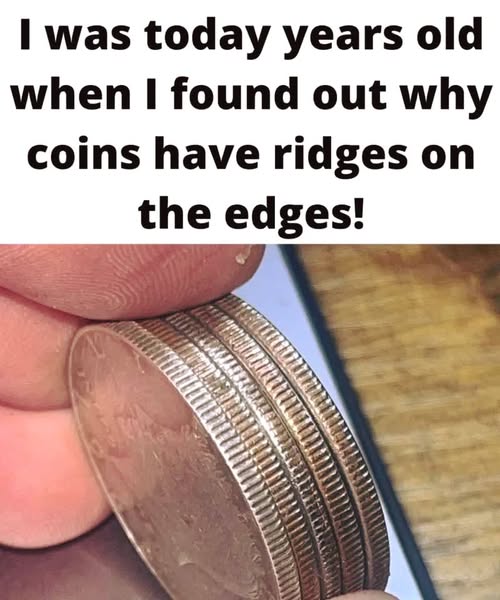
Why Coins Have Ridged Edges and How a Small Design Feature Helped Protect Entire Economies
A Tiny Detail Most People Never Notice
Coins pass through countless hands every single day. They are dropped into vending machines, carried in pockets, tossed onto counters, and stored in jars without most people giving much thought to their design.
Yet one small feature found on many coins has a surprisingly important history behind it: the ridged edge.
Those tiny grooves surrounding the outer edge of certain coins may seem decorative, but they were originally created for a very practical reason. Their purpose was tied directly to protecting money from fraud and preserving trust in entire financial systems.
What appears today to be a simple texture is actually the result of centuries of economic problems, criminal activity, and efforts to secure currency.
When the Value of a Coin Came From the Metal Itself
In earlier centuries, coins were very different from modern currency. Today, the value of most coins is determined mainly by government authority and economic systems rather than the physical material used to make them.
In the past, however, coins often contained precious metals such as gold or silver, and their value depended heavily on the actual amount of metal inside them.
A gold coin was valuable not only because it represented money, but because the gold itself carried worth.
This system created both convenience and danger. Since the coins physically contained valuable materials, people quickly realized that even small amounts of metal could be removed and collected over time.
As a result, currency became vulnerable to a widespread form of fraud that threatened trade and public confidence.
The Rise of Coin Clipping
One of the most common financial crimes involving early coins was known as coin clipping.
The method was simple but highly damaging. People would carefully shave tiny pieces of metal from the edges of gold or silver coins. Because the removed amounts were small, the damage often went unnoticed during ordinary transactions.
One clipped coin alone might not provide much precious metal. But if someone repeated the process on hundreds or thousands of coins, the collected shavings could eventually be melted down into valuable quantities of silver or gold.
The altered coins still circulated in the economy, even though they no longer contained their full intended metal content.
That meant dishonest individuals could profit while everyone else unknowingly accepted weakened currency.
How Coin Clipping Threatened Entire Economies
The danger of coin clipping extended far beyond isolated acts of theft.
As more altered coins entered circulation, trust in currency itself began to weaken. Merchants and ordinary citizens could no longer feel certain that a coin contained the amount of precious metal it was supposed to hold.
Trade became more difficult because people started examining coins more carefully or questioning whether certain money should be accepted at full value.
Governments also faced serious problems. When large numbers of coins were clipped, the official money supply no longer matched the precious metal reserves intended to support it.
The issue became so widespread in some regions that it contributed to broader financial instability and forced authorities to search for better methods of protecting currency.
The challenge was clear: coins needed to remain difficult to alter while still being easy for the public to recognize and trust.
Isaac Newton’s Unexpected Connection to Coin Design
An important turning point in the fight against coin fraud arrived in the late 17th century.
In 1696, Isaac Newton was appointed Warden of the Royal Mint in England. Although Newton is most famous for his scientific discoveries in physics and mathematics, his role at the Mint placed him directly in the middle of a national financial problem.
At the time, England faced widespread counterfeiting and coin clipping. Protecting the integrity of the country’s currency had become a major concern.
Newton approached the position seriously and became deeply involved in improving coin production and fighting fraud.
His work connected scientific precision with financial security, helping shape changes that would influence coin design for generations.
The Introduction of Reeded Coin Edges
One of the most important innovations associated with this period was the introduction of reeded edges on coins.
These ridges, grooves, or tiny lines carved around the outer edge of a coin were designed specifically to expose tampering.
The idea was highly effective because clipping a grooved coin would damage the pattern immediately.
If someone shaved even a small amount of metal from the edge, the evenly spaced ridges would become interrupted or uneven. The alteration would be much easier for merchants and ordinary people to notice.
Instead of relying only on the coin’s weight, people could inspect the edge visually and quickly identify suspicious damage.
This transformed the edge of the coin into an important security feature.
Why the Grooves Made Fraud More Difficult
Reeded edges worked because they created a pattern that was difficult to remove without leaving visible evidence behind.
Smooth-edged coins could be shaved carefully while still appearing mostly normal. Grooved coins, however, required the ridges to remain perfectly consistent around the entire edge.
Any disruption became a warning sign.
The ridges also complicated the work of counterfeiters. Reproducing the exact spacing and uniform appearance of the grooves required precision that was difficult to achieve with older manufacturing tools.
A fake coin might imitate the front and back designs successfully, but matching the edge detail accurately created another challenge.
As a result, reeded edges strengthened public confidence in currency by making fraud easier to detect and counterfeit production more difficult.
Why Coins Still Have Ridged Edges Today
Modern coins are no longer made primarily from precious metals like gold or silver, so coin clipping is not the major threat it once was.
Even so, ridged edges remain common in many currencies around the world.
One reason is security. Modern vending machines, parking meters, transit systems, and automated validators often use multiple physical characteristics to identify coins.
These systems examine features such as weight, diameter, thickness, metal composition, and edge texture.
The ridges therefore continue serving a practical role in helping machines distinguish authentic coins from damaged or counterfeit ones.
Although technology has advanced dramatically since the 17th century, physical coin design still matters.
An Important Accessibility Feature
Ridged edges also serve another important purpose in modern society: accessibility.
For individuals who are blind or visually impaired, the texture of a coin can help identify its denomination through touch alone.
Smooth-edged coins and grooved-edged coins feel noticeably different when handled. Combined with differences in size and thickness, the ridges help people distinguish coins without relying on sight.
This tactile design makes everyday transactions more manageable and independent for many users.
What originally began as protection against theft eventually became an important feature supporting inclusive currency design.
The Role of Tradition in Coin Design
Tradition also plays a major role in why ridged edges continue to exist.
Over time, people become accustomed to the way money looks and feels. A coin’s texture, weight, and appearance become part of how it is recognized instantly during daily transactions.
Changing those familiar features too drastically could create confusion.
Many modern coins therefore preserve design elements that originated centuries earlier, even when the original reason behind them is less important today.
Currency depends heavily on consistency. People trust money partly because it feels familiar in their hands.
The ridges surrounding certain coins have become part of that long-standing familiarity.
Why Some Coins Have Smooth Edges Instead
Not all coins feature ridged edges.
In many currency systems, lower-value coins are made with smooth edges instead. Historically, this difference reflected the value of the metal inside the coin.
Coins with lower intrinsic value were less attractive targets for clippers because removing material from them produced little profit.
Higher-value coins, however, were far more vulnerable to tampering and therefore required stronger visible protection.
That historical distinction still influences modern coin design today, even though the original precious metal content is no longer the main concern.
Different edge textures continue helping people distinguish denominations quickly and easily.
A Design Built Around Public Trust
The history of ridged coin edges ultimately reflects something larger than coin manufacturing.
It reflects the importance of trust in money itself.
For any currency system to function successfully, people must believe that the money they receive is genuine, reliable, and equal in value to what it claims to represent.
When coin clipping threatened that trust, authorities needed a visible and practical solution.
Reeded edges provided exactly that.
By making tampering easier to detect, the grooves helped protect transactions, stabilize trade, and strengthen confidence in the money supply.
Even though financial systems have evolved dramatically since the age of gold and silver coinage, the same principle still matters today.
Money must remain recognizable, dependable, and difficult to manipulate.
How Ordinary Objects Carry Hidden History
The ridges around a coin may seem insignificant, but they reveal how everyday objects often carry centuries of hidden history.
Something most people barely notice while paying for coffee or counting change was once an essential defense against widespread financial fraud.
The grooves were not added for decoration. They were introduced because economies depended on protecting valuable metal from theft and maintaining public confidence in currency.
Over time, the same feature gained additional purposes involving accessibility, machine recognition, identification, and tradition.
That evolution demonstrates how practical design solutions can survive long after the original problem changes.
Every ridged coin still circulating today carries traces of those earlier financial struggles.
A Lasting Solution to an Old Financial Problem
The ridged edges found on modern coins are the surviving result of one of history’s simplest but most effective anti-fraud innovations.
Coin clipping once allowed criminals to profit quietly by removing precious metal while leaving altered coins in circulation. The practice weakened trust in money and threatened economic stability.
By adding grooves around the edge, coin makers created a clear visual warning system that made tampering much harder to hide.
The idea proved so successful that it continued long after coins stopped containing large amounts of precious metal.
Today, those same ridges still support security, accessibility, identification, and familiarity in modern currency systems.
What appears to be a small design detail is actually a lasting reminder of how societies protected their economies and defended the reliability of money itself.
The next time a ridged coin passes through someone’s hand, it carries more than monetary value. It also carries centuries of history shaped by fraud prevention, public trust, and the ongoing effort to make currency dependable for everyday life.

