
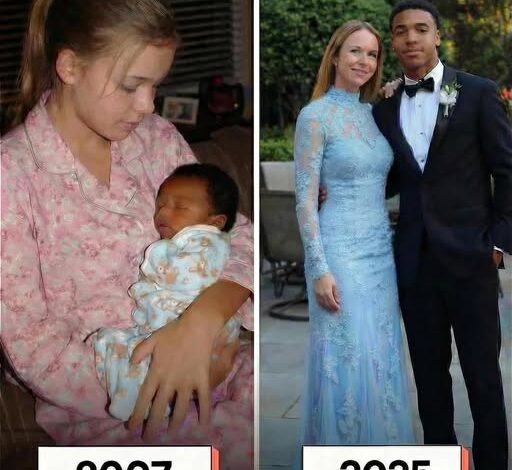
The Prom She Never Had: A Story of Sacrifice, Recognition, and Quiet Strength
For many people, prom is a milestone—an evening defined by formal clothes, music, and photographs that eventually fade into memory. It is often treated as a symbolic transition, a celebration marking the end of one chapter and the beginning of another. But for some, that experience never happens at all. Life intervenes, priorities shift, and moments that seem ordinary to others become something permanently out of reach.
For a woman named Emma, prom was one of those missed moments.
At seventeen, while many of her peers were thinking about dresses, dates, and future plans, Emma was facing a reality that required immediate adulthood. She became a mother at an age when most people are still discovering who they are. The father of her child was no longer present, and the responsibility of raising a baby fell entirely on her shoulders.
From that point forward, her life followed a very different path.
A Life Redirected
Emma’s days were not defined by milestones like graduation parties or social events. Instead, they were shaped by long work hours, financial uncertainty, and the constant demands of raising a child on her own. She worked nights to make ends meet, often sacrificing her own comfort to ensure her child had what was needed.
There were times when money was limited, and choices had to be made carefully. She wore secondhand clothes, skipped meals when necessary, and quietly managed the pressures that came with being the sole provider. These were not temporary adjustments—they became part of her daily life.
What stands out most is not just the difficulty of her circumstances, but the way she carried them. She did not seek recognition or sympathy. She focused on what needed to be done and did it consistently, without drawing attention to her sacrifices.
Over time, those sacrifices created opportunities for her child—opportunities she herself had not been able to experience.
A Son’s Realization
As her son grew older, the full weight of those sacrifices became clearer. Understanding did not come all at once, but gradually, through observation and reflection.
By the time he reached his senior year of high school, that understanding had deepened. It was no longer an abstract appreciation, but a recognition of the trade-offs his mother had made—what she had given up so he could have a more stable and open future.
Expressions of gratitude, while sincere, began to feel insufficient. Words alone did not seem capable of reflecting the scale of what she had done.
That realization led to an idea—one that was simple in concept, but deeply meaningful in intention.
He asked his mother to prom.
An Unexpected Invitation
At first, Emma did not take the request seriously. It seemed unusual, even humorous. Prom is typically associated with students and their peers, not parents. The idea felt out of place.
But as it became clear that her son was serious, her reaction shifted. The laughter gave way to emotion. The invitation was not just about attending a dance—it represented something much deeper.
It was recognition.
For years, her efforts had been quiet and largely unseen. This moment acknowledged not only what she had missed, but also what she had made possible for someone else.
Resistance and Criticism
Not everyone responded to the idea with the same understanding.
Within the family, there was opposition. His stepsister, Brianna, openly criticized the plan. She described it as inappropriate and unnecessary, framing it as an attempt to revisit something that no longer applied.
Her comments extended beyond simple disagreement. She questioned how others would perceive the situation and suggested that it would draw negative attention. The criticism was repeated and, at times, deliberately public.
For someone already stepping into an unconventional situation, this added pressure could have easily changed the outcome.
Choosing a Different Approach
Rather than responding with confrontation, Emma’s son chose a different path. He recognized that engaging directly with the criticism might only escalate the situation and shift the focus away from what truly mattered.
Instead of arguing, he focused on preparation.
He spoke with school administrators and event organizers, explaining the context behind his decision. He shared his mother’s story—not to attract attention, but to provide understanding. The goal was not to turn the event into a spectacle, but to ensure that her presence would be respected.
This approach required patience and restraint, but it allowed the situation to develop without unnecessary conflict.
The Night of the Event
When prom night arrived, the atmosphere carried a mix of anticipation and tension. The presence of Emma at the event was already known among some students, and reactions varied.
As expected, the criticism did not completely disappear. At one point, Brianna made a remark intended to draw attention and provoke a reaction. The comment was loud enough to be heard by others nearby, creating a brief moment of discomfort.
Emma remained composed. She did not respond or engage with the comment. Her focus stayed on the experience itself.
A Shift in the Room
Later in the evening, something unexpected happened.
The music paused, and the school principal addressed the room. Instead of continuing with the usual program, he shared a story. It was not framed as an announcement or a correction—it was simply a narrative.
He spoke about a young woman who became a mother at seventeen and raised her child alone. He described years of effort that often went unnoticed, highlighting the resilience and commitment required to sustain that kind of responsibility.
Then he mentioned Emma by name.
For a brief moment, the room was quiet. Then the reaction began.
Students and teachers stood up. Applause spread across the space, growing louder as more people joined in. It was not a formal or rehearsed response—it developed naturally, reflecting a shared recognition of what had been described.
In that moment, the focus shifted completely.
The attention was no longer on whether Emma’s presence was unusual. Instead, it was on what her life represented.
A Moment of Recognition
For Emma, the experience was overwhelming. The acknowledgment was not something she had expected, and it stood in contrast to years of quiet effort without public recognition.
What made the moment significant was not just the applause, but the understanding behind it. The people in the room were responding to a story that, until then, had not been widely known.
For her son, it confirmed that the decision to invite her had meaning beyond the two of them. It created a space where her experiences were not only seen, but valued.
After the Event
The evening concluded without further conflict. The earlier criticism lost its impact in light of what had taken place.
At home, the situation was addressed calmly. Rather than escalating tensions, the response focused on accountability. The consequences reflected the choices that had been made, emphasizing responsibility rather than punishment for its own sake.
This approach reinforced the idea that actions have outcomes, and that respect is an essential part of shared experiences.
A Lasting Perspective
The most important outcome of the night was not the event itself, but the shift in perspective it created.
For Emma, it provided an opportunity to see her own story differently. What had once been viewed as a series of missed experiences became something else—a foundation that allowed another person to move forward with greater opportunity.
Her life was not defined by what she had lost, but by what she had built.
For her son, the experience reinforced the value of recognizing the people who shape our lives, even when their contributions are not immediately visible.
More Than a Single Evening
The photographs from that night remain as a reminder, but their significance goes beyond the event they capture. They represent a moment when quiet effort was acknowledged and when a personal story became something shared.
Prom, in this case, was not just a social milestone. It became a setting for recognition, reflection, and connection.
Emma’s story illustrates that meaningful moments are not always those that follow expected patterns. Sometimes, they emerge from unexpected decisions—choices that prioritize understanding, respect, and gratitude.
In the end, the evening was not about revisiting something that had been missed. It was about recognizing the value of what had been given, and ensuring that it was not overlooked.
That recognition, once expressed, has a lasting impact—far beyond a single night.

