

The police officers arrived at the location after receiving a report about unauthorized street trading near a busy intersection. It was a place where pedestrian movement was constant and where local regulations clearly prohibited informal selling activities. They expected to encounter typical cases of unlicensed vendors who often tried to make a living in public spaces despite the rules.
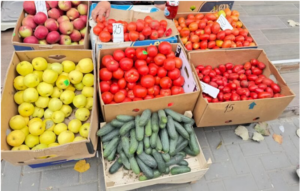
When they reached the corner, however, the situation appeared far less concerning than anticipated. Instead of a chaotic setup or a large group of sellers, they saw only one elderly woman standing quietly beside a small arrangement of vegetables placed neatly in a box. The display included simple produce such as tomatoes, carrots, cucumbers, and a few other garden vegetables. Everything looked orderly and modest, as if it had been carefully prepared with limited resources.
The woman herself appeared fragile and worn. She wore a faded skirt and an old sweater that showed signs of long-term use. Her posture was slightly hunched, and her hands moved slowly as she adjusted the vegetables in front of her. There was nothing about her appearance that suggested anything other than hardship and effort. To the officers, she seemed like someone struggling to get by rather than someone intentionally breaking rules for profit.

One of the officers approached her first, maintaining a calm and professional tone. He informed her that street selling was not permitted in that area and asked if she was aware of the regulation. The woman responded without resistance. She acknowledged that she knew about the rule but explained her situation in a quiet and tired voice. She said she needed to earn money to help support her son, who was unwell and depended on her. According to her explanation, the vegetables were grown in her own garden, and she was simply trying to sell them to afford basic necessities, including medicine.
Her words created a noticeable shift in the officers’ reaction. While the violation itself was still present, the circumstances made it difficult to respond with strict enforcement. The situation was no longer just about a rule being broken; it now involved personal hardship and survival. The officers exchanged brief looks, silently recognizing the difficulty of the moment. It was clear that the woman was not presenting herself as defiant or careless, but rather as someone driven by necessity.
After a short discussion, the senior officer decided not to take immediate action. He informed her that, under the circumstances, they would let the situation go this time. However, he also advised her to try to find a different and legal way to support herself, explaining that other officers or inspectors might not be as understanding. The tone was firm but not harsh, reflecting a balance between duty and compassion.
The woman nodded quickly in response, appearing relieved. She agreed politely and seemed eager for the officers to leave. Her behavior, however, carried a slight sense of nervousness that did not go unnoticed. As the conversation continued, one of the officers suggested buying a few vegetables from her as a small gesture of support. The idea was simple and intended as kindness, a way to help her earn something despite the situation.
The woman reacted immediately, declining the offer. She insisted that it was not necessary and mentioned that she already had enough customers. This statement caught the attention of the officers because the surrounding area was nearly empty. There were no visible buyers nearby, no signs of active trade, and no movement that would suggest a steady flow of customers. One of the officers asked her about it, expressing mild surprise.
She hesitated before responding, explaining that her customers usually came earlier in the day and that they had just missed them. Her explanation was vague, and her tone seemed uncertain. She avoided direct eye contact and spoke quickly, as if trying to move past the topic. Despite this, she repeated her refusal to accept payment from the officers and encouraged them to leave the vegetables for others instead.
At this point, the atmosphere subtly changed. While the situation had initially appeared straightforward and harmless, small inconsistencies in her behavior began to draw attention. Her nervousness, combined with the contradictory explanation about customers, created a sense of uncertainty. One of the officers became more observant and decided to take a closer look at the produce displayed in front of her.
He bent down and picked up one of the tomatoes. At first glance, it appeared normal. However, upon closer inspection, he noticed something unusual on its surface. There were small puncture marks that did not match the natural texture of the fruit. He examined it more carefully and then checked another tomato from the box. Similar markings were present there as well. This prompted him to inspect other vegetables in the container, where he discovered the same pattern.
The officer’s expression changed as he realized that the markings were not accidental or caused by natural damage. He immediately instructed his partner to stop the interaction and secure the area. The tone of the situation shifted instantly from uncertainty to seriousness. The woman, who moments earlier had seemed harmless and vulnerable, was now being treated as a suspect in a potential criminal case.
The officers proceeded to detain her while requesting additional support. The vegetables were collected as evidence, and the area was secured for further inspection. The woman did not resist physically, but her earlier calmness was replaced with visible tension. The situation escalated quickly as standard procedure was followed to determine the nature of the findings.
Subsequent investigation revealed that the unusual markings on the vegetables were linked to a more complex operation taking place behind the scenes. Authorities discovered that the appearance of the elderly woman had been used as a form of concealment. While she was present at the street location selling produce, further inquiry indicated that illegal substances had been hidden within the vegetables in a way designed to avoid suspicion.

The investigation expanded to include a search of her residence. There, officers found additional evidence that suggested coordinated activity involving another individual. It was discovered that her son, who was physically disabled, was allegedly involved in producing the substances from inside the home. The woman’s role appeared to involve transporting and distributing the items in a manner that would not attract attention, relying on her appearance to avoid scrutiny from law enforcement and the public.
This discovery reframed the entire situation. What had initially seemed like a simple case of a struggling vendor trying to survive under difficult conditions was now understood as part of a concealed illegal operation. The earlier perception of innocence and vulnerability was replaced with a more complex and serious reality.
The case highlighted how appearances can sometimes be misleading, especially in situations where individuals may intentionally use societal assumptions to avoid detection. The image of a harmless elderly woman had initially reduced suspicion, allowing the activity to go unnoticed until a closer inspection revealed inconsistencies that could not be ignored.
In the end, the officers reflected on how quickly their initial impressions had shifted. What began as a moment of sympathy turned into a formal investigation once evidence came to light. The situation served as a reminder that while compassion is important, careful observation and attention to detail remain essential in law enforcement work.
The case concluded with the individuals being taken into custody and the investigation continuing to determine the full extent of the operation. For the officers involved, the experience reinforced an important professional lesson about not relying solely on appearances when assessing a situation.

