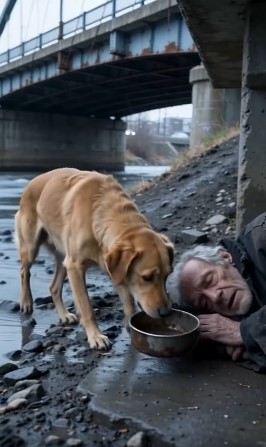
Golden Stray Refuses to Leave Elderly Man Behind and Changes Two Lives Forever
An Isolated Life Beneath a River Bridge
For Arthur Thompson, the passing days had become nearly impossible to distinguish from one another. Living beneath a bridge near the Monongahela River, the seventy-six-year-old relied on the sounds around him to mark the passage of time.
The rushing water, distant traffic, and cold wind once provided a sense of familiarity. As the days dragged on, however, those sounds became reminders of growing hardship.
Arthur had been alone for a long time. His body was weak, his clothes were damp, and the freezing temperatures seemed to settle deeper into his bones with each passing night.
Curled beneath the concrete structure, he struggled to find warmth or comfort. Hunger and exhaustion had worn him down physically, while years of loneliness had taken an emotional toll.
Separated from the people who had once been part of his life, Arthur had slowly come to believe that the world had forgotten him.
The isolation felt overwhelming.
As the days passed, he found himself reflecting on old memories, lost relationships, and opportunities that had long since disappeared.
By the time the coldest nights arrived, Arthur had nearly accepted that his life might end beneath that bridge.
A Surprising Visitor Appears
One afternoon, as Arthur drifted in and out of consciousness, he heard a faint sound nearby.
At first, he assumed it was a small animal searching through debris.
The noise grew closer.
Then he felt warm breath against his face.
Opening his eyes with difficulty, Arthur saw a dog standing over him.
The animal was clearly a stray.
Its golden coat was dirty and tangled. Its frame was thin enough to reveal visible ribs. One ear stood upright while the other folded downward, giving the dog a distinctive appearance.
Despite its condition, the animal’s eyes were calm and attentive.
The dog did not bark.
It did not growl.
Instead, it simply watched Arthur.
Moments later, the dog dragged a rusted bowl across the ground and placed it near him.
A small amount of water remained inside.
The gesture seemed almost impossible to understand.
Arthur tried to respond, but his voice was weak.
“I can’t.”
The dog stepped closer and gently licked his hand.
For Arthur, the simple act carried enormous meaning.
Years of loneliness suddenly surfaced.
Overcome with emotion, he began to cry.
A Silent Companion Stays Nearby
As the hours passed, the dog refused to leave.
Whenever Arthur opened his eyes, the animal remained nearby.
Sometimes it wandered toward the road above the bridge before returning moments later.
It appeared restless yet determined.
The dog seemed to understand that something was wrong.
Arthur watched as the animal repeatedly climbed the embankment and disappeared from view.
Each time, it eventually returned.
Then, on one trip, the dog stayed away longer than usual.
Arthur listened to the river and wondered if the animal had finally moved on.
He was too weak to search.
All he could do was wait.
The Dog Brings Help
Not long afterward, unfamiliar voices echoed beneath the bridge.
Several people hurried down the slope.
Leading them was the same golden dog.
A doctor, a younger man, and an older companion followed close behind as the dog barked urgently and repeatedly looked back toward Arthur.
The physician quickly assessed the situation and understood the seriousness of his condition.
Emergency services were called immediately.
Within a short time, medical personnel arrived and prepared Arthur for transport.
As they placed him onto a stretcher, Arthur reached toward the dog.
His gratitude was impossible to express fully.
The dog had found help when no one else knew he was there.
Without that intervention, Arthur’s chances of survival were rapidly diminishing.
As the ambulance doors closed, he looked through the window and saw the dog standing near the riverbank in the rain.
At that moment, Arthur made a promise to himself.
If he survived, he would find the dog again.
A Difficult Medical Reality
Arthur was transported to Mercy General Hospital, where doctors quickly determined that he had suffered a severe ischemic stroke.
A blood clot had blocked a major artery supplying the right side of his brain.
The condition left much of his left side weakened and significantly limited his mobility.
Medical staff explained that recovery would require patience, therapy, and extensive rehabilitation.
They also made one fact clear.
Had the dog not attracted attention and brought assistance when it did, Arthur likely would not have survived.
For two weeks, he remained in a hospital bed receiving treatment.
Nurses cared for him, doctors monitored his progress, and therapists encouraged him to focus on healing.
Yet despite the safety and warmth around him, Arthur’s thoughts constantly returned to the golden dog.
Every meal reminded him that the animal might still be struggling outside.
Every blanket reminded him that the dog remained exposed to the winter cold.
To hospital staff, the dog represented an extraordinary rescue story.
To Arthur, the dog had become something far more important.
He considered the animal family.
A Decision That Surprised Everyone
As Arthur’s discharge date approached, social worker Sarah Evans met with him to discuss long-term care options.
She had successfully arranged placement at Oakridge Senior Living, a facility that could provide housing, meals, medical supervision, and daily assistance.
It seemed like the ideal solution.
Arthur listened carefully before asking a single question.
“Can I bring my dog?”
Sarah explained that the facility could not accommodate a stray animal without vaccinations, documentation, or evaluation.
The answer disappointed Arthur immediately.
Without hesitation, he refused the placement.
Sarah attempted to explain the risks.
Returning to the streets after a stroke could place his life in danger.
Arthur understood perfectly.
Still, he could not accept safety at the cost of abandoning the dog that had saved him.
The next morning, after medical staff determined he was mentally capable of making his own decisions, Arthur left the hospital.
Armed with a cane and determination, he began searching.
The Search Begins
The journey back to the bridge was physically exhausting.
Each step required effort.
The winter air cut through his clothing, and his weakened leg slowed his progress.
Yet he continued forward.
When Arthur finally arrived beneath the bridge, his heart sank.
The dog was gone.
The area was empty.
No bowl remained.
No sign of the animal could be found.
Only scattered debris and footprints remained.
Arthur spent days searching.
He explored alleys, parking lots, abandoned buildings, loading docks, and rail yards.
He asked strangers, workers, and passersby whether they had seen a thin golden dog with mismatched ears.
No one could provide the answer he needed.
His strength gradually faded.
Cold temperatures and limited food began taking their toll.
Still, he refused to stop looking.
A Reunion at Last
Several days later, exhausted and discouraged, Arthur sat alone on a bench overlooking the river.
He had almost given up hope.
Then he felt something warm touch his hand.
Slowly, he opened his eyes.
Standing beside him was the dog.
The animal appeared just as thin and worn as before, but unmistakably familiar.
One ear pointed upward.
The other folded gently over one eye.
The dog immediately pressed against Arthur’s leg.
Relief washed over both of them.
Arthur embraced the animal tightly.
Tears filled his eyes once again.
After days of uncertainty, they had found each other.
Arthur decided to give the dog a name.
He called him Companion.
Building a New Life Together
Arthur and Companion eventually settled beneath a stone railroad arch located near a small creek at the edge of town.
The location provided protection from wind and rain.
Although simple, it offered a sense of security neither had experienced for some time.
Winter remained difficult.
Arthur gathered cardboard, branches, and discarded materials to improve their shelter.
Companion stayed close, providing warmth during the coldest nights.
Each morning began with the dog checking on Arthur before exploring the area.
The bond between them grew stronger every day.
They depended on one another.
Arthur provided companionship and care.
Companion provided loyalty, comfort, and emotional support.
Help Arrives Again
Eventually, Sarah Evans located them.
Rather than insisting Arthur move into a care facility, she chose a different approach.
She brought supplies.
Sleeping bags, tarps, food, cooking equipment, dog bowls, and warm clothing soon arrived.
Companion even received a proper coat for colder weather.
Sarah understood that forcing separation would only cause additional pain.
Instead, she focused on helping both Arthur and Companion remain safe.
She arranged regular visits and encouraged Arthur to accept assistance whenever necessary.
Her support made a significant difference.
Others soon followed her example.
Community members began stopping by with food, supplies, and encouragement.
Some offered dog food.
Others brought blankets or warm drinks.
Slowly, a network of kindness formed around them.
The Power of Belonging
As spring arrived, life became noticeably easier.
The snow disappeared.
Trees began to bloom.
The creek sparkled beneath warmer sunlight.
Companion’s health improved dramatically.
His coat regained its golden shine.
His ribs no longer showed.
He moved with confidence and energy.
Arthur also experienced change.
Although he still faced physical challenges from the stroke, he no longer felt invisible.
The friendships that developed around him restored something he believed had been lost forever.
For years, he had lived feeling forgotten.
Now, he felt connected.
The simple shelter beneath the stone arch no longer felt like a place of hardship.
It felt like home.
A Friendship That Changed Everything
Arthur often reflected on the unlikely series of events that brought Companion into his life.
A starving stray dog had approached a lonely elderly man at his lowest point.
That single encounter changed everything.
Companion saved Arthur’s life by finding help when it was desperately needed.
Yet the rescue extended beyond physical survival.
The dog also rescued Arthur from isolation, hopelessness, and the feeling of being forgotten.
In return, Arthur gave the animal something equally valuable: safety, companionship, and a place to belong.
Together, they formed a bond built on loyalty, trust, and gratitude.
Each evening, they rested beneath the stone archway, side by side.
Each morning, they greeted a new day together.
Their story became a powerful reminder that compassion can appear in unexpected forms and that even those who seem abandoned can find connection when they need it most.
For Arthur and Companion, what began as a chance meeting beside a river became the beginning of a new life—one defined not by loneliness, but by friendship, resilience, and hope.
