
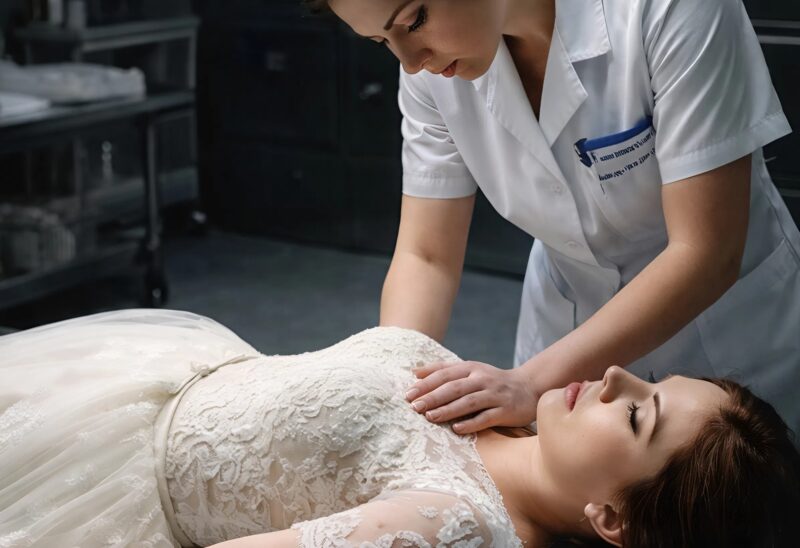
The events began on what should have been one of the happiest days in a young woman’s life. Instead, they unfolded into a deeply unsettling situation that raised serious questions about trust, responsibility, and the line between life and death.
Early that morning, an ambulance arrived quietly at a medical facility. The siren, which had likely sounded moments earlier, was turned off before entering the courtyard. Behind it followed a line of cars decorated with white ribbons and flowers—vehicles that clearly belonged to a wedding procession. The contrast between celebration and tragedy was impossible to ignore.
People dressed in formal clothing gathered outside the building. Some were visibly distressed, wiping away tears, while others stood in silence, unable to process what had happened. The bride, still dressed in her wedding gown, was carried inside on a stretcher. Her hair had been carefully styled, and her bouquet rested gently on her chest, as if nothing had changed. Walking beside her was the groom. His expression was calm, almost unnaturally so. He did not cry or shout. Instead, he looked at her with a distant gaze, as though refusing to accept the situation.
Inside the building, a morgue attendant observed the scene from a hallway. She had only recently begun working there and was still adjusting to the nature of her job. In her early days, fear had followed her home. She would dream of cold rooms and silent corridors. Over time, however, she had learned to approach her work with composure. A senior doctor had once told her something that stayed with her: that the truly dangerous individuals are not the ones who lie still, but those who move freely and appear harmless.
After the family members were escorted away, the bride’s body was placed in a preparation room. A doctor briefly reviewed the documents and gave instructions.
The autopsy, he said, would take place the following day. He told the attendant to finish her shift and not remain longer than necessary. When she asked whether the cause of death had been confirmed, he responded that it was a case of poisoning and that everything had already been documented. There was no need for concern.
Once the doctor left, the room became quiet.
The attendant approached the table. Something about the situation did not feel right. The bride’s appearance was unusual for someone who had reportedly passed away. Her skin was not pale or gray. Her lips had not turned blue. Instead, there was a faint color in her cheeks that resembled a natural blush.
She hesitated before reaching out to touch the bride’s hand. The moment her fingers made contact, she pulled back in surprise. The skin felt warm.
Thinking she might be mistaken, she tried again, this time more carefully. The warmth remained. It did not match what she had come to expect in her work.
She leaned closer, focusing on the chest area. For a brief moment, she thought she saw movement—subtle, almost imperceptible. Her uncertainty grew stronger.
Quietly, she whispered to herself that this could not be happening. Still, she needed to be sure. Gathering her courage, she placed her ear against the bride’s chest.
In the stillness of the room, she heard something faint.
It sounded like a heartbeat.
The attendant stepped back, overwhelmed by what she had just experienced. If she was correct, the situation was far more serious than anyone had realized. Acting quickly, she left the room and went to find the doctor.
She told him what she had observed, explaining that the body was warm and that she believed she had heard a heartbeat. The doctor, however, reacted with skepticism. He appeared irritated and suggested that she might be imagining things. According to him, residual warmth in a body shortly after death was not unusual, and certain muscle responses could be misinterpreted.
He agreed to examine the body again, but his demeanor made it clear that he did not expect to find anything significant.
Back in the room, he conducted a brief assessment. He checked the neck, examined the pupils, and used a stethoscope. After a few moments, he concluded that there were no signs of life. He reassured the attendant that what she had noticed could be explained by postmortem changes, especially in cases involving certain substances.
Despite his explanation, the attendant remained uneasy.
After he left, she stayed in the room a little longer. She observed the bride carefully, trying to determine whether her earlier impressions had been accurate. At one point, she thought she saw a slight movement in the fingers, but it was so subtle that she could not be certain.
That evening, instead of leaving immediately, she decided to take an additional step. Without informing anyone, she placed a small camera in the room, positioning it so that it faced the table. She wanted to monitor any possible changes overnight.
The next morning, she arrived earlier than usual and went directly to review the footage. For the first couple of hours, nothing appeared unusual. The room remained still and quiet.
Then, something changed.
On the recording, the bride suddenly took a deep breath. It was abrupt and unmistakable, as if someone emerging from underwater. Her fingers moved, and her eyes slowly opened.
The attendant watched in disbelief.
Shortly afterward, the doctor entered the room. He was not alone. The groom was with him.
The footage showed them speaking in low voices. The doctor appeared calm, explaining that everything was proceeding as planned and that the necessary documents had already been prepared. The groom looked around nervously, urging that they move quickly.
Together, they helped the bride sit up. She appeared weak but conscious. Within minutes, they guided her out of the room through a separate exit.
At that moment, the situation became clear.
The apparent death had not been accidental. Instead, it had been carefully orchestrated. The bride had been placed into a medically induced state that mimicked death closely enough to pass a basic examination. Her vital signs had been slowed to such an extent that they were nearly undetectable without thorough testing.
The reasons behind the plan were complex. In the days leading up to the wedding, a significant life insurance policy had been taken out in the bride’s name. In the event of her death, the payout would go to her husband. Additionally, she held a share in a family business. Her legal death would allow control of those assets to be transferred.
However, the plan appeared to involve more than financial gain. Based on what the attendant observed, the bride seemed to be cooperating. It suggested that she may have agreed to disappear, possibly to leave behind certain obligations or pressures in her life.
What the individuals involved had not anticipated was the presence of someone willing to question what did not seem right.
The attendant saved a copy of the footage. This time, when she went to speak with the doctor, she did not go alone.
The situation that followed would no longer be based on assumptions or uncertainty, but on clear and documented evidence.

