Highway Patrol Officer’s Late-Night Stop Leads to Rescue of Dozens of Children
An Overnight Call Near the Interstate
What began as a routine response to a reported disturbance became one of the most significant nights of Officer Miller’s career.
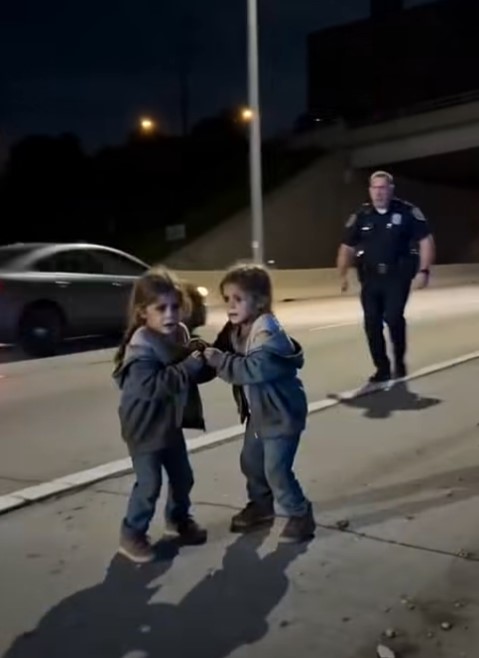
Shortly after 2:00 AM on a hot July evening, Miller was dispatched to investigate reports of children throwing rocks near an industrial area close to Interstate Route 85. The call sounded minor, the type of incident that officers frequently handle during overnight patrols.
The report suggested youthful mischief rather than anything serious. There was no indication that the situation involved danger, organized crime, or missing children.
When Miller arrived near the highway shoulder, however, he immediately sensed that something was different.
Standing beside the road were two young girls. They appeared exhausted, frightened, and completely alone.
Instead of running away when the patrol vehicle approached, the children remained where they were, watching the officer with expressions that revealed fear rather than guilt.
As Miller stepped closer, he realized the girls were identical twins.
Their clothes were torn and dirty, and both appeared physically drained. The scene did not match the original report at all.
A Disturbing Discovery
Wanting to avoid alarming the children, Miller introduced himself calmly and assured them they were safe.
One of the girls reached toward him and lightly grabbed the sleeve of his uniform. Without speaking at first, she looked toward the dark industrial buildings visible beyond the roadway.
As she turned her head, her hair shifted slightly.
Miller noticed bruises along her neck and collarbone.
The injuries immediately raised concern, but another detail proved even more troubling.
Near the base of her skull was a black barcode accompanied by a series of numbers.
The mark appeared recent and professionally applied.
When Miller looked at the second child, he discovered an almost identical marking.
The officer felt a growing sense of alarm. The girls appeared to have been labeled rather than identified as individuals.
Moments later, one of the twins quietly revealed why they had come to the roadside.
She explained that other children were still inside a nearby warehouse.
With that statement, the nature of the call changed completely.
The report of rock throwing was no longer a simple disturbance. It had become a potential rescue operation.
The Twins Tell Their Story
Miller quickly escorted the girls to the safety of his patrol vehicle.
Once inside, he gave them water and allowed them a few moments to recover.
The twins identified themselves as Maya and Mia.
They explained that they had escaped from an abandoned warehouse located within the industrial district.
According to the girls, numerous children remained trapped inside.
They described dark transport trucks arriving and leaving, masked men moving through the building, and large wooden crates being prepared for shipment.
The twins said they had found a narrow route out through an opening hidden behind shelving. After squeezing through the gap, they followed a pipe system until they eventually reached the highway.
Desperate to attract attention, they began throwing rocks near the road.
The tactic worked.
It brought Officer Miller to them.
A Difficult Decision
After hearing the girls’ account, Miller considered immediately broadcasting the situation over the standard dispatch channel.
As he reached toward his radio, however, the twins reacted with visible fear.
Their response caused him to pause.
He remembered a previous investigation in which suspects seemed to receive warning before officers arrived. The memory raised concerns about whether information could leak before a rescue operation was organized.
If the children inside the warehouse were moved before help arrived, valuable time could be lost.
Miller chose a cautious approach.
Instead of announcing the full situation over the radio, he informed dispatch that the area appeared quiet and that he intended to conduct a brief foot patrol.
The decision carried significant risk.
Still, he believed openly communicating what he had learned might place the children in greater danger.
Entering the Industrial Zone
After securing Maya and Mia inside the patrol car, Miller began moving toward the industrial park on foot.
From a distance, the warehouse looked abandoned.
The structure showed no obvious signs of activity. There were no bright exterior lights, no visible employees, and nothing to suggest people were inside.
As he approached the property, Miller discovered a section of chain-link fencing that had been carefully cut.
The opening appeared intentional and frequently used.
He slipped through and continued deeper into the property.
Moving between weathered containers and cracked pavement, he eventually reached the rear loading docks.
There he spotted a large black transport truck backed against one of the bays.
The vehicle carried no company markings or identifying information.
Its refrigeration system produced a steady mechanical sound that echoed through the otherwise quiet area.
From a concealed position, Miller observed several armed men near the loading area.
Their conversation referenced shipments, crates, and departure schedules.
The officer realized the operation was active and that time was running out.
The Truth Inside the Warehouse
Continuing around the building, Miller located a utility entrance that had been left slightly open.
He entered through a narrow corridor and carefully advanced toward the interior.
What he found confirmed the twins’ story.
The warehouse was not abandoned.
Inside, the facility had been transformed into a functioning operation.
Bright lighting illuminated the main floor. Electronic equipment, workstations, monitors, and metal tables occupied large sections of the building.
Most disturbing of all were the cages positioned along one wall.
Inside them sat children of various ages.
Many appeared frightened and exhausted. Most remained silent.
In the center of the room stood a man wearing a white coat and carrying a scanner device.
Several armed guards surrounded him.
Miller listened as instructions were issued regarding scanning, sedation, and transportation.
There was no longer any doubt that immediate action was necessary.
Chaos Erupts
The officer moved to intervene.
His sudden appearance caught those inside by surprise, but the shock lasted only moments.
The guards reacted quickly.
Within seconds, the warehouse descended into chaos.
Miller found himself heavily outnumbered.
Using available cover and the warehouse layout to his advantage, he worked to prevent the guards from reaching the children.
The confrontation intensified when damage to a refrigeration line released cold vapor into part of the building.
Visibility dropped significantly.
The confusion created an opportunity for Miller to reposition himself and slow the movements of several armed men.
Amid the disorder, the man in the white coat attempted to flee.
Carrying a metal briefcase, he ran toward the loading docks.
Miller tried to stop him but was forced to focus on protecting the children still trapped inside the facility.
Evidence of a Larger Operation
During the confrontation, Miller discovered a damaged tablet that had fallen to the floor.
The device contained extensive records connected to the children inside the warehouse.
Profiles, identification numbers, transportation information, and shipment details filled the system.
The contents suggested the operation extended far beyond a single location.
Information listed facilities connected to Atlanta, Savannah, Baltimore, and Dallas.
The records indicated the warehouse was part of a much broader network.
Miller also found entries for Maya and Mia.
The twins had already been entered into the system as missing.
Before he could examine the information further, a new threat emerged.
The main loading bay doors began opening.
Additional armed men were arriving.
Backup Reaches the Scene
As Miller prepared for another confrontation, flashing emergency lights suddenly illuminated the loading docks.
Law enforcement units poured into the industrial area.
State troopers, sheriff’s deputies, and tactical teams rapidly secured the perimeter.
The transport truck was blocked before it could leave.
Officers moved into the warehouse while tactical personnel confronted those attempting to escape.
The balance of power shifted immediately.
The suspects were overwhelmed by the coordinated response.
Inside the facility, Miller began helping free the children.
One by one, they were removed from the cages and brought to safety.
Medical teams soon arrived to evaluate them.
The industrial park transformed into a large emergency scene as ambulances, investigators, and federal agents filled the area.
The Twins’ Critical Role
Investigators later learned how backup had arrived so quickly.
While Miller was inside the warehouse, Maya had managed to activate the patrol vehicle’s emergency panic system.
The alert bypassed standard communications and transmitted an urgent signal tied directly to the cruiser’s location.
The alarm indicated that an officer might be in danger.
That signal triggered the large-scale law enforcement response that converged on the warehouse.
Without Maya’s quick thinking, help might not have reached the scene in time.
The same twins who had escaped captivity and flagged down a patrol officer also played a direct role in bringing rescuers to the facility.
The Investigation Expands
The man in the white coat was eventually captured following a pursuit.
The metal briefcase he carried was recovered as evidence.
Its contents helped investigators understand the full scope of the operation.
Authorities used the information to launch coordinated actions at additional locations.
Further rescues followed as investigators moved against other connected facilities.
The case also uncovered individuals who had allegedly assisted in protecting the operation.
Several corrupt officials connected to local systems were arrested.
The discovery helped explain why Miller had been concerned about openly broadcasting information over standard channels.
His caution proved justified.
A Lasting Bond
Following the rescue, Maya and Mia entered specialized care while authorities worked to ensure their safety.
As witnesses in a major investigation, they required protection and support.
Miller continued visiting them during their recovery.
He brought books, art supplies, and simple reminders that trustworthy people still existed.
Over time, the twins slowly began rebuilding their sense of security.
The healing process was gradual.
Fear did not disappear overnight, but small signs of progress became visible.
Eventually, surgeons removed the barcode markings from the girls’ bodies.
The tattoos were replaced by faint scars, leaving behind reminders of what they had endured but removing the labels that had once defined them.
A New Beginning
As discussions about the twins’ future continued, Miller realized his involvement in their lives extended beyond the events of that night.
One conversation remained especially meaningful.
When Maya asked whether they would ever be placed in a box again, the question deeply affected him.
He assured both girls that they would never have to face that fear again.
In time, Miller offered them a permanent home.
The process involved numerous legal and administrative challenges because of the extraordinary circumstances surrounding the case.
With support from the appropriate authorities, however, the adoption was completed.
Three years later, Miller had transitioned into a role focused on investigating crimes involving vulnerable victims.
His professional life had changed.
So had his personal life.
The once-quiet home of a patrol officer was now filled with the energy of two growing girls reclaiming the childhood that had nearly been taken from them.
There were still difficult moments.
Loud trucks occasionally triggered fear. Nightmares sometimes returned.
Yet their future was no longer defined by captivity or uncertainty.
They lived in safety, surrounded by support and stability.
The Importance of Looking Closer
The events that unfolded near Interstate Route 85 began with a call that appeared insignificant.
Two children standing near a highway in the middle of the night could easily have been dismissed as troublemakers.
Instead, one officer paid attention to what others might have overlooked.
His willingness to look beyond the initial report uncovered a situation far more serious than anyone imagined.
The result was the rescue of children, the exposure of a criminal operation, and a future restored for Maya and Mia.
The story serves as a reminder that life-changing moments often begin quietly.
A simple call for service, a frightened child seeking help, and one decision to investigate further can alter the course of many lives.
