Mysterious Photograph Found in Old European Estate Sparks Historical Debate
A Routine Archive Discovery That Drew Unexpected Attention
In a quiet and largely overlooked European village, a surprising discovery inside an old estate archive has recently attracted the attention of historians, archivists, and cultural researchers from several countries. What began as a routine cataloging effort inside a long-abandoned mansion soon turned into an unexpected subject of widespread discussion.
The estate had remained untouched for decades, preserving layers of historical material that included personal letters, worn documents, and aged family artifacts. Among these stored materials, researchers identified a small photograph that appeared unusually well-preserved compared to the surrounding items.
At first, the photograph was not considered particularly important. However, its unusual clarity and composition quickly set it apart from the rest of the archive, prompting closer examination by specialists working on the collection.
The Photograph and Its Unusual Composition
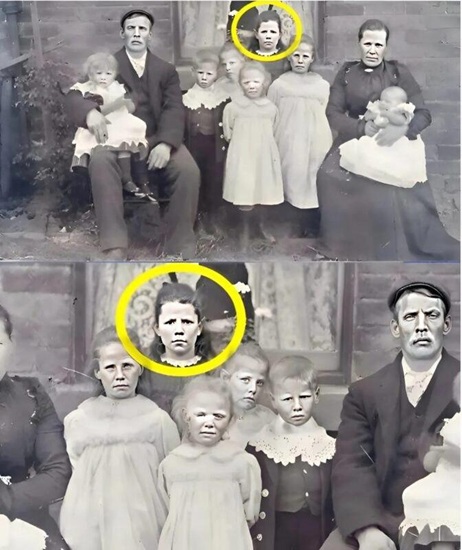
The image reportedly shows a formally posed family standing in front of a red brick house. Their clothing is consistent with early nineteenth-century European fashion, arranged in a traditional portrait style commonly used during that period.
The father figure is shown standing upright in period attire with a stern expression. The mother holds a young child in her arms, while other children are arranged neatly beside them in a structured composition typical of staged family portraits from that era.
However, attention quickly shifted to an unexpected detail within the background of the image. Behind the children, observers noted a faint and unclear figure that appears partially obscured. Its presence is visually ambiguous and difficult to define with certainty.
This detail became the focal point of discussion, as it did not seem to fit naturally within the composition of the portrait. The figure has been described in varying interpretations, though its exact nature remains uncertain based on the available visual evidence.
Local Narratives and Historical Gaps
Speculative interpretations later connected the photograph to regional narratives involving a family tragedy. Some accounts reference a missing daughter named Maria, who is said to have disappeared approximately one year before the estimated date associated with the image.
According to these narratives, Maria was believed to be the eldest child in the household. However, official historical documentation from the period is incomplete, and surviving records contain fragmented references that do not confirm a clear account of her fate.
This lack of consistent documentation has contributed to uncertainty surrounding both the family history and the context of the photograph itself. In the absence of complete records, multiple interpretations have emerged over time, often blending historical gaps with local storytelling traditions.
Folklore and Regional Interpretations
Over time, local folklore surrounding the estate developed additional layers of interpretation. Stories circulated about unexplained occurrences linked to the property, along with references to what residents described as “foundation spirits.”
These narratives often frame unresolved historical events in symbolic or supernatural terms, suggesting that emotional or historical memory may remain attached to physical locations. Within this context, the photograph became part of a broader set of regional stories.
One interpretation suggests that the faint figure in the background may represent Maria, symbolically appearing within the portrait as a reflection of unresolved loss within the family history. However, such interpretations remain speculative and are not supported by verifiable historical documentation.
Questions About the Photograph’s Historical Dating
Researchers examining the image have noted a significant chronological inconsistency. The photograph is associated in some accounts with a date around 1820, a period in which photography had not yet been practically developed in a documented form.
The earliest recognized photographic processes emerged in the late 1820s and 1830s, meaning any image dated earlier than this would require substantial evidence to confirm authenticity. This discrepancy has led many experts to question the reported dating of the artifact.
Because of this timeline issue, several possibilities have been considered, including the likelihood that the image may be a later reproduction, a misdated artifact, or a modern creation styled to resemble historical photography.
Growing Public Interest and Media Interpretation
Despite academic skepticism, the photograph has gained attention in popular media, where it is often presented with dramatic interpretations. These retellings frequently combine elements of folklore, mystery, and speculative storytelling, amplifying public curiosity about its origins.
The image’s ambiguous background detail has been central to much of this interest. In digital circulation, variations of the photograph have appeared online, leading viewers to claim that subtle differences exist in the appearance of the background figure.
Some interpretations suggest that these differences indicate changes in expression, while others attribute them to technical factors such as scanning quality, compression effects, or restoration inconsistencies in digitized archival material.
Additional Investigations and Unverified Claims
Following increased attention, further archival investigations were reportedly conducted in relation to the estate and its surrounding area. These efforts focused on verifying historical residency and burial records connected to the property.
Some accounts claim that excavation work near the estate uncovered human remains believed to belong to a young individual. However, these claims have not been formally verified within academic or archaeological documentation.
If confirmed, such findings would still require detailed forensic and archaeological analysis to determine identity, time period, and any possible connection to the historical family associated with the estate.
Experts caution that linking physical remains to undocumented historical narratives without strong evidence can contribute to misinterpretation and the reinforcement of local myths as factual history.
Analysis of the Image and Possible Explanations
Examination of the photograph itself has not produced definitive evidence of modern digital manipulation. However, this does not confirm the authenticity or historical accuracy of its dating or origin.
Specialists in archival imaging note that degradation of photographic materials, chemical changes over time, and reproduction imperfections can sometimes create visual anomalies. These distortions may appear as shapes or figures that were not originally intended or present.
In digitized versions of historical materials, additional variables such as contrast adjustments, resolution loss, and restoration algorithms can further alter visual interpretation. These technical factors may contribute to differing perceptions of the same image.
Balancing History, Folklore, and Interpretation
As interest in the photograph has grown, researchers have emphasized the importance of distinguishing between verified historical evidence and narrative interpretation. While emotionally compelling stories often emerge around ambiguous artifacts, academic standards require consistent documentation and reproducible verification.
The estate itself remains of historical significance primarily due to its architecture and preserved archival materials, rather than the disputed interpretations of the photograph. It continues to be studied within the broader context of regional history.
Over time, the image has become an example of how incomplete records, folklore, and modern digital circulation can combine to create layered and uncertain historical narratives. Its meaning continues to shift depending on interpretation and context.
Conclusion: A Case Study in Uncertain History
The discovery ultimately highlights how gaps in historical documentation can encourage imaginative explanations, especially when visual material appears ambiguous. In the absence of definitive evidence, interpretation often fills the space left by uncertainty.
While the photograph continues to circulate in public discussions, historians maintain that it should be treated as an unverified artifact until more concrete evidence is established. Its origin, date, and context remain open questions.
What remains clear is that the case reflects a broader human tendency to seek meaning in unclear or unexplained objects, blending history, memory, and imagination into compelling narratives that evolve over time.
