
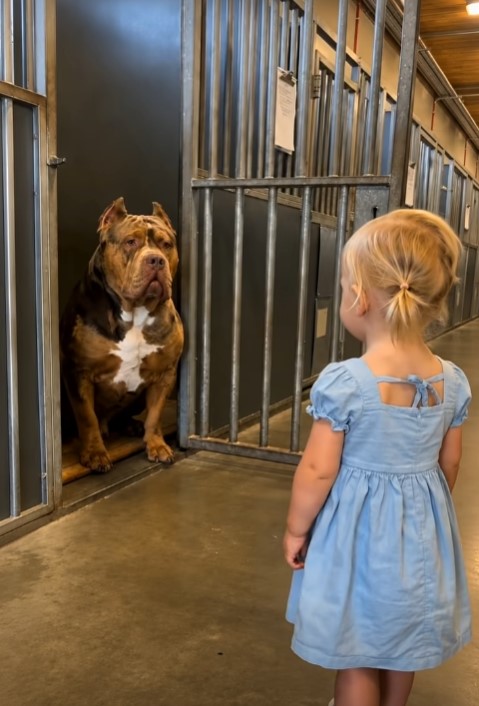
Feared Shelter Dog Reveals Gentle Side After Unexpected Encounter With Three-Year-Old Girl
A Reputation That Kept Everyone Away
For years, a large shelter dog named Bob carried a reputation that made him one of the most avoided animals in the facility.
Known for explosive reactions and intimidating behavior, he lived apart from many of the other dogs and was considered a serious challenge by staff members.
Visitors were routinely warned about him before reaching his section of the shelter.
Whenever unfamiliar people approached, Bob often responded with barking, growling, and lunging toward the kennel door.
His powerful build, visible scars, and fearful reactions convinced many people that he was simply too dangerous to trust.
As a result, very few visitors wanted anything to do with him.
A Troubled Past With Few Answers
The shelter never learned the complete story behind Bob’s behavior.
Records indicated that he had been discovered on an abandoned property located outside the city limits.
When rescuers found him, his body showed evidence of significant hardship.
Numerous scars covered him, suggesting that he had survived years of difficult conditions before arriving at the shelter.
Some people suspected that he may have been involved in illegal dog fighting at some point in his life.
However, no documentation existed to confirm exactly what had happened.
What everyone could see was that Bob carried deep fear and distrust.
He reacted to people as though danger was always nearby.
Even routine tasks such as cleaning his kennel required caution and careful planning.
The Isolation of Kennel Number Seventeen
Bob’s living space was located in kennel number seventeen, positioned away from the busiest areas of the shelter.
Over time, that kennel became associated with warnings rather than opportunities.
Families searching for pets were encouraged to focus on other animals.
Volunteers often chose different areas when offering assistance.
While many dogs attracted attention from potential adopters, Bob remained overlooked.
Month after month, he watched other animals leave with new families.
Puppies were adopted quickly.
Senior dogs eventually found homes.
Shy and nervous animals received second chances from patient adopters.
Bob stayed where he was.
As time passed, some shelter employees began wondering whether he would ever be able to leave.
His behavior seemed too unpredictable, and attempts to improve his social skills produced only limited results.
The situation became emotionally difficult for the people responsible for his care.
Many believed that beneath the aggression was a frightened animal, but reaching him appeared impossible.
A Family Searching for a Companion
Everything began to change on an ordinary day when a young family arrived at the shelter.
A mother and father were looking for a gentle pet suitable for their three-year-old daughter, Emily.
Their goal was simple.
They hoped to find a friendly companion that would fit comfortably into family life.
Shelter workers introduced them to several dogs and discussed different personalities.
The adults focused on practical questions involving care, training, and compatibility with children.
Meanwhile, Emily quietly observed the animals around her.
At first, she remained close to her parents.
Eventually, curiosity encouraged her to explore farther down the corridor.
Like many children her age, she became fascinated by the sights and sounds surrounding her.
Without realizing it, she slowly wandered toward the section where Bob was housed.
An Unexpected Encounter
As Emily walked past the kennels, dogs reacted in different ways.
Some barked excitedly.
Others wagged their tails and pressed against the doors.
She continued moving until she reached the final kennel.
Inside sat Bob.
Ordinarily, a stranger approaching his space would trigger an immediate response.
Staff members had witnessed the pattern many times before.
But when Bob saw Emily standing in front of him, something unusual happened.
He remained completely still.
The dog simply watched the child.
Emily stepped closer to the kennel door.
At that moment, a mistake no one had noticed became critically important.
Earlier cleaning had left the kennel latch improperly secured.
When Emily touched the door, it shifted open.
Suddenly, the barrier separating Bob from the public disappeared.
A Shelter Holds Its Breath
The moment the kennel opened, panic spread through the shelter.
Staff members immediately understood the potential danger.
Bob was free, and a three-year-old child stood directly in front of him.
One employee spotted the scene and rushed forward.
Emily’s parents turned around and saw what had happened.
The realization sent a wave of fear through everyone nearby.
People moved quickly toward the child, hoping to intervene before anything went wrong.
The shelter corridor fell strangely quiet.
All eyes focused on Bob.
The large dog stepped out of the kennel.
Emily remained where she was.
Then she smiled at him.
The Reaction Nobody Expected
What followed left witnesses stunned.
Instead of growling or lunging, Bob slowly lowered himself to the floor.
Moments later, he rolled onto his side and exposed his belly.
It was a gesture associated with trust and submission.
For the people who had known him for years, the behavior seemed almost impossible to believe.
The same dog who had frightened visitors and challenged handlers was now lying peacefully in front of a small child.
Emily gently reached out and touched his head.
Bob remained calm.
He closed his eyes and released a soft sigh.
The tension that normally surrounded him appeared to disappear.
For the first time, staff members witnessed a side of Bob they had never seen before.
He no longer looked threatening.
He looked tired, vulnerable, and unexpectedly gentle.
A New Perspective Emerges
Emily’s mother quickly picked her up, but the encounter had already changed everything.
Even after the child was moved to safety, Bob showed no signs of aggression.
Instead, he stayed close and continued watching Emily quietly.
The event sparked serious discussion among shelter employees.
Many realized that they might not fully understand the reasons behind Bob’s behavior.
Determined to learn more, the shelter arranged for a canine behavior specialist to evaluate him.
The assessment took place over several weeks.
During that time, experts carefully observed Bob’s reactions to different situations and environments.
The findings challenged assumptions that had existed for years.
Fear Hidden Beneath Aggression
The specialist concluded that Bob was not simply an aggressive animal.
Instead, his behavior appeared rooted in fear.
His outbursts served as a defensive strategy developed through painful experiences.
He reacted before others could hurt him because he expected danger from nearly every interaction.
Many adults unintentionally triggered those fears.
Their size, movement, or approach may have reminded him of traumatic events from his past.
Emily, however, represented something entirely different.
She approached without fear, judgment, or expectations.
To Bob, she did not appear threatening.
For reasons nobody could fully explain, her presence allowed him to lower the defenses he had maintained for so long.
The encounter revealed that trust still existed somewhere beneath the fear.
Building a Relationship Slowly
After learning more about Bob’s emotional state, Emily’s family decided to continue visiting him.
Every interaction was carefully supervised.
Safety remained a priority throughout the process.
Specialists monitored the sessions and helped guide Bob’s progress.
Week after week, the dog demonstrated the same pattern.
When Emily arrived, he relaxed.
He became more comfortable with touch and learned to remain calm in situations that once would have overwhelmed him.
The transformation did not happen instantly.
Years of fear could not disappear overnight.
Bob still required patience, structure, and consistency.
Yet steady improvement became impossible to ignore.
The dog many people considered hopeless was gradually learning how to trust again.
The Dog Behind the Reputation
As progress continued, staff members began seeing Bob differently.
They remembered the frightening incidents from the past, but they also witnessed new behaviors that had never appeared before.
He responded positively to training.
He showed affection during supervised interactions.
Most importantly, he demonstrated that fear no longer controlled every moment of his life.
For employees who had cared for him through years of isolation, the changes were deeply emotional.
Many realized they had spent so much time managing his reactions that they had never been able to see the frightened dog hidden beneath them.
Emily’s unexpected encounter had opened a door that everyone else believed was permanently closed.
An Adoption Few Thought Possible
Six months after the first meeting, Emily’s family reached a decision that once would have seemed unimaginable.
They chose to adopt Bob.
The decision was not made impulsively.
Months of visits, evaluations, and careful observation supported the choice.
The family understood Bob’s history and accepted the responsibilities that came with it.
Shelter staff felt a mixture of hope and concern.
Although Bob had made remarkable progress, his past remained part of his story.
Still, the evidence showed that he had formed a genuine bond with Emily and her family.
The adoption papers were signed, and Bob finally left kennel number seventeen behind.
A Different Life Begins
The transition to home life proved successful.
Weeks passed without problems.
Then months.
Eventually, years went by.
The dog who had once spent his days alone behind shelter bars adjusted to family life.
He became a devoted companion and a constant presence beside Emily.
People who knew his history found the change remarkable.
The frightened animal once considered unadoptable had become a loyal member of a household.
His relationship with Emily remained especially strong.
She had been the first person to reach him without fear, and that connection continued long after adoption.
A Lesson About Second Chances
Bob’s story became a powerful reminder that behavior does not always reveal the complete truth.
Many people initially saw only aggression, barking, and fear.
Those reactions created an image of a dog beyond help.
What they could not immediately see were the experiences that shaped those responses.
The encounter with Emily did not erase Bob’s difficult past.
It did, however, reveal that healing was still possible.
With patience, understanding, and professional guidance, he was able to move beyond the role that had defined him for so long.
His journey highlighted the difference between a dangerous animal and a deeply frightened one.
It also demonstrated the impact that compassion and consistency can have when fear has become a way of life.
The Legacy of Kennel Number Seventeen
For years, kennel number seventeen symbolized warning and disappointment.
Visitors avoided it.
Staff members approached it cautiously.
Many believed it would always house a dog nobody could save.
Instead, it became the starting point of an extraordinary transformation.
A chance encounter between a frightened dog and an unafraid child changed the course of Bob’s life.
The animal once viewed as the shelter’s greatest challenge discovered trust, companionship, and a permanent home.
His story remains a lasting example of how fear can sometimes disguise vulnerability and how patience can reveal possibilities that once seemed impossible.
The dog nobody wanted eventually found the family willing to see beyond his worst moments, and in doing so, he finally received the second chance he had waited for all along.

