
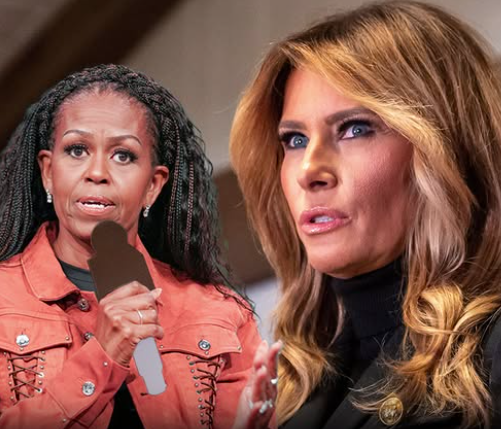
A newly released public opinion survey examining the popularity of several American First Ladies has sparked renewed discussion about how historical figures are remembered and how current public figures are evaluated. The findings compare approval ratings across a range of well-known First Ladies, placing Melania Trump alongside some of the most recognized names in modern American political history, including Michelle Obama, Jacqueline Kennedy Onassis, Jill Biden, and others.
The poll, which reportedly included responses from 2,255 adults in the United States, aimed to measure public sentiment toward former and current First Ladies. It used a structured sampling method designed to reflect a broad cross-section of the population. According to the report, participants were selected based on demographic factors such as age, gender, race, education level, and geographic distribution. The final results were also adjusted through weighting techniques to better reflect national voting patterns and political affiliation trends observed in recent elections.
In this survey, Melania Trump received a net approval rating of negative sixteen. This places her in a position that is lower than some First Ladies but not at the very bottom of the group measured. For comparison, Jill Biden was recorded at negative nine, while Hillary Clinton was listed at negative seventeen. These figures indicate that public opinion toward these figures is divided, with net negative ratings reflecting more unfavorable than favorable responses overall.
The poll also highlighted several First Ladies who received notably higher approval ratings. Among them were Nancy Reagan with a rating of plus twenty-five, Rosalynn Carter with plus thirty-two, Lady Bird Johnson with plus twenty-three, Barbara Bush with plus twenty-one, and Laura Bush with plus nineteen. Michelle Obama also appeared among the more positively viewed figures, receiving a net rating of plus twenty-one. These results suggest that certain First Ladies continue to be viewed favorably across different segments of the population, often reflecting a combination of public service initiatives, historical legacy, and personal image.
At the top of the rankings stood Jacqueline Kennedy Onassis, who received a significantly higher approval rating of plus fifty-six. This result reinforces her enduring status as one of the most admired First Ladies in American history. Her continued popularity is often attributed to her cultural influence, public image, and the historical significance of her time in the White House. Even decades after her tenure, she remains a widely recognized figure whose legacy continues to shape public perception.
The survey also pointed out that Melania Trump’s public image appears to be strongly influenced by political affiliation. According to the data, she tends to receive more favorable ratings from Republican respondents, while Democratic respondents view her less positively. This pattern is consistent with broader trends observed in evaluations of political figures connected to highly polarized administrations. The report suggests that perceptions of First Ladies in modern times are often closely tied to the political identity of their spouses, rather than being evaluated independently.
A notable aspect of Melania Trump’s public role, as described in the report, is her relatively limited public engagement compared to some of her predecessors. During and after her time in the White House, she maintained a more reserved public presence. While other First Ladies have often been associated with specific policy initiatives or highly visible public programs, Melania Trump has generally chosen a more private and less publicly active approach. This difference in visibility is noted as one of the factors that may contribute to the variation in public perception.
The poll places her ratings within a broader context of increasing political polarization in the United States. In recent years, approval ratings for public figures, especially those associated with presidential administrations, have become more divided along party lines. This trend is reflected in the results, where many figures show sharply contrasting evaluations depending on political affiliation. The report emphasizes that such divisions are not unique to Melania Trump but are instead part of a wider pattern affecting multiple public figures.
Beyond First Ladies, the survey also included an evaluation of former U.S. presidents. In this portion of the data, both Donald Trump and Joe Biden appear near the lower end of the approval spectrum. Donald Trump is listed with a net approval rating of negative twenty, while Joe Biden also ranks among the lower scores in the group of twenty presidents included in the survey. These results suggest that recent presidents tend to receive more polarized and often more critical evaluations compared to earlier historical figures.
The report further notes that approximately forty-eight percent of respondents rated Donald Trump’s presidency as “poor,” while an additional six percent described it as “below average.” These figures highlight the extent of division in public opinion, particularly regarding recent political leadership. The findings reflect a broader tendency in which contemporary political figures are often assessed through strongly divided perspectives, with fewer neutral or moderate evaluations.
Methodologically, the survey appears to have aimed for balance and representativeness. By using demographic weighting and structured sampling, the researchers intended to reflect a realistic snapshot of public opinion across different regions and population groups. However, as with all opinion-based surveys, the results are influenced by timing, current events, and the broader political climate at the moment the data was collected.
The overall results of the survey suggest a consistent pattern in how public figures are evaluated over time. Historical First Ladies, particularly those who served decades ago, often receive more favorable ratings. Their public images tend to be shaped by legacy, cultural memory, and retrospective appreciation. In contrast, more recent figures are evaluated in a more immediate and often more politically charged environment, where opinions are less stabilized and more influenced by current events.
The report also notes that popularity ratings for First Ladies cannot be separated entirely from the presidencies they are associated with. In many cases, public perception of First Ladies is influenced by broader approval or disapproval of the administration in which they served. This interconnected perception contributes to the variation in ratings observed across different individuals.
In the case of Melania Trump, her relatively lower public engagement and limited visibility in policy-driven initiatives are identified as contextual factors that may shape how she is viewed. Unlike some First Ladies who took on prominent public roles or led widely recognized initiatives, her approach has been more reserved, focusing less on public programs and more on private responsibilities within her role.
Despite these differences, the survey does not present its findings as definitive judgments. Instead, it reflects a snapshot of public opinion at a specific point in time. Public perception is not fixed, and approval ratings can change depending on future developments, historical reassessment, and shifts in cultural perspective.
The inclusion of multiple First Ladies across different political eras allows for comparison not only of individual popularity but also of how the role itself has evolved. Earlier First Ladies such as Jacqueline Kennedy Onassis and Lady Bird Johnson are often associated with historical milestones and long-term cultural influence. More recent First Ladies, including Michelle Obama and Jill Biden, are evaluated in the context of modern political expectations and media visibility.
Overall, the survey highlights how public opinion is shaped by a combination of personal image, political association, historical legacy, and media exposure. It also underscores the fact that approval ratings are not fixed measures of value, but rather reflections of how individuals are perceived within a specific social and political environment.
In conclusion, the findings offer a broad overview of how different First Ladies are viewed by the American public today. While some figures maintain consistently high favorability due to historical legacy, others are more affected by contemporary political division. Melania Trump’s position within the survey reflects this complexity, showing how modern public figures are often evaluated within a highly polarized and evolving landscape.

