
Stepmother Ends Marriage After Stepson Requests Wedding Money While Excluding Her From Family Celebration
A Difficult Beginning Inside a Blended Family
A woman’s attempt to build a relationship with her teenage stepson eventually ended in a painful family confrontation that changed the course of her marriage. What began years earlier as tension inside a blended household later evolved into a dispute involving money, loyalty, and emotional boundaries.
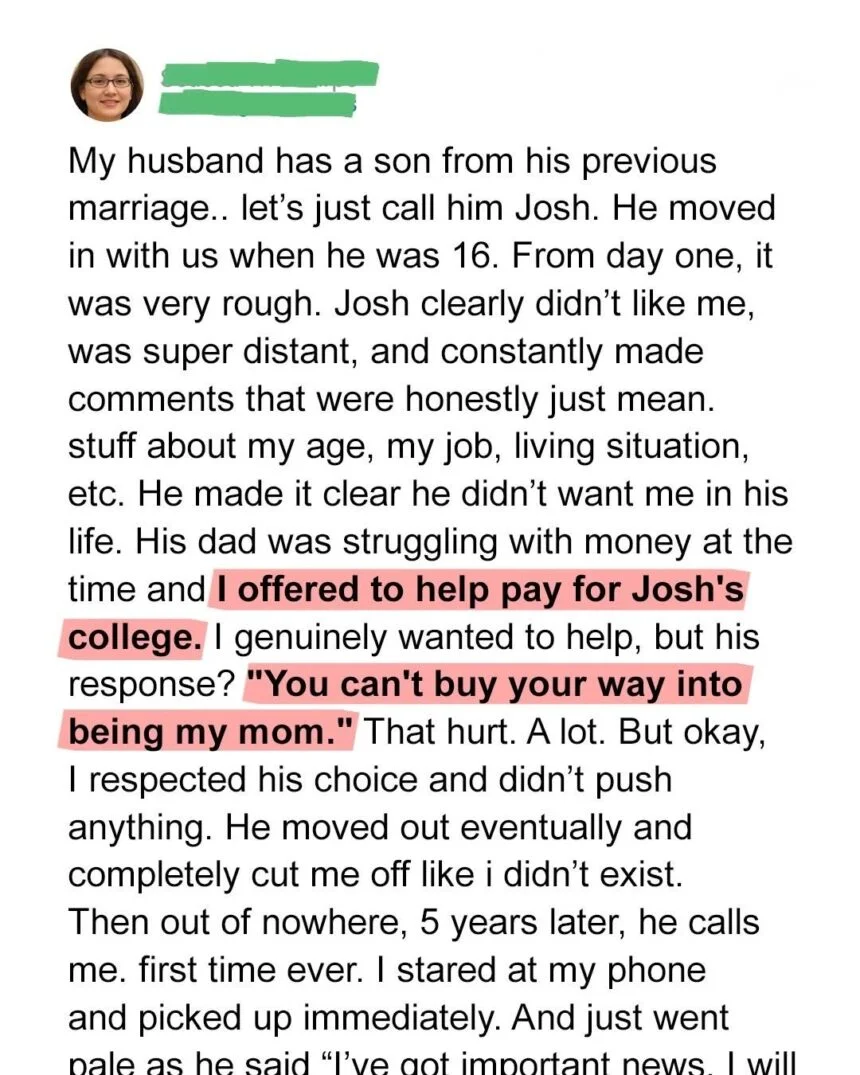
When her stepson Josh moved into the home at the age of sixteen, the relationship was strained from the beginning. Despite her efforts to create a welcoming environment, the teenager repeatedly rejected her attempts at connection.
She tried to establish normal family routines by preparing meals he enjoyed and suggesting shared activities such as movie nights. Rather than responding positively, Josh remained distant and openly hostile.
One phrase became especially common during their interactions. “You’re not my mom,” he would tell her, often with visible resentment.
The repeated rejection created an atmosphere of discomfort inside the home. Although she continued trying to improve the relationship, the emotional distance between them only appeared to grow stronger over time.
Efforts to Support His Future
As Josh approached the end of high school, conversations about college and tuition began to dominate the household. Like many families preparing for a major educational transition, financial planning became an important issue.
The woman decided to offer significant help using money she had inherited from her grandmother. She hoped the gesture might not only ease the financial burden of college but also demonstrate her commitment to supporting Josh’s future.
Her proposal involved paying his tuition costs, an offer that represented both emotional goodwill and substantial financial assistance.
Instead of appreciation, however, the response was harsh.
“You can’t buy your way into being my mom.”
The comment deeply affected her. Rather than seeing the offer as support, Josh interpreted it as an attempt to replace his biological mother or force emotional closeness.
The situation became even more painful when her husband David sided with his son during the disagreement.
That moment marked a turning point in the household dynamic. She realized her efforts to gain acceptance were not only unwanted but viewed negatively by both father and son.
After the argument, she stopped trying to force a relationship that clearly lacked mutual respect. Although the family continued living their lives, the emotional separation remained unresolved.
Years of Silence and Emotional Distance
Five years passed after the college dispute, and little changed between the woman and her stepson. Communication remained minimal, and the emotional distance established during Josh’s teenage years continued into adulthood.
During that period, she focused largely on maintaining peace rather than rebuilding a connection that repeatedly led to conflict.
The earlier rejection had left lasting emotional consequences. While outward arguments became less common, unresolved resentment continued beneath the surface.
The relationship eventually settled into a pattern of limited interaction and quiet tension.
Then, unexpectedly, Josh contacted her directly.
An Unexpected Wedding Request
The phone call came without warning. Josh announced that he was engaged and planning a destination wedding in Costa Rica with his fiancée, Kelsey.
The news itself was surprising, given the years of emotional distance between them. However, the purpose of the call soon became clear.
Josh explained that he and Kelsey hoped family members would contribute financially to help cover wedding expenses.
Destination weddings often involve substantial costs, including travel arrangements, accommodations, venues, and event planning. Financial support from relatives is sometimes requested in such situations.
However, the conversation quickly revealed a painful contradiction.
When she asked whether she would be attending the wedding herself, Josh explained that the event would include “only close family.”
Despite excluding her from the guest list, he still expected her financial contribution.
The request immediately reopened old emotional wounds connected to years of rejection and dismissal.
She declined the request.
The conversation ended abruptly after Josh hung up the phone.
Tension Inside the Marriage
Following the call, conflict quickly developed between the woman and her husband. David reacted angrily to her refusal to contribute money toward the wedding.
Rather than acknowledging her hurt over being excluded, he viewed the situation as a missed opportunity to repair family relationships.
“This was your chance to fix things!” he told her during the argument.
The statement intensified the emotional divide between them. From her perspective, years of rejection had never been addressed fairly, and she felt she was once again being expected to give emotionally and financially without receiving respect in return.
David’s frustration escalated further during the disagreement.
“Maybe I should reconsider our marriage.”
The comment transformed the dispute from a disagreement about money into a deeper examination of the marriage itself.
At that point, the woman began reevaluating not only her relationship with Josh but also the foundation of her partnership with David.
A Carefully Planned Dinner
Rather than continuing the argument immediately, she decided to invite Josh, Kelsey, and David to dinner.
The gathering appeared ordinary on the surface, though tension remained present throughout the evening. Conversation moved awkwardly between small talk and strained politeness.
No one fully addressed the unresolved conflict surrounding the wedding request.
After the meal concluded, she presented Josh with a folder containing what appeared to be a generous financial gift.
Inside the folder was a large check intended for the wedding expenses. Alongside the check, however, was a written contract.
The agreement outlined several conditions connected to the money.
“You’ll call me Mom.
Include me in holidays. Treat me with respect,” she said.
The conditions reflected years of emotional rejection and highlighted the absence of basic acknowledgment inside the family dynamic.
Josh focused immediately on the financial amount attached to the offer.
Without hesitation, he signed the agreement.
A Dramatic Final Decision
What happened next changed the direction of the entire evening.
After Josh signed the contract, the woman took both the check and the agreement and threw them into the fireplace.
The action stunned everyone present at the table.
The dramatic gesture revealed that the offer had never truly been about the money itself. Instead, it exposed what she believed had become a transactional relationship built entirely around financial benefit rather than genuine emotional connection.
Josh’s willingness to sign the contract for money confirmed her belief that respect and affection were being treated as negotiable only when financial rewards were involved.
Then the evening took another unexpected turn.
From beneath a key bowl in the home, she removed a second set of documents.
These papers were divorce filings.
She placed them in front of David.
“I’ve also reconsidered,” she said.
The Emotional Meaning Behind the Decision
The confrontation was not simply about wedding expenses or family etiquette. It represented years of emotional imbalance within the household.
Throughout the relationship, she had repeatedly attempted to offer support, care, and financial assistance while receiving rejection in return.
The earlier college tuition incident demonstrated that her gestures were often interpreted negatively regardless of intention.
At the same time, the wedding request highlighted what she saw as a double standard. She was not considered “close family” when invitations were discussed, yet she was still expected to contribute financially as though she carried full family responsibility.
The dinner table confrontation forced everyone involved to confront the uncomfortable reality underlying the relationship.
Her decision to destroy the check before handing over the divorce papers symbolized a final rejection of the role she believed she had been assigned within the family: someone valued primarily for what she could provide financially rather than emotionally.
A Reflection on Boundaries and Respect
Blended family relationships can involve complex emotional challenges, particularly when loyalty, grief, identity, and parental roles intersect.
Teenagers entering new family structures often struggle with feelings of resentment, confusion, or emotional displacement. In some cases, stepparents spend years attempting to build trust while navigating resistance and conflict.
However, healthy family relationships typically require mutual respect from all sides.
In this situation, the years of unresolved tension eventually reached a breaking point because deeper emotional wounds were never properly addressed.
The wedding dispute exposed frustrations that had accumulated over many years.
For the woman involved, the issue was no longer about receiving acceptance as a mother figure. Instead, it became about recognizing her own emotional limits and deciding what kind of treatment she was willing to continue accepting.
The Lasting Message Behind the Story
The final moments of the confrontation carried a message that extended far beyond financial disagreement.
“Some things can’t be bought. But sometimes, the price reveals the truth.”
The statement reflected the realization that money cannot create genuine emotional connection, loyalty, or respect where those qualities do not already exist.
At the same time, the willingness of others to exchange affection or acknowledgment for financial gain can reveal uncomfortable truths about the nature of personal relationships.
By ending both the financial offer and the marriage simultaneously, the woman made clear that she no longer wished to remain in relationships where her value appeared tied primarily to her ability to provide material support.
The evening that began as a family dinner ultimately became the closing chapter of years of emotional conflict, disappointment, and unspoken resentment.
In the end, the confrontation was less about revenge than clarity. After years of trying to earn acceptance, she finally chose to stop negotiating for basic respect.

