
I never imagined that a single evening could change the entire course of my life. What began as an ordinary argument inside our home quickly turned into something far more painful and defining than I could have expected. That night, standing outside in the cold rain, I realized how fragile security can be when it depends on someone else’s choices.
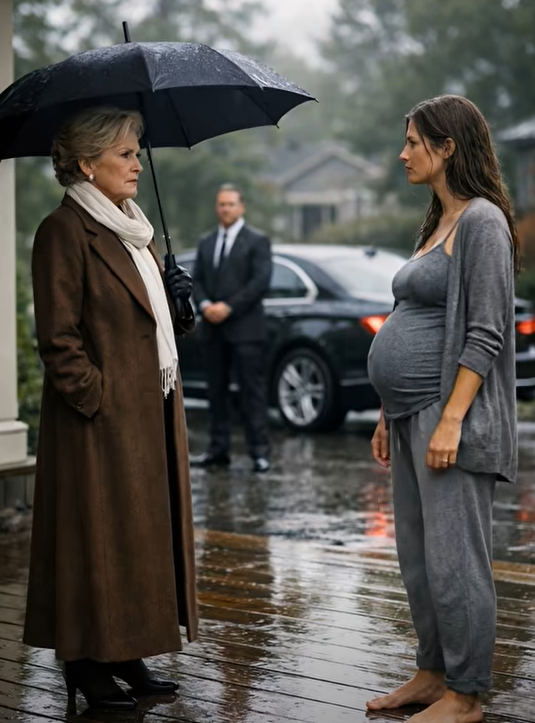
The rain was relentless, pouring down in heavy sheets that soaked everything within minutes. The wooden porch beneath my feet had become slick and unsteady, water streaming down each step and pooling at the edges. I stood there barefoot, my hands instinctively resting on my pregnant belly, trying to shield it from the cold as best as I could. My clothes, thin and not meant for the outdoors, clung tightly to my skin, offering no protection from the chill.
Behind me was the closed front door. Just minutes earlier, my husband had shut it firmly, ending our argument not with resolution, but with dismissal. His final words echoed in my mind, calm yet cutting, as though what he had done was justified. When I first knocked, I hoped he would open it again, that he would realize the seriousness of what he had done. But there was no response. I knocked harder, calling out, but the silence on the other side remained unchanged.
Inside, the house was warm, filled with light and familiarity. Outside, there was only darkness, wind, and the growing feeling of isolation. I realized quickly that I had nothing with me. My phone was inside, along with my shoes and everything I might have needed. I felt exposed, vulnerable, and unsure of what to do next. The idea of going to a neighbor’s house crossed my mind, but I hesitated. I was soaked, shaken, and overwhelmed, and the thought of explaining my situation felt impossible in that moment.
Eventually, I lowered myself onto the porch, trying to conserve what little warmth I had left. My body trembled, whether from the cold or the emotional weight of the situation, I could not tell. Tears came freely, blending with the rain until I could no longer distinguish one from the other. Time seemed to stretch, each minute feeling longer than the last.
Then, through the darkness, I noticed headlights approaching. A car slowly came into view, its presence unexpected in our quiet street. It was not a vehicle I recognized, and its appearance felt almost surreal against the backdrop of the storm. It pulled up in front of the house, and for a moment, I simply stared, unsure of what would happen next.
The door opened, and a familiar figure stepped out. It was my grandmother. Even in the rain, she carried herself with the same calm composure she had always shown. Her posture was straight, her expression focused, and there was a quiet authority in the way she moved. She approached me without hesitation, opening an umbrella and holding it over both of us, shielding me from the rain.
When she said my name, her voice was gentle but filled with understanding. She took in the entire scene at once—my bare feet, my soaked clothes, my condition—and I could see the shift in her expression. She then looked toward the house, her gaze steady and thoughtful.
Without raising her voice or showing outward anger, she turned slightly and spoke to the driver who had accompanied her. Her tone was calm, measured, and direct. She gave a brief instruction, one that the driver acknowledged without question. There was no need for further explanation.
Then she turned back to me and extended her hand. Her words were simple, but they carried reassurance and strength. In that moment, I felt something I had been missing since the door had closed behind me—a sense of support, of not being alone. I took her hand and stood up, leaving the porch behind.
We left quietly, without confrontation, without further words spoken toward the house. But even then, I understood that the situation was far from over. My grandmother was not someone who reacted impulsively. She believed in measured actions, in addressing problems with precision rather than emotion. Whatever would come next, I knew it would be deliberate.
The following day unfolded in a way that was unexpected, yet carried a sense of inevitability. Developments began to occur around the property, involving matters that had clearly been in motion long before that night. Financial and legal arrangements tied to the house came into focus, revealing complications that had not been apparent before.
What became clear was that the house, which had seemed secure, was actually connected to unresolved financial obligations. Those obligations had been transferred and reorganized through proper legal channels, leaving little room for reversal. The process was carried out within the boundaries of the law, with documentation and procedures that were final and binding.
As these changes took effect, it became evident that my husband was facing consequences that extended beyond a single decision made in anger. The situation was not chaotic or dramatic in the way one might expect. Instead, it unfolded with quiet efficiency, each step following established rules and processes.
From a distance, I observed these developments alongside my grandmother. She remained composed, offering no unnecessary commentary. Her actions were not driven by revenge, but by a firm belief in accountability and fairness. To her, what mattered was ensuring that I was safe, supported, and no longer in a position of vulnerability.
In the days that followed, further changes occurred. Professional relationships shifted, and opportunities that had once been available were no longer within reach. These outcomes were not the result of impulsive decisions, but rather the natural consequences of circumstances that had been set into motion.
For me, the experience became a turning point. What began as a moment of rejection and isolation transformed into an opportunity to rebuild my life with a stronger foundation. I came to understand the importance of independence, of having support systems, and of recognizing when a situation is no longer healthy or sustainable.
My grandmother never spoke at length about what she had done. She did not seek recognition or acknowledgment. Instead, she focused on helping me move forward, ensuring that I had what I needed to create a stable and secure future.
Looking back, that night in the rain remains vivid in my memory. It was painful, uncertain, and deeply emotional. But it also marked the beginning of a new chapter, one defined not by fear or dependence, but by resilience and clarity.
What I learned from that experience is that moments of hardship can reveal both the challenges we face and the strength we carry within us. With the right support and a willingness to move forward, even the most difficult situations can lead to meaningful change.

