
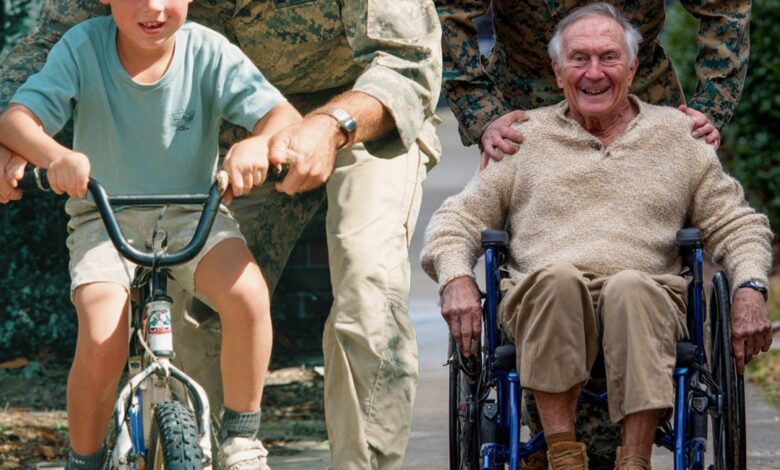
Before his father underwent a high-risk surgical procedure, Owen received something unexpected: a small, worn key accompanied by a quiet but serious instruction. If anything went wrong, he was told to return home and search for a hidden door in the basement. At the time, the request felt unusual and unexplained. However, what Owen eventually discovered would reshape his understanding of his family and reveal a deeply hidden past.
Owen, 27, had always seen his father as a steady and dependable figure. From childhood through adulthood, his father represented strength, discipline, and quiet resilience. He was not overly expressive, but his actions consistently demonstrated care and reliability. After Owen’s mother passed away during his early years, the bond between father and son grew even stronger. Their relationship was built not on frequent emotional conversations, but on shared routines—long drives, meals together, and working side by side on everyday tasks.
As Owen grew older, he found himself modeling his behavior after his father. He adopted his habits, his calm demeanor, and even followed a similar life path by joining the military. His father had once advised him to become his own person, but Owen still viewed him as the standard by which he measured himself.
Over time, however, his father’s health began to decline. What started as occasional issues gradually developed into more serious medical concerns. Doctor visits became more frequent, medications accumulated, and physical strength slowly diminished. Despite these changes, his father rarely complained. When asked how he felt, he would respond simply, “Still here,” maintaining the same composed attitude he had always shown.
Owen adjusted his life to support him. He attended medical appointments, helped manage daily responsibilities, and remained present throughout the progression of his illness. Their shared goal became a specific surgery that doctors believed could significantly improve his father’s condition. They saved money, made sacrifices, and placed their hopes in that single procedure.
As the surgery date approached, Owen noticed subtle changes in his father’s behavior. He appeared more reflective, spending time looking at old photographs and pausing longer than usual during conversations. Though he remained outwardly calm, there was a sense that something weighed on him.
The night before the surgery, while sitting together in the hospital room, his father handed him the key. It was clearly old, with visible signs of wear. He hesitated before speaking, then told Owen that if something happened during the operation, he should go home and find a door hidden behind an old cabinet in the basement.
When Owen asked for clarification, his father did not provide further explanation. Instead, he simply said, “You’ll understand,” and shifted his attention away, ending the conversation.
The following morning, his father was taken into surgery. The procedure was expected to last many hours, and the uncertainty of the outcome created a tense and difficult atmosphere. Owen initially remained at the hospital, but the waiting became overwhelming. Remembering the key and the instructions, he decided to return home.
The house felt unusually quiet when he arrived. Moving through familiar spaces with a sense of urgency, he went directly to the basement. The cabinet his father had mentioned was heavy and rarely moved, but he managed to shift it aside.
Behind it, he found a door.
The discovery immediately raised questions. He had lived in the house for years and had never known the door existed. With a mixture of hesitation and determination, he inserted the key into the lock and turned it.
The door opened into a small, enclosed space.
Inside, the walls were covered with photographs. Nearly all of them featured the same person: a girl at different stages of her life. In some images, she appeared very young, smiling while sitting on his father’s shoulders. In others, she looked older, standing beside him in various settings.
There were also personal items arranged carefully throughout the room—drawings, greeting cards, small keepsakes, and a pair of children’s shoes. Everything suggested that the space had been preserved over many years.
At the center of the room was a framed photograph of the girl as a teenager. On the back of the frame, written in his father’s handwriting, were the words: “My Lily, always.”
The realization was immediate and difficult to process. Owen had a sister he had never known about.
As he tried to make sense of the discovery, he noticed a folded letter placed on a nearby desk. It was addressed to him.
In the letter, his father explained that Lily was indeed his daughter and Owen’s older sister. He admitted that her absence from their lives was the result of decisions made years earlier, influenced by family pressure and circumstances he had not fully challenged at the time.
He expressed regret for keeping the truth hidden and acknowledged that the choice had caused lasting consequences. He wrote that he had never stopped thinking about Lily and had preserved her memory in the room Owen had just discovered.
The letter also included an address, along with a request: if he did not survive the surgery, Owen should find Lily and try to reconnect, even if forgiveness would be difficult.
After reading the letter, Owen experienced a mix of emotions—confusion, sadness, and a strong sense of urgency. Without delaying further, he decided to go to the address provided.
The drive gave him time to reflect, but it did not lessen the intensity of what he had learned. When he arrived, the house appeared modest and quiet. After a brief moment of hesitation, he approached the door and knocked.
A woman answered. Based on her age and appearance, he immediately recognized that she could be Lily.
He introduced himself and explained the situation, including his father’s condition and the letter he had found. At first, she reacted with disbelief. The information was unexpected, and the connection between them required time to process.
As the conversation continued, the initial shock gave way to emotion. She asked whether their father had remembered her, and Owen explained that he had kept an entire room dedicated to her memory.
The realization affected her deeply. She had believed she had been forgotten, but now understood that her absence had been more complicated than she had known.
The moment marked the beginning of a connection that had been missing for years.
Shortly after, Owen received a call from the hospital informing him that his father had survived the surgery and was awake. He shared the news with Lily, and they agreed to go to the hospital together.
When they entered the room, the reunion was quiet but significant. His father, still recovering, recognized Lily immediately. The emotional weight of the moment was clear, but there was also a sense of relief that the opportunity to reconnect had not been lost.
In the months that followed, the three of them began rebuilding their relationship. The process required time, patience, and understanding, but it created a foundation for something that had previously been missing.
They started spending time together regularly, gradually forming a bond that reflected both the past and the present. While the years apart could not be undone, the effort to move forward provided a sense of closure and connection.
The experience ultimately highlighted how unresolved family history can shape lives in ways that are not always visible. It also showed that even after long periods of separation, it is possible to rebuild relationships through honesty and willingness to engage with the past.
For Owen, the key his father had given him unlocked more than just a hidden room. It revealed a part of his family he had never known, and in doing so, changed his understanding of identity, connection, and the importance of truth.

