
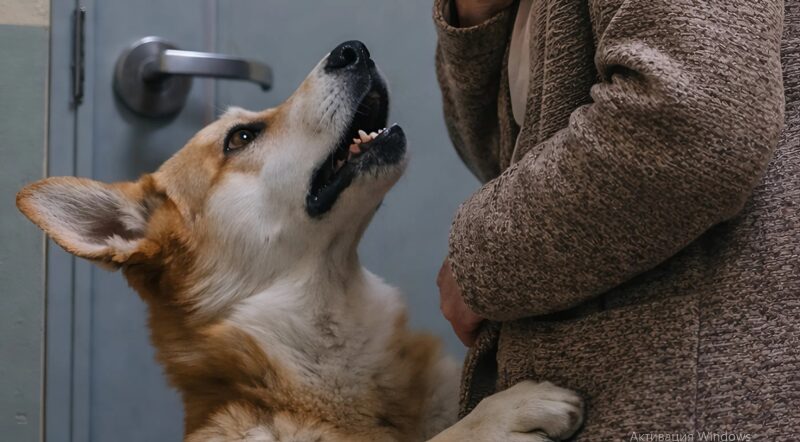
A Dog’s Instinct Helps Prevent a Potentially Dangerous Situation at Home
What began as an ordinary evening quickly turned into a situation that underscored the importance of awareness, instinct, and the unique bond between humans and animals. A routine walk, familiar surroundings, and a quiet return home gave no indication that anything unusual was about to occur. Yet within moments, subtle changes would reveal that something was not right.
The evening started calmly. After completing a typical walk, the dog and its owner made their way back home along a familiar path. The environment felt safe and predictable, with no visible disturbances or unusual activity. The dog’s behavior was relaxed and consistent with what might be expected after physical exercise—calm, steady, and content..
As they reached the apartment door, everything still appeared normal. The owner paused briefly to retrieve keys, a simple action repeated countless times before. There was no reason to suspect that anything out of the ordinary was about to happen.
However, at that exact moment, the dog’s behavior changed.
Without warning, the dog became alert and tense. His body stiffened, his ears stood upright, and his attention fixed directly on the door. A low growl followed—something unfamiliar and distinctly different from his usual demeanor. The shift was immediate and noticeable.
Only seconds earlier, he had been calm. Now, he appeared focused and uneasy, reacting to something that was not immediately visible or audible to the human senses. At first, the behavior seemed confusing rather than alarming. It was reasonable to assume he might have heard a distant sound or detected movement in the hallway..
Attempts were made to calm him. Gentle reassurance and verbal cues were given, but they had no effect. The dog remained focused, his attention unwavering and his posture tense.
As the owner moved to unlock the door, the dog’s reaction intensified. He began to physically intervene, stepping in front of the door and blocking access. His actions became more deliberate and urgent. He pressed against his owner’s legs, whining and showing visible distress.
This was not typical behavior. It was not playful or distracted. It was persistent and purposeful.
Despite the unusual nature of the reaction, it was still difficult to interpret. After a long day, the situation felt more frustrating than concerning. Eventually, the dog was gently moved aside, and the key was inserted into the lock!
As the door began to open, the dog’s behavior escalated further. His bark became louder and sharper, carrying a tone of urgency that was difficult to ignore. Even so, the door was opened, and the owner stepped inside.
At first, nothing seemed out of place. The apartment was quiet and dimly lit, appearing much as it had been left. However, within moments, a sense of unease began to develop.
There was an unfamiliar scent in the air—subtle, but clearly different from the usual environment. It was enough to raise concern. As attention shifted to the surroundings, small irregularities became noticeable.
A drawer that had been closed earlier was now slightly open. This detail, though minor on its own, signaled that something was not as it should be. Soon after, a faint sound could be heard deeper inside the apartment.
The quiet atmosphere now felt heavy rather than calm.
Looking further, a door to another room appeared partially open. The possibility that someone else might be inside became increasingly difficult to ignore. The situation had shifted from uncertainty to clear concern.
Before any further decision could be made, the dog broke free and rushed forward. His leash slipped away as he moved quickly into the apartment, barking loudly and assertively.
Within seconds, movement was heard inside. A sudden noise followed—footsteps, a thud, and the unmistakable sound of someone reacting in alarm. The presence of an intruder became evident.
The response was immediate. The owner quickly retreated from the apartment and pulled the door shut, prioritizing safety. Outside, the realization of what had just occurred began to settle in.
Inside, the dog remained active, positioning himself between the intruder and the exit. His earlier behavior now made complete sense. What had seemed confusing moments before was clearly an attempt to prevent entry into a dangerous situation.
The dog had detected something unusual long before the door was opened. Whether it was a scent, a faint sound, or another environmental cue, he had recognized the presence of danger.
His efforts to block the door, to push his owner away, and to signal distress were all attempts to communicate that something was wrong. Even when those signals were not immediately understood, he continued to act.
His persistence proved critical.
Outside the apartment, calls for help were made. Neighbors, alerted by the noise, began to respond. Some stepped into the hallway to assist, while others contacted local authorities.
The situation quickly shifted from isolated concern to a coordinated response. Within a short time, authorities arrived and entered the apartment.
The intruder was located inside and taken into custody. It was later understood that the individual had likely entered earlier, expecting the apartment to remain empty. The plan appeared to involve a quiet entry and exit without detection.
That plan was disrupted entirely by the presence of the dog.
In the aftermath, the sequence of events became clearer. The dog’s behavior at the door was no longer puzzling—it was protective. He had identified a risk and acted to prevent exposure to it.
His instincts had provided a warning before any visible signs were apparent. His actions created time—time to recognize the situation, to retreat, and to seek help.
The experience highlighted the remarkable awareness that animals can possess. Dogs, in particular, are known for their sensitivity to environmental changes. They can detect sounds, scents, and subtle cues that may go unnoticed by humans.
In this case, that sensitivity made a meaningful difference.
It also reinforced the importance of paying attention to unusual behavior. While it may not always be immediately understood, such behavior can carry important signals. Recognizing and responding to those signals can have significant outcomes.
The bond between the dog and its owner was also strengthened through the experience. Trust, already present, was reinforced by a clear demonstration of loyalty and protection.
What began as a routine evening became a powerful reminder of the role animals can play in everyday safety. The situation could have developed very differently, but the dog’s actions helped prevent a direct and potentially dangerous encounter.
Looking back, the events serve as an example of how quickly circumstances can change and how important awareness can be in those moments. They also highlight the value of instinct—especially when it comes from a companion who is deeply attuned to their surroundings.
Ultimately, the outcome was shaped by a combination of quick reaction, community support, and the dog’s refusal to ignore what he sensed. His actions were not random—they were purposeful and protective.
In situations where every second matters, those instincts can make all the difference.
The experience remains a lasting reminder that sometimes the most important warnings do not come in words. Instead, they come through behavior, attention, and instinct—signals that, when recognized, can help prevent harm and ensure safety.

