
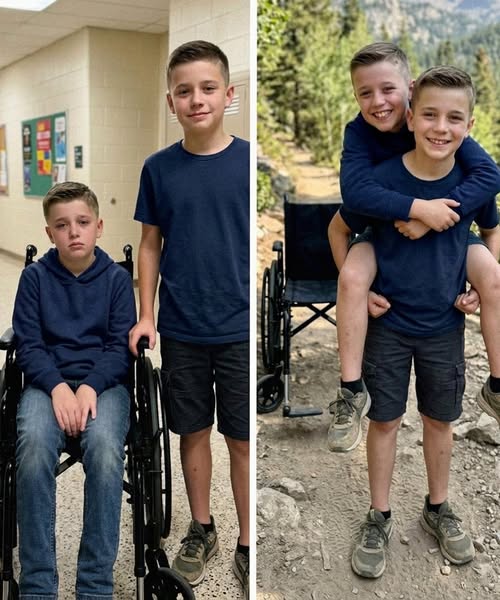
Student’s Determination to Include a Friend Inspires Recognition and Reflection
A routine school trip can sometimes reveal unexpected lessons that extend far beyond the classroom. What began as a standard hiking excursion for a group of students turned into a widely shared story about empathy, determination, and inclusion. While the details of this account have circulated in various forms online, it is important to approach it as an inspirational narrative rather than a fully verified event.
The story centers on a middle school student preparing for a class hiking trip. Like many school outings, the activity was designed to encourage teamwork, physical activity, and engagement with the outdoors. Parents signed permission slips, teachers organized logistics, and students looked forward to a day away from their usual routine.
In the days leading up to the trip, a conversation at home revealed a concern. The student mentioned that a close friend would not be participating in the hike. According to the account, the reason was related to mobility limitations, as the trail was considered too difficult for someone who used a wheelchair.
This situation, while not uncommon in outdoor activities with physical challenges, raised questions about inclusion. The friend was expected to remain at the campsite rather than join the full experience. Although the plan followed standard safety considerations, it left an emotional impact.
On the day of the trip, everything appeared to proceed as expected. Students boarded buses, teachers supervised the group, and the hike began without incident. However, during the activity, the student reportedly made a decision that would later become the focus of the story.
Rather than accept that his friend could not participate, he chose to include him in a direct and physically demanding way. According to the narrative, he carried his friend along the trail, allowing him to experience the hike despite the challenges.
This action required significant effort and persistence. The terrain was described as uneven and physically demanding, making the task even more difficult. Witnesses in the story noted that the student continued despite fatigue, encouraging his friend throughout the journey.
When the group returned, the student’s condition drew attention. He appeared exhausted, reflecting the physical strain of the effort. At first, it seemed like a typical result of a long hike, but the details of what had occurred soon became known.
The response from adults, as described in the story, was mixed. On one hand, there was concern about safety and adherence to established guidelines. School trips typically follow strict protocols to ensure student well-being, and any deviation can raise legitimate questions.
On the other hand, the effort demonstrated by the student was difficult to overlook. The act reflected a strong sense of responsibility and commitment to a friend, qualities that resonated with those who learned about the situation.
The following day, the story takes an unexpected turn. The student was reportedly called to the school office, creating a sense of concern that he might face disciplinary action. However, the meeting was described as something entirely different.
According to the account, individuals had gathered to recognize his actions. The focus shifted from rule-breaking to the values demonstrated—empathy, determination, and inclusion.
The story further describes an emotional moment involving the friend’s parent, who expressed appreciation for what the experience meant. The opportunity to participate fully in the activity was presented as meaningful, highlighting the importance of inclusion in everyday situations.
In many versions of the narrative, the recognition includes a formal acknowledgment, and in some retellings, even a scholarship or award is mentioned. However, these elements vary significantly across sources and are not supported by confirmed reporting.
Because of these inconsistencies, it is important to clarify that the story should be viewed as inspirational rather than factual in every detail. There is no widely documented evidence confirming the full sequence of events as described.
Despite this, the themes presented in the story remain relevant. It highlights the importance of inclusion, especially in environments where physical or logistical limitations can affect participation. It also illustrates how individual actions can influence the experiences of others in meaningful ways.
The narrative also raises broader questions about how institutions balance safety with inclusivity. While guidelines are essential, situations like this encourage discussion about how to create opportunities for all participants.
From another perspective, the story emphasizes the role of personal choice. The student’s decision was not described as planned or intended for recognition. Instead, it was presented as a response to a situation that felt unfair or incomplete.
This aspect of the story contributes to its appeal. Audiences are often drawn to examples of spontaneous kindness, particularly when they involve effort and sacrifice without expectation of reward.
It also reflects a broader pattern in storytelling, where individual acts of empathy are used to illustrate larger values. These narratives are often shared widely because they provide a sense of hope and highlight positive human behavior.
However, maintaining a clear distinction between verified events and inspirational storytelling is important. Doing so ensures that information remains accurate and trustworthy, especially when shared in informational or journalistic contexts.
In conclusion, the story of a student carrying a friend during a school hike serves as a powerful example of empathy and determination. While not fully verified, it captures themes that resonate widely—friendship, inclusion, and the impact of personal choices.
Whether viewed as a real event or a symbolic narrative, its message remains consistent: meaningful actions often arise from a willingness to support others, even when it requires effort and persistence.
These stories, when approached responsibly, can encourage reflection and inspire positive behavior, reminding readers of the value of compassion in everyday life.

