
A Quiet Act of Compassion Near Santa Monica Beach Leaves a Meaningful Impression
Acts of kindness often occur in the most ordinary settings, away from attention and without expectation. These moments may not be planned or widely publicized, yet they can leave a lasting impression because of their sincerity and immediacy. One such moment recently unfolded near Santa Monica Beach, where a simple decision to pause led to a meaningful human interaction.
The encounter involved Jennifer Garner, who is widely recognized not only for her work in film and television but also for her consistent involvement in charitable and community-focused efforts. While going about what appeared to be a routine day, she came across a man in a wheelchair who appeared to be experiencing homelessness.
Situations like this are not uncommon in urban areas, and many people pass by without engaging, often due to uncertainty about how to respond. In this case, however, Garner chose to stop. That decision, though simple, set the tone for everything that followed.
From inside her vehicle, she rolled down the window and began speaking with the man. Rather than treating him as a distant figure, she engaged him directly, acknowledging him as an individual. This initial exchange, while brief, established a sense of respect and connection that shaped the rest of the interaction.
Moments of acknowledgment like this can carry significant weight. In many cases, individuals facing difficult circumstances may feel overlooked or ignored. Taking the time to engage in conversation can help restore a sense of dignity and recognition.
Garner’s approach to the situation reflected a broader pattern that has been noted throughout her public life. Over the years, she has been involved in various initiatives supporting children, families, and underserved communities. Her work has often emphasized consistent effort rather than visibility, focusing on practical support and long-term impact.
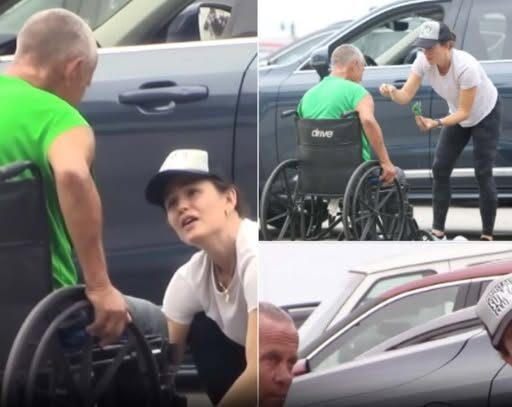
After speaking with the man, she offered him a bag containing essential items. The gesture was practical and immediate, addressing some of his needs in a straightforward way. However, as the interaction continued, she noticed an additional concern—the man did not have shoes.
Recognizing this, she stepped out of her car and approached him more closely. This shift transformed the interaction from a simple exchange into a more personal act of assistance. She crouched down beside him and began placing socks on his feet.
This action, though small in scale, carried a deeper significance. It demonstrated a willingness to engage directly and without distance, focusing entirely on the individual in front of her. Such gestures can reinforce dignity by showing care not only in what is given, but in how it is given.
Public acts of generosity often involve a level of separation between the person offering help and the person receiving it. In this case, there was no such distance. The interaction was immediate, personal, and centered on addressing a specific need.
After providing socks, Garner recognized that the absence of shoes remained an issue. Without hesitation, she removed her own shoes and offered them. The gesture reflected a spontaneous willingness to give what she had available at that moment.
However, it became clear that her shoes were not the right size. Rather than ending the effort there, she continued to look for a solution. This persistence highlighted an important aspect of the interaction—the focus remained on resolving the need rather than simply making a gesture.
At this point, another individual nearby became involved. A photographer who was present in the area for unrelated reasons was approached. Garner asked about his shoe size, considering whether his footwear might be a better fit.
When it appeared that his shoes could help, she offered to purchase them from him. The request was direct and practical, aimed solely at addressing the situation at hand. In response, the photographer chose not to accept payment and instead offered the shoes freely.
This response added another dimension to the moment. What began as one person’s decision to help became a shared act of generosity. It demonstrated how acts of kindness can influence others, creating a chain reaction that extends beyond the initial interaction.
The entire situation unfolded without preparation or structure. There was no formal setting, no organized event, and no expectation of attention. Each step was shaped by the circumstances and the choices made in real time.
This unscripted nature is part of what made the moment meaningful. It reflected a form of compassion that arises naturally, guided by awareness and a willingness to act. Such moments often resonate because they feel genuine and immediate.
Garner has previously spoken about her perspective on social challenges, including poverty and access to resources. Her views often emphasize the importance of proximity—of being close enough to understand the realities faced by others. This perspective can influence how individuals respond when they encounter such situations directly.
In this case, her response suggested an awareness of both the practical and human aspects of the situation. The actions taken addressed immediate needs while also acknowledging the individual’s dignity.
The encounter also serves as a reminder of how easily people can become overlooked in busy environments. Daily routines and distractions can create distance, making it difficult to fully recognize the experiences of others. Taking a moment to pause and engage can help bridge that gap.
Small actions, when carried out with intention, can have a meaningful impact. Providing socks, offering shoes, and taking time to speak with someone are not large-scale efforts, but they address immediate concerns and reinforce a sense of care.
Stories like this often resonate because they highlight genuine human connection. They show that meaningful interactions do not require complex plans or significant resources. Instead, they rely on awareness, empathy, and a willingness to respond.
The interaction near Santa Monica Beach reflects these qualities. It demonstrates how a simple decision—to stop, to notice, and to act—can create a moment that extends beyond its immediate setting.
At its core, the experience was about presence. It was about choosing to remain engaged rather than turning away. It showed that compassion can take many forms, often expressed through small, direct actions.
Encounters like this do not always receive widespread attention, yet they can leave a lasting impression. They remind others of the value of empathy and the impact of thoughtful action.
They also illustrate how one act of kindness can encourage others to contribute, creating a broader effect. In this instance, the involvement of a second individual added to the outcome, reinforcing the idea that compassion can be shared.
Ultimately, the significance of the moment lies not in recognition, but in the example it provides. It shows that meaningful change often begins with something simple—paying attention and choosing to respond.
In a setting as ordinary as a parking area, a brief interaction became a reminder of what is possible when individuals act with care and awareness. It highlights the importance of seeing others, acknowledging their needs, and taking steps, however small, to make a difference.
While the actions themselves may have been modest, their impact was real. They addressed immediate needs, reinforced dignity, and demonstrated how compassion can unfold in everyday life.
Moments like this encourage reflection on how people engage with the world around them. They suggest that even in routine situations, there are opportunities to act with empathy.
In the end, the message is straightforward. Compassion does not require planning or recognition. It begins with awareness, continues through action, and often inspires others in the process.
This quiet moment near Santa Monica Beach serves as a lasting example of that principle in practice.

