
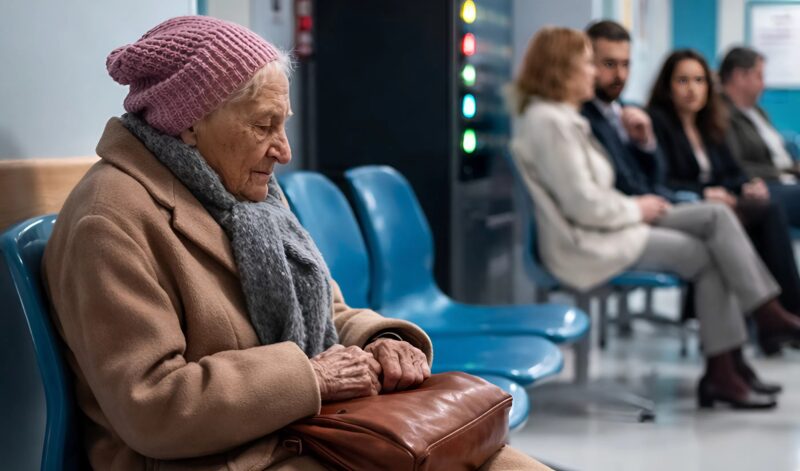
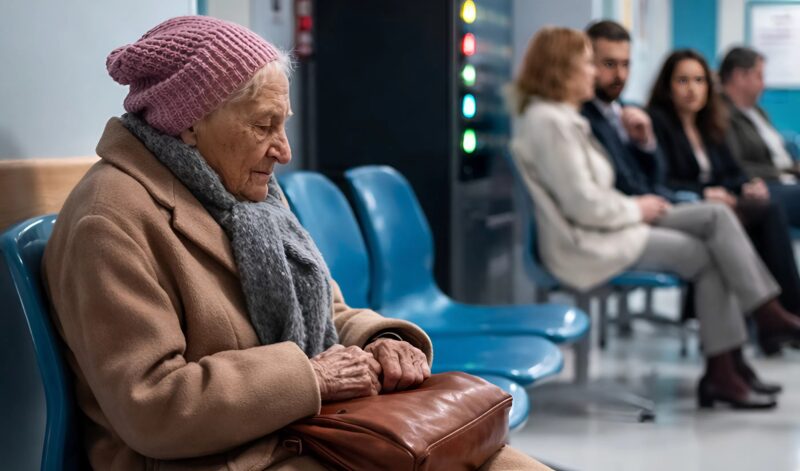
In a crowded hospital waiting room, a quiet scene unfolded that at first appeared unremarkable. Patients and visitors sat in rows of plastic chairs, each absorbed in their own concerns—some scrolling through their phones, others staring at the clock on the wall, waiting for names to be called. The air carried the usual mixture of antiseptic cleanliness and quiet anxiety that defines such places.
In one corner of the room, an elderly woman sat alone on a hard bench. She held an old brown bag tightly in her lap, gripping it with both hands as if it contained something deeply important. Her clothing was modest and worn: a thin coat that offered little protection against the weather, a faded scarf wrapped loosely around her neck, and shoes that showed clear signs of long, difficult years. She rarely looked up. When she did, her eyes moved cautiously across the room before returning to her bag, as though she were silently confirming that everything she needed was still there.
The waiting room was full, yet her presence seemed to draw attention in a way she did not invite. A few patients began to notice her, and soon quiet comments started to spread among those seated nearby.
One woman, dressed in an expensive coat, leaned toward her husband and spoke in a lowered voice. She suggested that perhaps the elderly woman had gotten lost and ended up in the wrong department. Her husband responded with a faint, dismissive smile, suggesting instead that she might simply be using the hospital as a place to sit and stay warm.
A little further away, a man in a business suit glanced over and frowned. In a tone just loud enough to be overheard, he remarked on her appearance, implying that someone should have already questioned why she was there. Another woman added to the conversation with a careless comment, suggesting that older people sometimes entered places like this without real purpose, simply because they had nowhere else to go.
None of these remarks were said directly to the woman, but they were not entirely hidden either. Words carried through the quiet room, and although she did not respond, she clearly heard them. Her hands tightened around her bag, and her posture became even more withdrawn. She lowered her gaze, choosing silence over reaction.
After some time, a nurse approached her. The nurse’s tone was polite and careful, though slightly uncertain, as if she was trying not to cause offense.
She asked whether the woman was certain she was in the correct department, suggesting gently that she may have made a mistake. The elderly woman slowly raised her eyes. There was no anger in her expression, no defensiveness—only exhaustion, deep and enduring. In a calm voice, she replied that she was exactly where she needed to be.
The nurse hesitated for a moment, then nodded and returned to her duties, still unsure but unwilling to press further.
Time passed slowly. An hour turned into another. Patients were called in one by one. Some left relieved, others returned with worried expressions. The elderly woman remained in her seat the entire time, unmoving except for occasional small adjustments of her grip on the brown bag.
Eventually, a shift in the atmosphere occurred as the doors leading to the operating unit suddenly opened. A young surgeon stepped into the hallway. He still wore his surgical cap, and his mask hung loosely below his chin. His face showed clear signs of exhaustion, as though he had been working without rest for many hours.
He paused just inside the room and scanned the waiting area. For a brief moment, his eyes moved across the crowd, until they landed on the elderly woman sitting quietly in the corner.
Without hesitation, he walked directly toward her. The conversations in the room began to fade as people noticed his movement. Within seconds, the quiet murmurs stopped entirely. Chairs stopped creaking. Phones were lowered. The atmosphere shifted into complete attention.
He stopped in front of the woman’s bench.
In a calm but clear voice, loud enough for everyone to hear, he thanked her for coming. He added that her help was more important at that moment than anything else he had access to.
The room fell into a deeper silence. Confusion spread among those watching. Some exchanged uncertain glances, while others simply stared, unsure of what they were witnessing.
The elderly woman slowly lifted her head to look at him.

In a quiet voice, she asked whether he was certain he could not manage the situation on his own. The surgeon allowed a slight, restrained smile, though his expression remained serious.
He replied that if he were certain, he would not have called her.
From a folder he carried, he carefully removed a set of medical scans and handed them to her. The woman accepted them without hesitation. At first, her hands trembled slightly, but as she focused on the images, her posture changed. Her movements became steady and controlled, and her attention narrowed completely to the medical information in front of her.
She studied the scans in silence. The waiting room, still filled with observers, seemed to fade into the background.
After a few moments, she spoke with quiet confidence. She stated that what they were looking at was not a tumor, but a rare complication. She explained that if the surgical team proceeded in the current direction, they would lose valuable time and potentially harm the patient’s chances of recovery. Her voice remained steady as she pointed out a specific area on the scan, indicating a different approach.
She emphasized that immediate action was necessary and that there was no more than a limited window of time to proceed correctly.
The young surgeon listened carefully. After a brief pause, he asked for confirmation of the alternative approach. She responded clearly, repeating her guidance with the same calm precision.
Without hesitation, he acknowledged her instructions.
As he began to turn away, he paused and spoke once more, this time addressing the room. He introduced her as the person responsible for his development as a surgeon. He explained that she had been his teacher, someone whose expertise and influence had shaped his entire professional path.
The room, which had previously been filled with quiet judgment, shifted into uncomfortable silence. Those who had made earlier comments now looked away. The man in the suit lowered his gaze. The woman in the expensive coat turned her head slightly, avoiding eye contact.

The elderly woman remained composed. She carefully folded the scans and handed them back to the surgeon.
In a calm voice, she simply told him to proceed and not to fail the patient.
He nodded once, then quickly returned to the operating unit.
As the doors closed behind him, the waiting room remained silent for several moments longer. The weight of what had just occurred settled over the space, leaving behind a sense of reflection and regret among many of those who had spoken too soon.
The elderly woman stayed seated in the corner, still holding her worn bag, unchanged in appearance but now viewed differently by those around her.

