
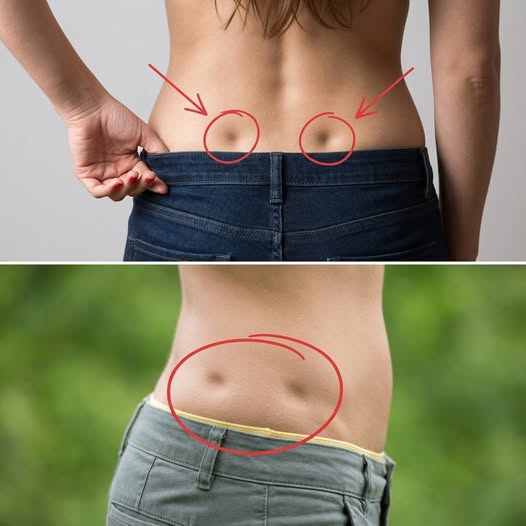
The small indentations that appear on the lower back, just above the buttocks, are often known by two different informal names depending on gender. In women they are commonly referred to as “Venus dimples,” while in men they are sometimes called “Apollo dimples.” In medical terminology, however, these features are described more precisely as sacral dimples or lumbosacral dimples. They are located in a very specific anatomical area where the spine meets the pelvis, near a bony landmark known as the posterior superior iliac spine.
These dimples are not random skin features. They occur because of how the underlying connective tissue is structured in that region. In simple terms, the skin in this area is tightly anchored to deeper ligaments and bony structures. This firm attachment creates a slight inward pull on the surface of the skin, resulting in a visible depression. The effect is subtle in most people, but in certain body types it becomes more noticeable and aesthetically defined.
From an anatomical perspective, the appearance of sacral dimples is entirely natural. They are not caused by injury, illness, or external factors. Instead, they are part of normal human variation, similar to features like cheek dimples or the shape of the jawline. Their presence is primarily determined during early development, which is why many people notice them from a young age if they are present at all.
Genetics plays the most significant role in whether a person has these dimples. The structure of connective tissue, the positioning of ligaments, and the shape of the pelvic bones are all inherited traits. Because of this, sacral dimples tend to run in families, although their appearance can vary in depth and visibility even among relatives. Some individuals may have very pronounced dimples, while others may have only slight indentations that are barely noticeable.
Although genetics determine their existence, other physical factors influence how visible they appear. Body composition is one of the most important secondary factors. People with lower levels of body fat often have more defined muscle structure, which can make natural indentations in the body more noticeable. In contrast, higher levels of subcutaneous fat can soften or partially conceal these features, making them less visible.
Muscle tone also plays a role in their appearance. The lower back, gluteal muscles, and surrounding core structures all contribute to the overall shape of this region. When these muscles are more developed and firm, the contrast between muscle and connective tissue can enhance the visibility of the dimples. This is why athletes or individuals who engage in regular strength training sometimes display more prominent sacral dimples.
It is important to understand that these dimples are not a sign of fitness or health by themselves. They do not indicate strength, weakness, or any medical condition. Instead, they are simply a structural feature that may become more or less visible depending on body composition and posture. Their prominence can change over time as a person’s body changes through aging, exercise, or lifestyle factors.
In some fitness and aesthetic discussions, sacral dimples are often mentioned in relation to physical appearance and body symmetry. Because they are located near the lower back and gluteal region, they can become more visible when the surrounding muscles are well developed. However, it is essential to approach this topic with realistic expectations. No exercise can create these dimples if a person does not naturally have the underlying anatomical structure. They can only enhance what is already present.
Exercises that target the lower back, core, and gluteal muscles can improve overall strength and posture, which may indirectly influence how defined this area appears. Strengthening the posterior chain, which includes the muscles along the back of the body, is particularly important for stability and movement efficiency.
Movements such as back extensions help engage the muscles of the lower spine. These exercises involve controlled lifting of the upper body while the lower body remains stable, activating the muscles that support posture and spinal alignment. Over time, consistent training in this area can improve muscle tone and contribute to a more defined lower back region.
Another commonly used movement in strength training is the deadlift. This exercise activates multiple muscle groups at once, including the hamstrings, glutes, lower back, and core. Because it involves lifting weight from the ground while maintaining spinal stability, it strengthens the entire posterior chain. When performed correctly, it can significantly improve muscular balance and support in the lower body.
Hip thrusts and glute bridges are also frequently used to develop the gluteal muscles. These exercises focus on lifting the hips while engaging the buttocks, helping to build strength and shape in that region. As the glute muscles become more developed, the surrounding structure of the lower back may appear more defined, which can make natural indentations more noticeable.
Core stability exercises such as planks and side planks contribute indirectly to this area as well. A strong core supports the spine and improves posture, which affects the alignment of the entire torso. When the body is held in a more upright and stable position, natural anatomical features can become more visible. Planks in particular require sustained engagement of deep abdominal muscles, while side planks activate the obliques and supporting structures along the sides of the torso.
The Superman exercise is another movement that targets the lower back. It involves lying face down and lifting the arms and legs simultaneously, engaging the spinal extensors. This exercise strengthens the muscles that support the spine and contributes to overall back stability. While it is a relatively simple movement, it can be effective when performed consistently as part of a balanced training routine.
Despite the attention these exercises receive in relation to appearance, it is important to emphasize that their primary benefit is functional rather than cosmetic. Strengthening the core, glutes, and lower back improves posture, reduces the risk of injury, and enhances overall physical performance. Any changes in appearance are secondary effects of improved muscle tone and body composition.
It is also worth noting that sacral dimples themselves do not require any treatment or correction. They are a completely normal anatomical variation and do not indicate any underlying health issue. In medical contexts, they are only significant when associated with rare structural abnormalities, which are typically identified in early childhood. In the vast majority of cases, they are harmless and purely cosmetic in nature.
Culturally, these dimples have gained attention in fashion, fitness, and beauty discussions, often being highlighted as a subtle aesthetic feature. However, perceptions of attractiveness vary widely across cultures and individuals, and there is no universal standard that assigns meaning or value to them. Their visibility is simply one of many natural variations in human anatomy.
Ultimately, sacral or lumbosacral dimples are a small but interesting example of how genetics and physical structure interact to create unique features in the human body. While exercise and body composition can influence how noticeable they appear, their existence is determined primarily by inherited anatomy. They serve as a reminder that many aspects of physical appearance are shaped long before lifestyle factors come into play.
Understanding these dimples from both a scientific and practical perspective helps separate natural anatomy from aesthetic interpretation. They are neither an indicator of health nor a requirement of beauty, but simply one of many subtle variations that contribute to the diversity of the human body.

