
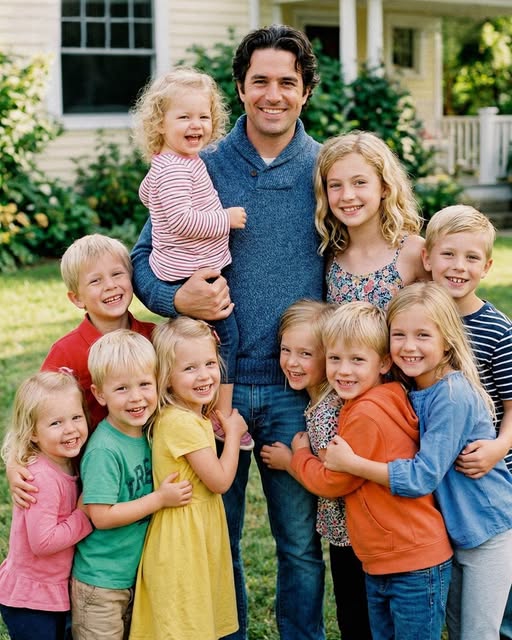
A Father’s Devotion and a Long-Hidden Truth: A Story of Resilience, Responsibility, and Family
In a home filled with constant motion, noise, and responsibility, one man’s quiet determination shaped the lives of ten children who depended on him every single day. What began as an ordinary morning—complete with rushed breakfasts, missing shoes, and school preparations—was, in reality, part of a much larger story defined by sacrifice, resilience, and an unexpected truth that would surface years later.
At 44 years old, Hank had built a life centered entirely around caring for ten children on his own. Though none of them were his biological children, he had become their primary caregiver, emotional anchor, and daily source of stability. Over time, the structured chaos of their household transformed into something meaningful—a system built on patience, routine, and unwavering commitment.
Each morning followed a familiar rhythm. Preparing meals, organizing school schedules, and resolving minor sibling disputes were all part of Hank’s routine. What might appear overwhelming to an outsider had, for him, become second nature. The home was not quiet or easy, but it was full of life and purpose.
The Disappearance That Changed Everything
Years earlier, the family’s foundation had been shaken by a sudden and deeply confusing event. Calla, the woman who had once been central to the household, disappeared under circumstances that led authorities to believe something tragic had occurred.
Her car was discovered near a river, abandoned with personal belongings still inside. Her coat had been left behind, creating a scene that suggested a possible accident or worse. Despite extensive search efforts, no definitive evidence was found. After days of uncertainty and no resolution, the family was left with no choice but to accept a painful conclusion without clear answers.
For the children, the loss was profound. For Hank, it was life-altering.
Choosing Responsibility Over Doubt
In the aftermath of the disappearance, Hank faced intense pressure and skepticism. Many questioned whether a single person could realistically raise ten children, especially after such an emotional and logistical upheaval.
Despite the doubts, Hank made a decision that would define the next chapter of his life. He chose to stay.
Through legal channels, he fought for and secured guardianship of all ten children. From that point forward, his life became fully dedicated to meeting their needs—both practical and emotional.
He adapted quickly, learning skills he had never expected to need. From managing school responsibilities and healthcare routines to providing emotional support during difficult moments, Hank developed a deep understanding of each child’s personality and needs.
Rather than attempting to replace the person they had lost, he focused on consistency. Showing up every day became his most important contribution, and over time, that consistency rebuilt a sense of security within the home.
A Conversation That Changed the Past
Seven years after Calla’s disappearance, an unexpected conversation would challenge everything Hank believed he knew about that night.
Mara, one of the older children, approached him with a request to talk privately. Her tone was serious, and it was clear that what she had to say carried weight. Later that evening, in a quiet corner of the house, she revealed something she had been holding onto since childhood.
Contrary to what she had told authorities years earlier, Mara had not forgotten what happened the night Calla disappeared. She remembered everything.
According to her account, Calla had staged the entire scene. She had deliberately left her belongings behind to create the impression of a tragic event, but in reality, she had chosen to leave.
At just eleven years old, Mara had been asked to keep that secret. She had been told that revealing the truth would cause harm to the family and permanently damage how others viewed her mother.
For years, Mara carried that burden alone.
The Emotional Weight of a Childhood Secret
The impact of that secret extended far beyond the original event. Every conversation about their mother, every unanswered question, and every moment of grief had been shaped by something Mara could not share.
For Hank, this revelation brought a new layer of understanding—but also a deeper sense of loss. The situation was no longer defined solely by disappearance, but by a deliberate choice that left both emotional and practical consequences behind.
Even more troubling was the realization that a child had been placed in a position of emotional responsibility far beyond her years.
Evidence That Changed Everything
The situation became even more complex when Mara revealed that she had recently been contacted. Hidden among household items was an envelope containing a photograph and a message.
The image showed Calla alive, appearing older but clearly recognizable. The message indicated a desire to reconnect and explain her past decisions.
What stood out most, however, was the method of contact. Rather than reaching out to an adult or legal guardian, Calla had chosen to contact Mara directly—the same child she had once asked to carry a life-altering secret.
For Hank, this raised serious concerns about judgment and responsibility.
Taking Legal and Protective Action
Recognizing the need to protect his family, Hank sought legal guidance. With the help of a legal professional, he established clear boundaries regarding any future contact.
As the children’s legal guardian, he had both the authority and the responsibility to manage the situation in a way that prioritized their well-being. Formal steps were taken to ensure that any communication would be handled through appropriate channels, removing pressure from Mara and restoring a sense of structure.
This decision marked an important shift—one that reinforced the idea that the children’s emotional safety came first.
A Confrontation Years in the Making
Soon after, Hank agreed to meet Calla in a neutral location. The meeting was not driven by reconciliation, but by a need for clarity.
During their conversation, Calla attempted to explain her actions. She described feeling overwhelmed and suggested that leaving had, in her mind, been a way to allow the family to rebuild without her.
Hank rejected that perspective. He made it clear that abandoning responsibility could not be reframed as a positive or selfless act.
One question remained central: why had she chosen to contact Mara first?
Her answer—that she believed Mara would respond—confirmed his concerns. It reflected a pattern of decisions based on convenience rather than accountability.
Telling the Truth to the Children
With careful planning, Hank began sharing an age-appropriate version of the truth with the younger children. The conversation was difficult, but necessary.
Each child reacted differently. Some were quiet, others emotional, and some struggled to process the information. Through it all, Hank emphasized one critical message: the actions of adults are never the fault of children.
He also set clear expectations. Any future involvement from Calla would depend entirely on what was best for the children—not on her wishes.
Just as importantly, he ensured that Mara was not blamed for the years of silence she had been forced to maintain.
The Strength of Family Bonds
In the end, the family’s response was not division, but unity. The children instinctively supported one another, reinforcing the bond that had been built over years of shared experience.
Later, Mara asked a question that captured the complexity of the situation: what should she do if her mother tried to return?
Hank’s answer was simple—tell the truth.
He also made something else clear. Parenthood is not defined solely by biology, but by presence, responsibility, and care.
A Lasting Message
This story is not only about loss or revelation—it is about the enduring impact of showing up. Over seven years, Hank had built a home defined by stability, trust, and effort.
While the truth about the past provided answers, it did not change the reality of who had been there every day.
In the end, the family’s strength came not from what they had lost, but from what they had built together.

