
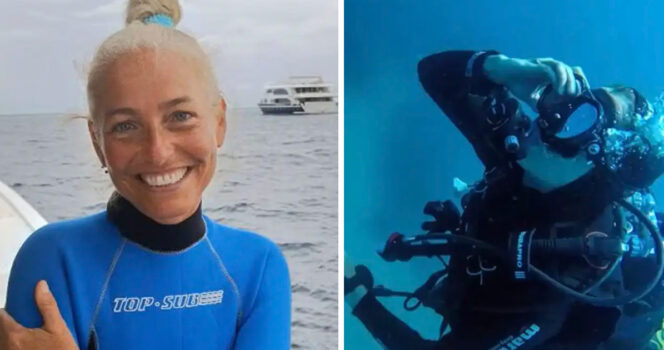
Italian Diving Tragedy in the Maldives Leaves Five Dead as Sole Survivor Remains Key Witness
A tragic scuba diving accident in the Maldives has drawn international attention after five Italian divers lost their lives during an underwater expedition near Vaavu Atoll.
The incident unfolded last Thursday in the Indian Ocean archipelago and has since become one of the deadliest diving disasters ever recorded in the Maldives.
As investigators continue working to understand what caused the fatal dive, new details have emerged involving a sixth member of the group who reportedly avoided the tragedy after deciding not to enter the water.
The unnamed woman, identified as a student from the University of Genoa, had originally planned to dive alongside the rest of the group before changing her mind at the last moment and remaining aboard the yacht.
Because she stayed behind, she is now considered the only direct survivor connected to the group’s final preparations before the fatal descent.
A Routine Dive Turns Into Disaster
The group of Italian divers had been aboard the Duke of York yacht near Vaavu Atoll when the tragedy occurred.
Authorities believe the divers descended approximately 160 feet into an underwater cave system near Alimatha Island.
What began as a planned cave dive quickly escalated into a deadly emergency.
The exact sequence of events remains unclear, and investigators are still attempting to determine what went wrong beneath the surface.
Emergency rescue efforts followed shortly after the group failed to return safely.
The scale of the incident shocked both local authorities and the international diving community due to the number of fatalities involved.
Reports indicate that around two dozen non-crew members were on board the Duke of York during the excursion.
The diving accident has since been described as the deadliest single diving incident in Maldivian history.
The Sole Survivor’s Last-Minute Decision
One of the most striking details surrounding the tragedy involves the student who reportedly decided against participating in the dive shortly before the group entered the water.
Although she had prepared to join the expedition, she ultimately remained aboard the yacht.
At this stage, authorities have not publicly explained why she changed her mind.
Her decision, however, may have saved her life.
Investigators are now expected to rely heavily on her testimony to reconstruct the group’s final moments before the descent.
Because she witnessed the preparations leading up to the dive, she may help authorities understand whether there were any visible concerns, equipment problems, or unusual circumstances before the accident occurred.
The student has been described as a crucial witness in the ongoing effort to piece together the events that unfolded beneath the water.
The Victims Identified
Among those who lost their lives was Monica Montefalcone, a respected marine biology professor at the University of Genoa.
Her daughter, 20-year-old Giorgia Sommacal, also died in the incident.
The tragedy involving both mother and daughter has added a particularly emotional dimension to the disaster.
The remaining victims were identified as Muriel Oddenino, Gianluca Benedetti, and Federico Gualtieri.
The deaths of the five divers have deeply affected colleagues, friends, and members of the diving and academic communities.
The accident has also renewed discussions surrounding the dangers associated with deep cave diving, especially in unfamiliar underwater environments.
Cave diving is widely considered one of the most technically demanding forms of scuba diving due to limited visibility, confined spaces, and the difficulty of emergency escape.
Recovery Mission Claims Another Life
The tragedy became even more devastating after a Maldivian military rescue diver reportedly died during a subsequent recovery operation.
According to reports, the rescuer later suffered decompression sickness following the mission.
Decompression sickness can occur when divers ascend too quickly after spending time at significant depths, causing dangerous gas bubbles to form within the body.
The additional death highlighted the hazardous conditions involved not only in the original dive but also in the rescue and recovery efforts that followed.
Emergency recovery operations in deep underwater cave systems are often extremely dangerous due to limited access, pressure changes, and visibility challenges.
The loss of the rescue diver added another layer of sorrow to an already devastating incident.
Possible Causes Under Investigation
Authorities and diving experts continue examining several possible explanations for the accident.
At this stage, investigators have not confirmed a definitive cause.
However, experts have suggested that oxygen toxicity may have played a role.
Oxygen toxicity, also known as hyperoxia, can occur when divers breathe gas mixtures containing excessive oxygen at great depths.
The condition can trigger severe physical reactions, including seizures, confusion, and loss of consciousness underwater.
Pulmonologist Claudio Micheletto commented on the possible dangers associated with the dive.
“It’s likely that something went wrong with the tanks.”
He also described oxygen toxicity as one of the most frightening fatal risks associated with scuba diving.
“Death from oxygen toxicity, or hyperoxia, is one of the most dramatic deaths that can occur during a dive — a horrible end.”
Another possible factor under consideration is panic within the underwater cave system.
Cave environments can quickly become disorienting even for experienced divers, particularly at significant depths.
The Risks of Cave Diving
Experts have emphasized that cave diving carries unique dangers compared to open-water diving.
Inside underwater cave systems, visibility can disappear rapidly if sediment is disturbed.
Divers also face narrow passages, restricted movement, and the challenge of navigating enclosed spaces far from the surface.
At depths approaching 50 meters, even minor equipment issues or moments of panic can quickly escalate into life-threatening emergencies.
Alfonso Bolognini, president of the Italian Society of Underwater and Hyperbaric Medicine, noted how fragile conditions can become during deep cave dives.
“Inside a cave at a depth of 50 meters, all it takes is a problem for a diver or a panic attack for a diver.”
Because cave divers cannot always ascend directly to the surface, emergency responses are far more complicated than in traditional recreational diving.
The environment demands extensive training, careful planning, and precise coordination among divers.
Even experienced teams can encounter unexpected complications.
An International Community in Mourning
The tragedy has generated grief both in Italy and within the global diving community.
The involvement of respected academics and experienced divers has intensified public attention surrounding the incident.
Friends, colleagues, and supporters have expressed shock over the sudden loss of life.
The deaths also serve as a painful reminder of the risks associated with extreme underwater exploration.
While scuba diving is enjoyed safely by millions of people worldwide, technical cave diving remains one of the most dangerous forms of the activity.
The accident has prompted renewed discussion about safety procedures, equipment reliability, and emergency preparation for deep cave expeditions.
As investigators continue reviewing evidence and interviewing witnesses, many questions remain unanswered.
The Investigation Continues
Authorities are expected to continue examining dive equipment, environmental conditions, and witness accounts as part of the ongoing investigation.
The testimony of the student who remained aboard the yacht may prove especially important in helping officials understand the group’s condition and preparation before entering the water.
Investigators will likely focus on whether any signs of equipment malfunction, confusion, or concern appeared prior to the descent.
At the same time, diving experts continue evaluating how conditions inside the underwater cave may have contributed to the disaster.
The combination of extreme depth, enclosed spaces, and possible equipment complications creates a highly dangerous environment where emergencies can unfold rapidly.
For now, families and loved ones continue mourning the loss of the divers whose trip ended in tragedy.
The incident has left a lasting impact not only on those directly connected to the victims, but also on the broader international diving community.
A Tragedy That Shocked the World
What began as a planned underwater exploration in the Maldives turned into a devastating loss of life that captured global attention.
The fact that one member of the group chose not to dive at the last moment has added another emotional and mysterious dimension to the tragedy.
Her decision to remain aboard the yacht ultimately separated her from the disaster that unfolded below the surface.
As authorities continue searching for answers, the incident stands as a sobering reminder of the dangers associated with deep cave diving and the unpredictable risks that can arise even among experienced groups.
The deaths of the five Italian divers, along with the rescue diver who later lost his life during recovery efforts, have left a profound mark on everyone connected to the tragedy.
For now, the investigation continues as officials work to determine exactly what happened during the final moments of the fatal dive near Vaavu Atoll.

