
A Moment of Tension Aboard a Crowded Flight Becomes a Subtle Lesson in Courtesy and Communication
Air travel is often described as a carefully coordinated process, where timing, organization, and cooperation come together to move hundreds of people efficiently from one place to another. Yet within that system, there are small, human moments—interactions that reveal how individuals respond to shared challenges in confined spaces. One such moment recently unfolded aboard a fully booked flight, offering a thoughtful reminder of the importance of preparation, communication, and mutual respect.
A Familiar Scene Inside a Full Cabin
As passengers boarded the aircraft, the cabin quickly filled with the usual activity that accompanies departure. Travelers moved down the narrow aisle, lifting carry-on luggage into overhead compartments, checking seat numbers, and carefully navigating around one another.
The environment was typical of a busy flight. Conversations blended into a low murmur, punctuated by the sounds of closing compartments and the occasional request to shift slightly to make room. Flight attendants moved methodically through the cabin, assisting passengers and ensuring that the boarding process remained on schedule.
With each passing minute, the available space grew more limited. By the time the final passengers entered, nearly every seat was occupied, and the aisle became increasingly difficult to navigate.
A Situation That Draws Attention
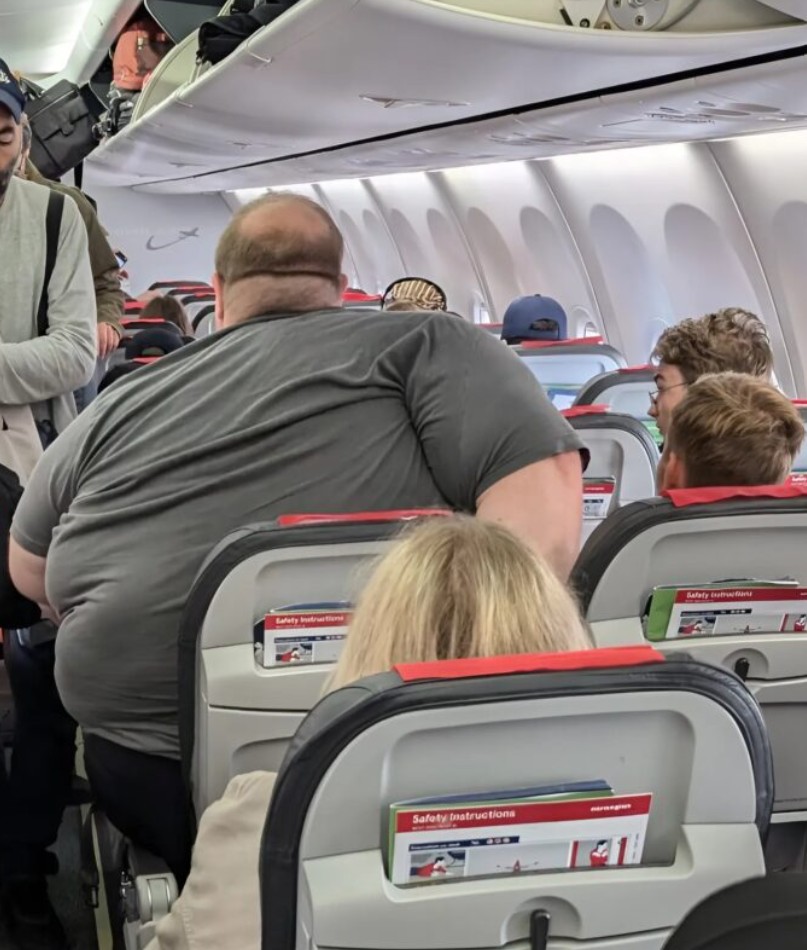
In one of the middle rows, a situation began to attract quiet attention. A man seated in the aisle position appeared to take up more space than the already compact seating arrangement allowed. His posture extended slightly into the aisle, making it more difficult for others to pass comfortably.
The middle seat next to him seemed particularly constrained. Nearby passengers noticed the tightness of the space and began exchanging subtle glances. No one spoke openly about it, but the shared awareness was clear.
Such moments are not uncommon in air travel. With limited personal space and close proximity to others, even minor discomforts can become noticeable. In this case, the situation created a brief sense of uncertainty among those seated nearby.
The Quiet Build-Up of Tension
As boarding continued, the atmosphere around the row shifted slightly. The confined setting made it difficult to ignore the issue, and small movements felt more pronounced.
Passengers adjusted their seating positions, some leaning slightly away, others watching with curiosity. Despite the growing awareness, no one directly addressed the situation. Instead, the tension remained unspoken, lingering in the background as people waited to see how it might be resolved.
This kind of silent anticipation is a common feature of shared spaces. Without clear communication, assumptions can quickly form, often shaping perceptions before the full picture is understood.
A Professional Intervention
Shortly afterward, a flight attendant approached the row. Her presence signaled that the situation had been noticed and would be addressed.
Maintaining a calm and professional demeanor, she politely asked the man if he would be willing to step into the aisle for a brief conversation regarding the seating arrangement. Her tone was respectful and composed, reflecting the balance required in such situations.
The interaction immediately drew the attention of nearby passengers. Conversations paused, and several individuals watched quietly, curious about how the situation would unfold.
A Calm and Constructive Response
In contrast to what some might have expected, the man responded without hesitation or frustration. He stood up calmly, making space in the aisle and allowing the conversation to proceed.
Then, turning slightly toward those nearby, he offered a clear and measured explanation.
He stated that he understood how the situation might appear and acknowledged that it could cause discomfort for others. He then explained that he had purchased two seats in advance specifically to avoid inconveniencing anyone.
According to his account, the second seat he had reserved appeared to have been assigned to another passenger due to a booking error.
His explanation was delivered in a composed and respectful manner, without defensiveness or blame. The clarity of his response immediately changed the tone of the interaction.
Providing Clarity Through Action
To support his statement, the man presented both boarding passes. The documents confirmed that he had indeed arranged for an additional seat ahead of time.
This simple act provided clarity and helped resolve any uncertainty. Passengers who had been observing the situation began to reassess their initial assumptions.
What had initially seemed like a lack of consideration was, in fact, the opposite. The man had taken proactive steps to ensure comfort for himself and those around him.
The misunderstanding, it appeared, stemmed from a logistical error rather than personal oversight.
A Swift and Professional Resolution
The flight attendant reviewed the boarding passes carefully. After confirming the details, she acknowledged the situation with a nod and a polite expression of appreciation for the man’s patience.
Within a short time, the issue was resolved. The additional seat was cleared, and the intended arrangement was restored.
The process was handled efficiently, with minimal disruption to the overall boarding procedure. The calm and respectful exchange ensured that the situation did not escalate or delay departure.
A Noticeable Change in Atmosphere
As the resolution became clear, the mood within the cabin shifted. The earlier tension gave way to a more relaxed and cooperative environment.
Passengers resumed their activities, returning to conversations or settling into their seats. The sense of uncertainty that had briefly filled the space was replaced by a feeling of ease.
Some nearby passengers acknowledged the situation with subtle gestures, such as nods or quiet remarks. The overall sentiment reflected appreciation for how the matter had been handled.
The Value of Preparation
One of the key takeaways from this moment was the importance of planning ahead. In environments where space is limited and shared among many people, thoughtful preparation can make a significant difference.
By anticipating potential challenges and taking steps to address them in advance, the man demonstrated a proactive approach that benefited not only himself but also those around him.
Even though a booking error temporarily disrupted his plan, his readiness to explain the situation ensured a smooth resolution.
The Role of Clear Communication
Equally important was the role of communication. The man’s willingness to explain the situation calmly and openly allowed others to understand his intentions.
Without that explanation, the misunderstanding might have persisted, potentially leading to frustration or discomfort.
This interaction highlights how clear and respectful communication can quickly resolve uncertainty, especially in shared environments where assumptions can easily arise.
Professionalism in Practice
The flight attendant’s handling of the situation also played a crucial role. Her calm approach and respectful tone set the stage for a constructive interaction.
By addressing the matter directly and efficiently, she prevented it from becoming a larger issue. Her actions reflected the importance of professionalism in maintaining a positive environment within a busy cabin.
Such moments often go unnoticed, yet they are essential to ensuring that air travel remains orderly and comfortable for passengers.
Shared Spaces and Mutual Awareness
Airplanes are unique environments where individuals from different backgrounds share a confined space for an extended period. In such settings, mutual awareness and consideration become especially important.
Small actions—such as being mindful of personal space or planning ahead—can have a meaningful impact on the overall experience.
In this case, what could have been a source of discomfort became an example of how thoughtful behavior can improve a shared environment.
A Subtle but Meaningful Example
What made this moment particularly notable was its simplicity. There were no raised voices, no conflict, and no disruption beyond a brief pause in routine.
Instead, the situation was resolved through calm explanation, professional handling, and a willingness to understand.
For those who witnessed it, the interaction served as a quiet reminder that consideration and communication can make a significant difference, even in small, everyday situations.

Returning to Routine
With the matter resolved, the boarding process continued without further interruption. Passengers settled into their seats, adjusted their belongings, and prepared for departure.
The earlier moment of tension became just a brief pause in an otherwise routine sequence of events. However, its impact lingered in the minds of those who had observed it.
The cabin, once marked by subtle uncertainty, now felt balanced and at ease.
A Lasting Impression
Although the incident lasted only a few minutes, it left a lasting impression on those nearby. It demonstrated how quickly assumptions can form—and how easily they can be corrected through clear communication.
It also highlighted the role that individual choices play in shaping shared experiences. In a structured environment like air travel, even small decisions can influence the atmosphere in meaningful ways.
Final Reflection
Moments like this illustrate an important principle: challenges themselves do not define an experience—responses do.
In this instance, a potential source of discomfort became an opportunity to demonstrate courtesy, preparation, and understanding. The calm and thoughtful way in which the situation was handled ensured a positive outcome for everyone involved.
Ultimately, the interaction served as a simple yet meaningful reminder that respect and awareness are essential in shared spaces. Even in the most routine settings, these qualities can turn a moment of tension into an example worth remembering.

