
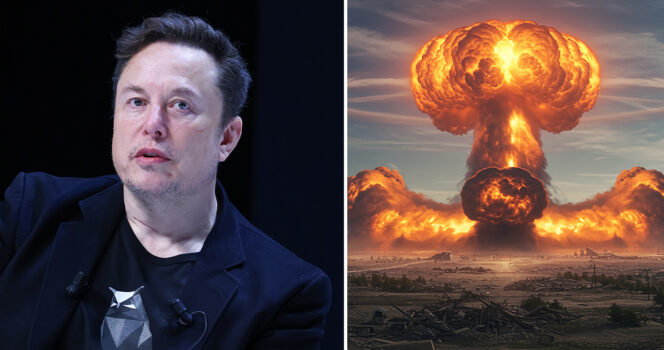
Recent discussions about global stability have intensified as political tensions rise across several regions, prompting renewed debate about the possibility of a large-scale international conflict. Public figures, analysts, and even artificial intelligence systems have weighed in, offering perspectives that range from cautious concern to more direct warnings about the future.
Among those drawing attention to the issue is Elon Musk, who recently spoke about the long-term risks of global conflict during an appearance on a popular podcast. In his remarks, he suggested that while the timing is uncertain, a major global war is not impossible. He framed the issue in broader terms, connecting it to humanity’s future and the importance of technological progress, particularly space exploration.
At the same time, discussions online have increasingly included input from artificial intelligence tools designed to analyze global trends. In one such case, a user asked an AI system to estimate the likelihood of a third world war based on current geopolitical conditions. The system responded with an approximate probability range, suggesting that while such a conflict is not the most likely outcome, it is also not something that can be dismissed entirely.
A key factor often cited in these discussions is the role of nuclear deterrence. Since the end of World War II, the existence of nuclear weapons has significantly influenced international relations. The principle of deterrence—where the potential consequences of escalation are so severe that they discourage direct conflict—has played a central role in preventing large-scale wars between major powers.
However, experts frequently point out that this stability is not necessarily permanent. Instead, it is often described as a delicate balance. The idea is that while global leaders may avoid actions that could lead to catastrophic outcomes, the system relies heavily on careful decision-making and clear communication.
Economic interdependence is another factor that contributes to this balance. Major global economies are deeply connected through trade, finance, and supply chains. For example, countries rely on one another for goods, energy, and investment. This interconnectedness means that a large-scale conflict would likely cause widespread economic disruption even before any direct confrontation occurs.
Despite these stabilizing factors, analysts continue to highlight areas of concern. Ongoing regional conflicts, shifting alliances, and competition between major powers have created a more complex and uncertain global landscape. In addition, some observers note that the institutions and agreements that once helped manage tensions—such as arms control treaties and diplomatic frameworks—have weakened in recent years.
This evolving situation has led to increased attention on how quickly misunderstandings or miscalculations could escalate. In complex geopolitical environments, decisions are often made under pressure, and even small errors can have significant consequences. As a result, many experts emphasize the importance of maintaining communication channels and diplomatic efforts to reduce the risk of unintended escalation.
Leadership dynamics also play a role in shaping outcomes. Different countries have their own priorities, challenges, and internal pressures, all of which influence how decisions are made on the global stage. While leaders generally aim to avoid large-scale conflict, the combination of competing interests and unpredictable events can make the situation more difficult to manage.
Artificial intelligence systems, when used in this context, do not predict the future with certainty but instead analyze patterns, historical data, and current conditions to estimate potential outcomes. Their assessments are meant to provide perspective rather than definitive answers. In this case, the estimate offered by AI reflects both the presence of risk and the existence of factors that continue to limit escalation.
Donald Trump, Vladimir Putin, and Xi Jinping are often mentioned in these discussions because of their influence on global affairs. Decisions made by leaders of major powers can have far-reaching effects, particularly during periods of heightened tension.
Musk’s comments added another dimension by linking geopolitical stability to technological progress. He has long advocated for advancing space exploration, including the idea of making humanity a multi-planet species. In this context, he suggested that global conflict could disrupt or delay such ambitions, highlighting the broader implications of instability beyond immediate political or economic consequences.
While these perspectives vary in tone, they share a common theme: the importance of taking global risks seriously without assuming that negative outcomes are inevitable. History shows that periods of tension can be managed through diplomacy, cooperation, and strategic decision-making, even when challenges appear significant.
Ultimately, discussions about the possibility of a large-scale conflict reflect broader concerns about the direction of global affairs. They also underscore the need for continued efforts to maintain stability, strengthen international cooperation, and address the underlying issues that contribute to tension.
Although no single prediction can determine what will happen in the future, the combination of expert analysis, technological tools, and public discourse highlights the value of awareness and preparedness. By understanding the factors at play, individuals and institutions alike can contribute to a more informed and thoughtful approach to global challenges.

