
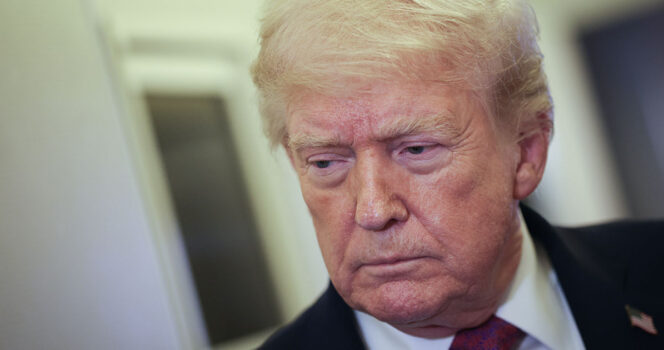
Public attention has long followed the health and behavior of Donald Trump, and recent developments have once again brought those concerns into focus. A newly shared video on his social media account has sparked renewed discussion about his communication style, decision-making, and overall public presence.
At the same time, the United States continues to be involved in a complex geopolitical situation involving Iran. The situation has evolved rapidly, with tensions rising around the Strait of Hormuz, a critical global shipping route through which a significant portion of the world’s oil supply passes.
Reports indicated that the strait had briefly been reopened before being closed again amid claims of attacks on vessels. These developments have added uncertainty to an already tense situation, drawing global attention and concern over potential economic and security impacts.
During this period, President Trump’s public communication has drawn scrutiny. Observers have noted that his tone and messaging have shifted frequently. At certain moments, he has taken a firm and confrontational stance, while at other times, he has signaled openness to negotiation and dialogue.
According to reporting by The Wall Street Journal, this pattern has also been reflected in private discussions. The report suggested that the president has alternated between expressing concern about the duration and consequences of the conflict and promoting a more assertive approach toward resolving it.
This variation in messaging has been evident in public statements as well. Officials cited in the report indicated that some remarks were made spontaneously rather than as part of a structured communication strategy. For example, statements referencing large-scale consequences for Iran were described as being made without prior planning or alignment with formal policy.
At the same time, some officials suggested that this unpredictability may be intentional. According to the report, senior aides indicated that the president has, at times, adopted an unpredictable communication style as a strategic approach. The idea behind this approach is that appearing less predictable could influence negotiations by creating uncertainty for opposing parties.
Despite this interpretation, the president’s social media activity continues to generate public discussion. A recent post drew particular attention when he shared a video featuring Frank Sinatra performing the song My Way. The clip, which lasted several minutes, was posted without any accompanying explanation or context.
The lyrics of the song include reflective lines about life, personal choices, and facing the future. Phrases such as “the end is near” and “I did it my way” have long been associated with themes of self-reflection and individual legacy.
Because no explanation was provided with the video, viewers began interpreting the meaning in different ways. Some focused on the reflective tone of the lyrics, while others questioned whether the post carried a deeper message.
Reactions on social media varied. Some users expressed concern, interpreting the lyrics as potentially symbolic. Others viewed the post as consistent with the president’s known appreciation for traditional music and cultural references.
Additional interpretations centered on the idea of independence and personal decision-making. Some observers suggested that the choice of song could reflect a message about handling ongoing challenges according to one’s own judgment, without external influence.
The wide range of interpretations highlights how public figures’ actions, especially on social media, can be understood in multiple ways depending on context and audience perspective. Without clarification, even a simple post can lead to extensive speculation.
Discussions about the president’s communication style are not new. Throughout his time in public office, his approach has often differed from that of previous leaders. He has frequently used direct and informal messaging, particularly through online platforms, to communicate with the public.
Supporters have described this approach as transparent and unfiltered, while critics have raised concerns about consistency and clarity. These differing perspectives contribute to ongoing debate about how public communication should be handled at the highest levels of government.
Questions about health have also occasionally surfaced, though they are typically difficult to assess based solely on public appearances or statements. Public figures, especially those in leadership positions, often face heightened scrutiny, and their words and actions are closely analyzed.
In a previous interview, President Trump made remarks about health in a casual and conversational tone, discussing topics such as blood flow and general well-being. While such comments may be informal, they have contributed to broader discussions about how he expresses himself in public settings.
It is important to note that communication style alone is not a reliable indicator of health or capability. Public statements can be influenced by many factors, including personality, strategy, and context. As a result, interpretations should be approached carefully and based on verified information rather than speculation.
The ongoing situation involving Iran continues to evolve, and the United States remains engaged in efforts to manage tensions while avoiding further escalation. Diplomatic, military, and economic considerations all play a role in shaping decisions during such periods.
In this environment, communication from leadership becomes particularly significant. Clear and consistent messaging can help provide stability, while shifting tones may lead to varied interpretations both domestically and internationally.
At the same time, some analysts argue that flexibility in communication can allow leaders to adapt quickly to changing circumstances. This perspective suggests that varying approaches may reflect responsiveness rather than inconsistency.
Public reaction to leadership behavior often reflects broader concerns about global stability and national direction. When uncertainty exists in international affairs, attention naturally turns to those responsible for decision-making.
The recent social media post, combined with ongoing geopolitical developments, has therefore become part of a larger conversation about leadership, communication, and public perception.
While some individuals interpret the situation as cause for concern, others see it as consistent with established patterns. The diversity of opinions underscores the complexity of evaluating public figures based on limited information.
Ultimately, understanding such situations requires careful consideration of verified facts, context, and multiple perspectives. Isolated actions, such as a single social media post, may not provide a complete picture when viewed on their own.
As events continue to unfold, attention will likely remain focused on both the geopolitical situation and the communication coming from leadership. Observers, analysts, and the public will continue to interpret developments through their own perspectives, contributing to an ongoing and evolving discussion.
In times of uncertainty, maintaining a balanced approach—grounded in information rather than assumption—remains essential.

