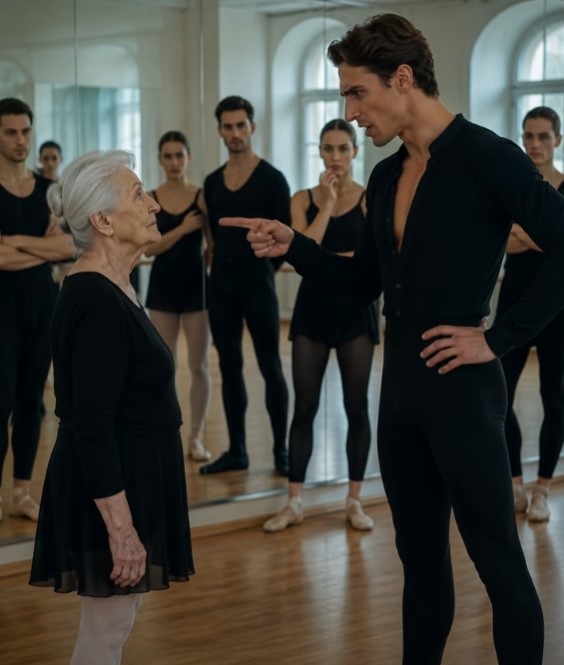
Elderly Woman Walks Into Elite Ballet Class and Leaves the Entire Studio Speechless
An Elite Ballet Academy Built on Discipline and Precision
The ballet academy was widely recognized as one of the most respected training environments in the city, attracting aspiring performers, competitive dancers, and highly dedicated students who devoted years of their lives to perfecting their craft.
Inside its studios, discipline and structure defined every session. Students trained under strict guidance, constantly refining posture, timing, alignment, and movement quality in pursuit of technical excellence.
Among the instructors was Daniel, the lead choreographer. Although relatively young compared to many in his field, he had established a strong reputation built on precision, high standards, and an uncompromising approach to performance quality.
His expectations were consistently demanding. Every movement had to meet exact requirements, and repetition was a core part of his teaching method. Students often practiced the same combinations repeatedly until they achieved the required level of accuracy.
On a typical morning, the rehearsal studio was filled with energy and focus. Music echoed through the space as dancers moved through barre work and technical exercises, each one fully concentrated on improvement.
Daniel moved steadily through the room, correcting posture, adjusting positioning, and calling out instructions that shaped the rhythm of the session.
“Higher leg.”
“Keep your back straighter.”
“Don’t lose your balance.”
“Again from the beginning.”
The environment remained structured and serious, with every dancer fully engaged in refining their technique under constant observation.
Nothing about the morning suggested that anything unusual would occur. The focus remained on discipline, repetition, and progress.
An Unexpected Arrival That Interrupted the Routine
Without warning, the studio door opened and immediately disrupted the carefully controlled atmosphere. Every eye in the room turned toward the entrance.
An elderly woman stood in the doorway.
She appeared to be around eighty years old, dressed in a simple ballet outfit consisting of black attire, white tights, and ballet shoes. Despite her age, she carried herself with calm confidence.
Her silver hair was neatly tied into a bun, and she held a small sports bag in her hands. Her expression was steady, as though she fully intended to be there.
For a moment, silence filled the room. Students exchanged confused glances, unsure of how to respond to the unexpected interruption.
Daniel stepped forward, attempting to clarify the situation.
“Ma’am, I think you may have the wrong address.”
The woman calmly shook her head.
“No. I came for the ballet class.”
Whispers spread among the students. Some smiled in disbelief, while others tried to suppress their reactions. The situation felt unexpected and out of place within such a structured environment.
Daniel expressed concern, emphasizing the physical demands of ballet and the risks involved.
“I’m sorry, but ballet is a serious physical activity. At your age, you could get injured. You could damage your joints, fall, or break a bone. And I would be responsible for that.”
The woman remained composed and unfazed.
“I won’t break anything.”
Despite her confidence, Daniel remained unconvinced.
“Even so, I can’t accept you.”
“Why?”
“Because ballet is not a place for people like you.”
The room grew noticeably quieter as the tension shifted.
The woman maintained eye contact and calmly asked for clarification.
“What kind of people?”
Daniel hesitated briefly before responding.
“Older people. You probably can’t even stand on pointe, let alone perform turns or big jumps.”
His words triggered laughter throughout the studio. Some students openly reacted, while others exchanged amused looks.
Despite the reaction around her, the woman showed no signs of frustration or embarrassment. She remained still, observing the room calmly.
A Silent Response and an Unexpected Demonstration
Rather than engaging in argument, the woman placed her bag carefully against the wall. She then walked toward the center of the studio with measured steps.
Curiosity replaced laughter as the students began to watch more closely. The unexpected situation had shifted their attention entirely toward her.
Daniel asked a direct question as she reached the center of the floor.
“What are you going to do?”
She responded calmly.
“I’m just going to show you something.”
She took her starting position. The studio fell completely silent.
At first, many assumed the moment would be brief or symbolic. However, her movements quickly challenged those assumptions.
She raised her arms with controlled elegance and transitioned into classical ballet positions with remarkable precision. Every motion appeared intentional and refined.
Her posture remained perfectly aligned, her shoulders relaxed, and her movements controlled with a level of discipline that reflected years of training.
The atmosphere in the room began to change. Smirks faded, replaced by focused attention. Even those who had laughed earlier now watched in silence.
She continued across the floor, executing turns with steady balance and smooth transitions. Each movement flowed into the next without hesitation or instability.
The studio remained completely quiet as the demonstration continued.
Then she prepared for a final movement. After a brief pause, she executed a powerful grand battement that displayed both flexibility and control, leaving the entire room visibly stunned.
The reaction was immediate. Several students gasped while others exchanged shocked looks, unable to process what they had just witnessed.
Moments earlier, she had been dismissed as an unlikely participant. Now she stood as the center of attention, having demonstrated extraordinary ability.
Applause gradually began, led first by Daniel, followed by the rest of the studio until the entire room joined in recognition of her performance.
Respect, Recognition, and a Long-Hidden Legacy
Daniel approached her with visible embarrassment and newfound respect. His earlier certainty had been replaced by humility.
“Please forgive me.”
She looked at him calmly.
“For what?”
“For everything I said.”
She responded with understanding.
“Don’t worry about it. You simply made your conclusions too quickly.”
Daniel lowered his head, recognizing the assumption he had made based on appearance rather than ability.
After a pause, he asked the question that had become central for everyone in the room.
“Who are you?”
She remained silent briefly before answering.
“I started studying ballet when I was two years old.”
Her statement drew immediate attention from the students, who began to realize the depth of experience behind her presence.
“Later, I danced in the country’s leading theaters for nearly forty years.”
The room grew even quieter as understanding began to spread.
Finally, she revealed her identity, and recognition moved through the studio instantly.
“That can’t be…”
“It’s really her.”
One of the senior instructors reacted with shock, confirming what many were beginning to realize. The woman standing before them was not simply a visitor, but a celebrated figure from ballet history.
Her past performances had once drawn widespread admiration, with audiences recognizing her as a remarkable talent whose career left a lasting impact on the art form.
Despite her legacy, she had entered the studio without expectation of special treatment or recognition, blending in as an ordinary participant rather than a celebrated figure.
A Lasting Lesson in Talent and Assumptions
The atmosphere in the studio had completely transformed from casual amusement to deep respect. Students who had laughed earlier now observed her with admiration and reflection.
The experience reshaped their understanding of ability and appearance. What had initially seemed impossible had become a demonstration of mastery and discipline accumulated over a lifetime.
The incident served as a powerful reminder that talent is not defined by age or appearance. Years of dedication can produce skill that remains present regardless of outward perception.
Daniel and his students were left with a lasting lesson that extended beyond ballet itself. Assumptions made too quickly can obscure truth, and respect should be given without prejudice.
In the end, the elderly dancer’s performance became more than a demonstration. It became a defining moment that reshaped the way an entire studio viewed experience, dedication, and human potential.
