
A Visual Puzzle That Challenges Attention to Detail
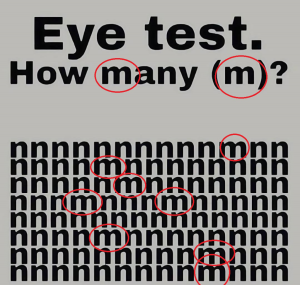
In today’s fast-paced digital environment, small details can often go unnoticed. A simple visual puzzle has recently captured attention by testing how carefully people observe patterns. The challenge invites viewers to find the letter “M” hidden among a grid filled with the letter “N.”
At first glance, the image appears straightforward. Rows of identical letters are arranged in a uniform pattern, giving the impression that nothing stands out. However, this consistency is exactly what makes the puzzle more difficult than expected.
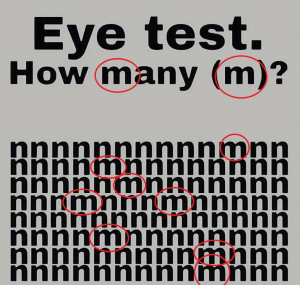
The task is to identify how many “M” letters are hidden within the overall composition. Because the shapes of “M” and “N” are visually similar, especially when placed closely together, the differences can be easy to miss. This creates a situation where the brain quickly assumes uniformity, even when small variations are present.
As a result, many people initially scan the image quickly and feel confident in their answer. However, when they take a closer look, they often realize that they overlooked some of the hidden letters. This effect highlights how visual perception can sometimes rely more on patterns than on careful inspection.
The challenge becomes more interesting when considering that not all of the hidden “M” letters are located within the grid itself. Some may appear in the surrounding text or instructions, adding another layer to the task. This encourages a broader approach to observation rather than focusing only on one section.
After careful examination, the total number of “M” letters in the full composition is ten. This includes both the letters embedded within the grid and those that appear in the text connected to the puzzle.
Many participants report different answers at first, often underestimating the total. This is a common outcome in visual challenges, where the brain tends to simplify complex patterns and overlook subtle differences.
Puzzles like this serve as a reminder of how perception works. They demonstrate that what we see is not always a complete reflection of what is present, but rather an interpretation shaped by attention, expectation, and pattern recognition.
Taking extra time to observe carefully can often reveal details that were not immediately visible. In that sense, the challenge is not only about finding hidden letters, but also about practicing patience and improving focus.
In the end, this simple exercise shows how even basic visual elements can create an engaging and thought-provoking experience. It encourages a slower, more attentive way of looking at things, which can be useful far beyond the puzzle itself.

