Strange Red Fungus Found in Backyard Demonstrates One of Nature’s Most Unusual Survival Methods
An Ordinary Garden Morning Takes an Unexpected Turn
The day began much like any other in a quiet backyard garden.
Morning sunlight stretched across the lawn, highlighting dew-covered grass and flowerbeds that had become part of a familiar daily routine. The air carried the scent of damp earth, blooming plants, and the lingering coolness of the night.
With a cup of coffee in hand, the homeowner stepped outside expecting nothing more than a peaceful start to the day.
Within minutes, however, that sense of calm disappeared.
A powerful odor drifted through the yard. It was sharp, unpleasant, and completely out of place among the flowers and greenery.
The smell was so intense that it immediately raised concern. Rather than resembling soil or vegetation, it was much closer to the scent of decaying meat.
The unusual odor seemed to grow stronger with each step, prompting a search for its source.
A Disturbing Object Appears Near the Flowerbeds
As the homeowner moved through the garden, the smell became increasingly difficult to ignore.
Shrubs, garden borders, and patches of mulch were examined carefully. At first, there was concern that a small animal might have died somewhere nearby.
Then something unusual appeared near the edge of a flowerbed.
Partially hidden among plants was a vivid red growth unlike anything normally seen in a backyard garden.
Its appearance was immediately unsettling.
Several elongated structures extended upward from a central point in the soil. The bright crimson arms twisted and curved in different directions, creating a shape that looked more like something emerging from beneath the ground than a typical mushroom.
The surface appeared wet in the morning light, and parts of the structure were covered in a dark, sticky coating.
Combined with the strong odor, the strange growth transformed what had been a relaxing morning into a moment of uncertainty.
The closer the homeowner moved, the more unusual the object appeared.
The red arms narrowed toward their tips, where black slime clung to the surface. The contrast between the vivid red color and the dark coating made the fungus appear almost unnatural.
Several possibilities came to mind. Perhaps it was the remains of an animal. Perhaps it was debris brought into the yard overnight. Perhaps it was something buried long ago that had resurfaced.
None of those explanations seemed particularly reassuring.
Photographs Lead to an Unexpected Identification
Unable to determine what the object was, the homeowner decided to document it.
Photographs were taken from several angles in hopes of finding an explanation.
The images captured every unusual detail. The glossy surface, the twisted red arms, and the black slime appeared even more dramatic in the photographs than they did in person.
A search was conducted using a simple description of the object and its powerful smell.
The answer appeared surprisingly quickly.
The strange growth was identified as Devil’s Fingers Mushroom, a fungus scientifically known as Anthurus archeri.
The images associated with the identification looked nearly identical to the fungus discovered in the garden.
The bright red arms, dark slime, and strong odor all matched.
The realization brought immediate relief. The object was not an animal, a carcass, or a dangerous mystery.
It was a fungus.
Even though its appearance seemed alarming, it was a completely natural organism carrying out its life cycle.
A Fungus Unlike Most People Have Ever Seen
Devil’s Fingers stands apart from many other fungi because it does not resemble the classic mushroom shape most people recognize.
Instead of a cap and stem, it produces multiple red arms that unfold from the ground.
These structures can resemble fingers, claws, tentacles, or even pieces of coral depending on the stage of development.
The fungus is native to Australia and Tasmania but has been observed in other regions over time.
Although still considered uncommon in many locations, it occasionally appears in gardens, parks, wooded areas, and landscapes containing rich organic material.
Its unusual appearance is one of the main reasons it attracts attention whenever it is discovered.
People encountering it for the first time often assume they are looking at something far more alarming than a fungus.
The dramatic color and unusual shape naturally invite curiosity and concern.
The Purpose Behind the Disturbing Smell
The odor associated with Devil’s Fingers is one of its most remarkable characteristics.
The smell is often compared to rotting flesh.
For many people, the odor is actually noticed before the fungus itself is seen.
That was exactly what happened in this garden.
The smell was strong enough to prompt an immediate search of the property.
While the scent may seem unpleasant to humans, it serves a very important biological purpose.
The fungus uses the smell as a method of attracting insects, particularly flies.
Covering parts of the red arms is a dark slime that contains spores.
When flies land on the fungus, the spores attach themselves to the insects.
As the insects move elsewhere, they carry those spores with them, helping the fungus reproduce and spread.
The odor is therefore not accidental.
It is an effective survival strategy developed through natural processes.
By imitating the smell of decay, the fungus attracts exactly the insects it needs.
A Survival Strategy Hidden in Plain Sight
What initially appeared disgusting began to reveal a surprisingly efficient system.
Every unusual feature of the fungus served a purpose.
The bright red coloration made the structure visually striking.
The open shape exposed the spore-containing slime.
The powerful smell attracted insects capable of transporting those spores to new locations.
Together, these characteristics created an effective reproductive mechanism.
What seemed frightening from a human perspective represented a carefully adapted survival method from the perspective of the fungus.
The discovery transformed from something alarming into something fascinating.
Understanding the purpose behind the fungus made its appearance easier to appreciate.
How Devil’s Fingers Develops
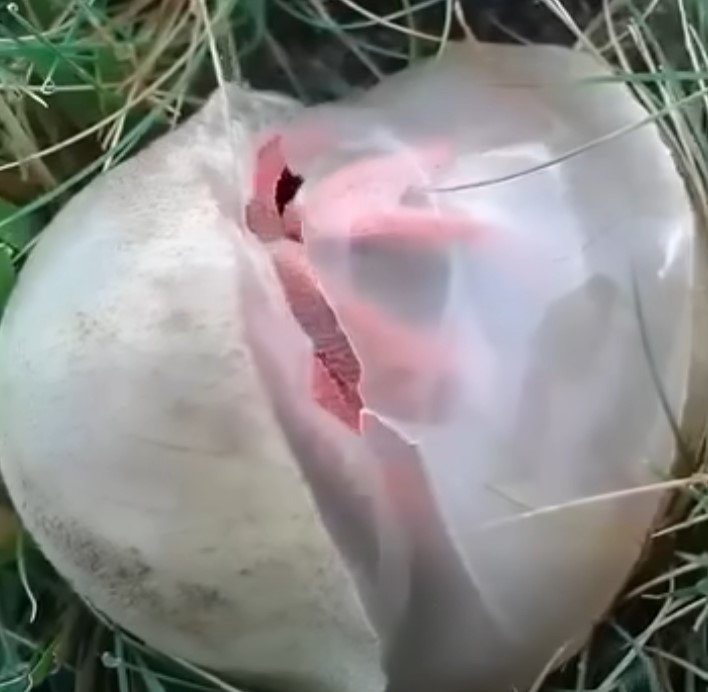
Before the red arms become visible, Devil’s Fingers exists in a much less dramatic form.
It begins as a pale structure hidden beneath or partially within the soil.
At this stage, it can easily go unnoticed.
The fungus remains concealed until environmental conditions support further development.
When the time is right, the outer layer splits apart.
The red arms then emerge and gradually unfold.
This transformation can appear sudden to anyone who discovers it after the process is underway.
The dramatic change is one reason the fungus often surprises gardeners.
One day the area appears normal, and shortly afterward a vivid red structure seems to have appeared from nowhere.
In reality, the fungus has been developing beneath the surface long before it becomes visible.
An Unexpected Lesson About the Hidden Life of Gardens
The discovery encouraged a different way of thinking about the garden.
What had previously seemed like a familiar and predictable space suddenly appeared much more complex.
Beneath the soil, countless organisms carry out their life cycles unnoticed.
Fungi, insects, microorganisms, and plant roots interact continuously below the surface.
Most of these processes remain invisible until something unusual emerges.
The appearance of Devil’s Fingers served as a reminder that gardens are not static environments.
They are active ecosystems filled with hidden activity.
The fungus simply happened to reveal a small part of that hidden world.
Its presence demonstrated that remarkable biological processes can exist only a few steps from a home without attracting attention.
Curiosity Replaces Initial Fear
Over the following days, the homeowner continued to observe the fungus.
The unpleasant smell remained difficult to ignore, but curiosity gradually replaced alarm.
Each visit offered an opportunity to study details that had initially been overlooked.
The arms appeared sculpted in their arrangement, twisting in different directions while maintaining a striking symmetry.
Sunlight reflected from the moist surfaces, emphasizing the unusual texture.
Meanwhile, insects could be seen visiting the fungus exactly as intended by its survival strategy.
The scene became a living demonstration of how the organism functioned.
What first appeared frightening had become a source of fascination.
The fungus had not changed.
The understanding of it had changed.
A Discovery That Drew Interest From Fungal Enthusiasts
Photographs of the fungus were later shared with a local mycology group.
People familiar with fungi quickly recognized the species.
The responses reflected genuine interest rather than concern.
Several members confirmed the identification and noted that sightings remained relatively uncommon in the area.
The discovery therefore represented more than an unusual backyard encounter.
It became a noteworthy observation of a distinctive species appearing in a local environment.
The experience demonstrated how even small observations can contribute to broader awareness of fungal diversity.
For the homeowner, what began as a search for the source of a bad smell became an opportunity to learn about a remarkable organism.
Understanding the Science Behind the Appearance
The strongest reaction to Devil’s Fingers often comes from its appearance.
The human brain naturally associates certain colors, textures, and smells with danger or decay.
The fungus takes advantage of those same associations when attracting insects.
The red coloration resembles flesh.
The dark slime resembles decomposition.
The smell mimics the scent of rotting material.
Together, these features create an effective illusion.
For flies, the deception works remarkably well.
They are drawn toward what appears to be a potential food source or breeding location.
In the process, they help the fungus distribute its spores.
What appears disturbing to people is actually a highly specialized adaptation.
A Memorable Reminder of Nature’s Creativity
Eventually, the fungus completed its life cycle and disappeared from the garden.
The powerful odor faded, and the flowerbed returned to its familiar appearance.
Yet the encounter left a lasting impression.
The most memorable aspect was not simply the shock of discovering bright red fingers emerging from the soil.
It was the realization that the strange object represented an ingenious survival strategy.
The experience highlighted how quickly fear can arise when something unfamiliar appears.
It also demonstrated how understanding can completely change that reaction.
Once identified, the fungus no longer seemed threatening.
Instead, it became an example of adaptation, persistence, and the extraordinary diversity of life.
Nature often presents beauty in familiar forms such as flowers, trees, and birds.
At other times, it reveals itself through organisms that challenge expectations.
Devil’s Fingers belongs firmly in that second category.
Its appearance may seem unsettling, but every feature serves a purpose.
The vivid color, powerful smell, and sticky spores work together to ensure survival.
In the end, the strange red fungus transformed an ordinary morning into an unforgettable lesson about the hidden wonders that can exist in even the most familiar backyard garden.
