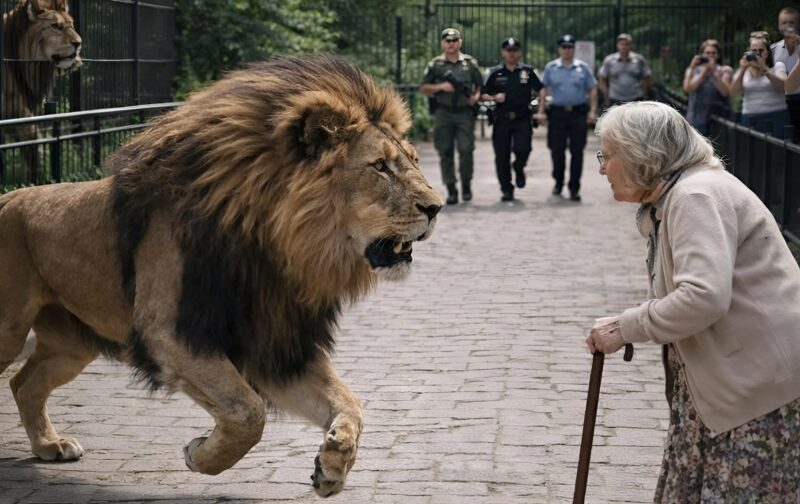
A Lion Escaped From the Zoo and Stopped Beside an Elderly Woman in a Park: What Happened Next Changed Everything
An Ordinary Morning That Quickly Turned Into Chaos
It began as a normal morning at the zoo, with staff carrying out routine checks and visitors moving peacefully through the walkways. Nothing suggested that the day would take a dramatic turn.
That sense of calm was shattered when sudden screams echoed across the main visitor area. People began running in every direction, with some grabbing children and others rushing to find shelter inside nearby shops or behind barriers.
Amid the confusion, staff members rushed toward the source of the panic, only to witness a sight that immediately changed the atmosphere from confusion to alarm.
A full-grown lion was moving through the visitor pathways inside the zoo.
How the Lion Escaped Its Enclosure
Zoo personnel later determined that a power failure had occurred during the night. This disruption caused an electronic locking system on one of the enclosures to fail, allowing the animal to escape.
The lion, named Atlas, left its enclosure without forcing its way through physical barriers. Instead, the unlocked system provided an unexpected opening that made the escape possible.
Despite the sudden freedom, the animal did not immediately behave in a violent or chaotic manner. Instead, it moved with surprising calmness, walking through the zoo grounds without attacking or chasing visitors.
Witnesses observed that Atlas appeared focused, pausing occasionally as if reacting to distant scents before continuing forward. This unusual behavior created both confusion and heightened concern among those attempting to respond to the situation.
From the Zoo to the Streets
After moving through internal pathways, the lion reached a service exit gate and forced its way out onto nearby streets. Authorities were immediately alerted, and emergency response teams were deployed.
Police units and veterinary specialists equipped with tranquilizer tools began tracking the animal’s movement. As word spread, panic quickly developed in surrounding areas. Vehicles stopped abruptly, pedestrians scattered, and streets were cleared in urgency.
Despite the growing response effort, the lion continued forward without reacting to the surrounding commotion. At times, it paused briefly, lifted its head, and appeared to be following a specific direction.
This steady and deliberate movement made it increasingly difficult for responders to predict its path.
The Unexpected Stop in a Quiet Park
Several blocks away, the lion entered a small public park. There, an elderly woman was sitting calmly on a bench, feeding pigeons with small pieces of bread.
The contrast between the peaceful scene and the approaching danger was immediate and striking. The lion moved closer from behind, while response teams positioned at a distance prepared for intervention.
Officers raised their equipment, ready to act, but hesitated as the situation developed in an unexpected direction.
The woman turned around.
In that moment, instead of reacting aggressively or continuing forward, the lion stopped completely.
A Reaction No One Expected
After pausing, the lion slowly approached the elderly woman and lowered itself to the ground beside her feet. Its behavior shifted from tense movement to calm submission.
It pressed its head gently against her knees and remained still, making low, soft sounds that resembled quiet vocalizations rather than aggression.
Those observing from a distance were unable to immediately explain the behavior. The tension in the area eased slightly, but uncertainty remained as responders cautiously moved closer.
When asked to explain the situation, the woman identified herself as Margaret.
Margaret’s Story From Years Earlier
Margaret explained that many years earlier she had worked as a volunteer in Africa. During that time, she encountered a young lion cub whose mother had been killed by poachers.
The cub had suffered serious injuries, including a broken paw and a severe infection. Its survival was uncertain, and its condition required intensive care.
She took responsibility for the cub’s recovery, feeding it, treating its injuries, and staying with it through the most difficult stages of its healing process. Over time, the animal survived, although its injured paw healed in a way that left a permanent limp.
Because it was no longer suitable for release into the wild, the lion was eventually placed in a zoo for long-term care. Margaret later left the animal’s life as she continued her conservation work, focusing on protecting wildlife in other regions.
A Reunion Years in the Making
After many years away, Margaret eventually returned and visited the zoo with her granddaughter. It was during this visit that she recognized the lion, now fully grown, by a distinctive scar on its paw.
She chose not to approach at the time and left quietly, not realizing that the animal had recognized her presence through scent.
According to what was later understood, the lion’s escape was not driven by aggression or randomness. Instead, it appeared to follow a familiar scent that led it directly toward her location.
That path ultimately brought it to the park where the unexpected reunion occurred.
A Bond That Continued Beyond the Enclosure
Following the incident, zoo management reviewed the situation and later granted Margaret unrestricted access to visit the enclosure.
She often spent time near the glass, sitting quietly while the lion rested on the other side. On many occasions, she would read or speak softly, creating a calm routine that visitors came to recognize.
The animal would lie close to the barrier, remaining still as if responding to her presence with familiarity and recognition.
Over time, these visits became a regular part of the zoo environment.
The Passage of Time and a Sudden Loss
As the years went on, staff began to notice changes in Margaret’s visits. She appeared less frequently and moved more slowly with each passing season.
Eventually, one of her usual visits did not occur. The chair near the enclosure remained empty, while the lion showed signs of restlessness and agitation.
Not long after, it was learned that Margaret had passed away in her sleep.
When staff returned to the enclosure, the lion reacted with prolonged agitation, pacing and vocalizing in a way that reflected distress and confusion.
Those observing believed the animal recognized the absence of someone it had long associated with safety and familiarity.
A Final Act of Care
Shortly after her passing, it was revealed that Margaret had made arrangements in her will following the earlier incident. Her instructions directed that her home be sold and that the proceeds be donated to the zoo.
The funds were intended to improve conditions for the lion and other animals in its care.
This final gesture reflected a connection that had lasted across decades, beginning with the rescue of a vulnerable cub and continuing through an unexpected reunion years later.
What began as a zoo escape ultimately became a story defined not by fear alone, but by an enduring bond between a human and an animal shaped by trust, survival, and memory.
