
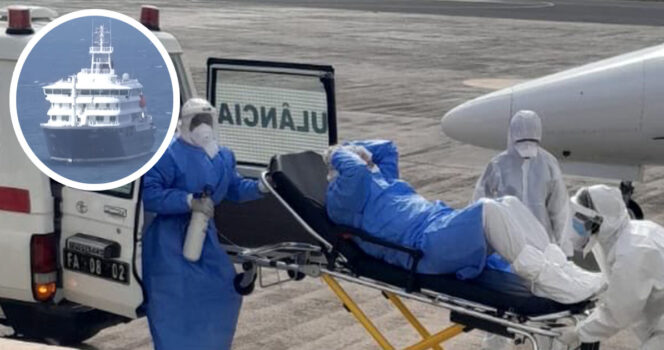
A suspected case of hantavirus aboard the expedition cruise ship MV Hondius has led to another emergency medical evacuation, as new images released by health officials reveal the seriousness of the situation unfolding in the Atlantic Ocean.
The Dutch-flagged vessel, carrying nearly 150 passengers and crew members, has remained under close monitoring after multiple people onboard developed symptoms linked to hantavirus, a rare but potentially deadly disease associated with rodents.
On Wednesday, World Health Organization Director-General Tedros Adhanom Ghebreyesus shared new details and photos showing a patient being evacuated from the ship near the coast of Cape Verde.
The images showed emergency crews in full protective gear transferring a suspected patient from an ambulance into a medical aircraft. Police officers wearing hazmat suits were also seen stationed at the port in the capital city of Praia, highlighting the precautions being taken during the operation.
According to health officials, three suspected hantavirus patients were evacuated from the vessel and transported for medical care in the Netherlands. The evacuation was coordinated between the WHO, the cruise operator, and health authorities from Cape Verde, the United Kingdom, Spain, and the Netherlands.
The patients reportedly include a 56-year-old British passenger, a 65-year-old German national, and a 41-year-old Dutchman. One of the individuals evacuated is believed to be the ship’s doctor, who had previously been listed in serious condition. Officials later said his condition had shown signs of improvement.
The outbreak has already turned deadly. Authorities confirmed that three people connected to the incident have died, while several others continue to be monitored closely for symptoms.
The situation began after the MV Hondius departed from Ushuaia, Argentina, on April 2 for an expedition voyage across the Atlantic. During the journey, several passengers reportedly developed a rapidly progressing respiratory illness, prompting growing concern among medical authorities.
Health experts say hantavirus infections are rare but extremely dangerous. The virus is usually spread through contact with infected rodents, particularly exposure to their urine, droppings, or saliva. In some cases, contaminated particles can become airborne and inhaled without direct contact.
Doctors investigating the outbreak believe the source may be linked to exposure during land excursions earlier in the trip rather than from conditions onboard the vessel itself. Officials stated that no rodents have been discovered on the ship so far.
However, investigators are also examining the possibility of limited person-to-person transmission. While this type of spread is considered very rare, it has been associated with a strain known as the Andes virus, which has one of the highest fatality rates among hantavirus infections.
Medical experts warn that symptoms can initially resemble the flu before rapidly progressing into severe breathing complications. Serious cases can develop into hantavirus pulmonary syndrome, a life-threatening condition that often requires intensive care treatment.
Despite the alarming developments, the World Health Organization currently considers the broader public health risk to remain low. Monitoring programs have been launched both for passengers still onboard and for individuals who may have already left the vessel earlier in the journey.
The MV Hondius is expected to continue toward Tenerife in the Canary Islands, where passengers will eventually be allowed to disembark. Spanish authorities stated that non-Spanish travelers would likely be transferred directly to their home countries rather than remaining in Spain.
For passengers still onboard, uncertainty continues to hang over the voyage. Many remain confined to the ship while health teams monitor for any additional symptoms during the virus’s incubation period.
The newly released images of patients being evacuated in protective isolation gear have only intensified global attention on the incident, raising concerns about how quickly rare infectious diseases can create emergencies even in highly controlled travel environments.

