
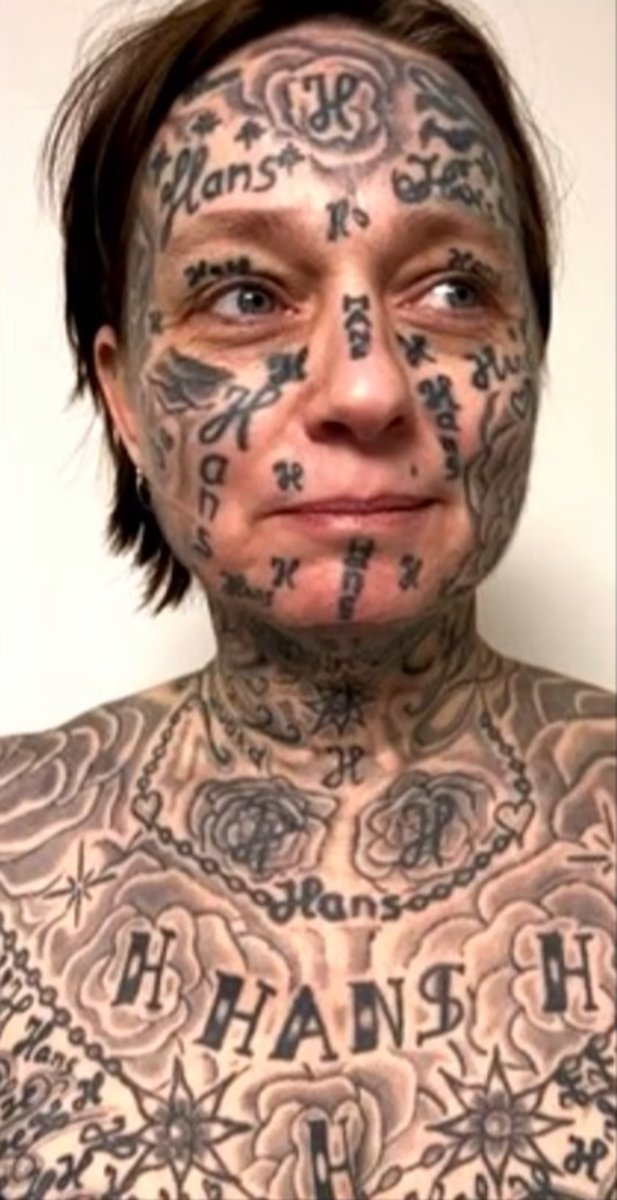
Authorities and support organizations in the Netherlands are currently drawing attention to a deeply disturbing case involving a 52-year-old woman known as Joke, whose story has sparked widespread international discussion. At the center of this situation is her ongoing effort to remove extensive tattoos that she claims were forcibly applied by her former partner as part of a pattern of coercive and abusive behavior.
According to accounts shared by advocacy groups and reported sources, Joke’s ex-partner allegedly used a tattoo machine over a prolonged period to repeatedly inscribe his name and controlling messages across her body. These markings were reportedly placed in highly visible areas, including her torso and face, and are described by supporters as symbols of extreme psychological control combined with physical coercion. The case has been widely discussed as an example of how abuse can extend beyond emotional manipulation and result in lasting physical consequences.

The story gained significant public attention after it was revealed that Joke is undergoing an extensive and costly tattoo removal process. Medical experts note that removing large-scale tattoos is far more complex than applying them, often requiring multiple laser sessions over an extended period of time. In this case, the process is expected to continue for several years, with full completion projected well into the future due to the density and placement of the ink.

In response to her situation, Joke has become associated with a Dutch awareness initiative aimed at highlighting forms of abuse that are not always immediately visible. The campaign, supported by organizations focused on tattoo removal and trauma recovery, emphasizes the long-term impact of coercive control and psychological violence. One of the central goals of the initiative is to bring attention to how abusive relationships can involve not only emotional harm but also irreversible physical alterations imposed on victims.
Supporters of the campaign have highlighted that Joke’s experience reflects a broader issue in cases of domestic and psychological abuse, where victims may be subjected to sustained patterns of domination and control. In some instances, such behavior can include acts intended to mark or permanently associate a victim with an abuser, thereby reinforcing dependency and limiting autonomy. While such cases are not representative of all abusive relationships, professionals in the field of domestic violence prevention stress that coercive control can take many forms, some of which leave lasting physical and psychological effects.

To assist with her recovery, a crowdfunding effort was launched to help cover the significant financial cost of tattoo removal treatments. Reports indicate that the estimated expense for the full procedure is in the tens of thousands of euros. The funds raised have allowed Joke to begin an ongoing series of laser treatments, which are gradually reducing the visibility of the tattoos, particularly in more exposed areas such as the face. However, specialists involved in similar procedures emphasize that complete removal is often difficult and may not always result in total erasure of ink, especially when tattoos are deeply layered or extensively applied.
The organization supporting her case has described the initial medical assessment as emotionally challenging, noting the scale and visibility of the tattoos. Despite this, they have also pointed to measurable progress in the removal process. The treatment is being carried out gradually to minimize skin damage and ensure safe healing between sessions, which further extends the timeline for full recovery.
https://x.com/MerGarza/status/2043147536714625378?
Beyond the physical aspect of tattoo removal, advocates involved in the campaign stress the psychological dimension of Joke’s recovery. They highlight that the visible changes to her body represent only one part of a much longer healing process. Emotional recovery from prolonged coercion and abuse often requires continued support, counseling, and time to rebuild a sense of personal autonomy and identity.
The case has also prompted broader public discussion about the hidden nature of psychological violence. Experts in domestic abuse prevention note that coercive control is often difficult to identify from the outside, as it may not always involve visible injuries or immediate signs of harm. Instead, it can manifest through patterns of dominance, restriction, and manipulation that gradually erode a person’s independence.

At the same time, professionals have emphasized the importance of access to resources for survivors, particularly when financial barriers make recovery more difficult. In situations involving physical alterations such as tattoos, costs associated with removal procedures can create additional obstacles for individuals attempting to rebuild their lives after leaving abusive environments.
Joke’s decision to participate in public awareness efforts has contributed to ongoing conversations about these issues. By allowing her experience to be shared, supporters say she has helped draw attention to forms of abuse that are often overlooked or misunderstood. The intention behind this visibility is not only to document her personal recovery but also to encourage others in similar situations to seek help and support.
While her physical transformation is expected to continue over a long period of time, advocates stress that the significance of her story extends beyond appearance. It serves as an example of both the lasting impact of coercive abuse and the possibility of recovery through sustained support and intervention.
Ultimately, the case underscores the complex reality of recovery from long-term abuse, where healing involves both visible and invisible dimensions. As Joke continues her treatment, her situation remains a focal point in discussions about psychological violence, bodily autonomy, and the long path toward rebuilding life after coercion.

