
A Quiet Airport Moment Turns Into an Unforgettable Performance
Airports are typically associated with movement, urgency, and constant activity. People move quickly from one place to another, announcements echo across large terminals, and attention is usually focused on schedules, boarding times, and destinations. It is an environment where stopping, even for a moment, is often seen as a delay rather than an opportunity.
On this particular day, however, something unexpected interrupted that familiar rhythm and transformed the atmosphere in a subtle but meaningful way.
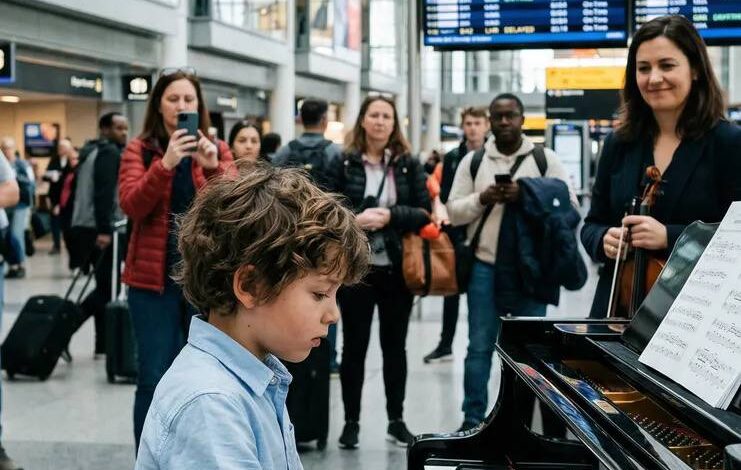
In the middle of a busy terminal, a young boy approached a public piano and quietly took a seat. At first, the moment seemed entirely ordinary. Travelers passed by without much notice, assuming it was simply a child exploring the instrument while waiting for a flight. The background noise of rolling suitcases, distant conversations, and overhead announcements continued as usual.
Then he began to play.
From the very first notes, it became clear that this was not a casual or random attempt at music. The sound was controlled, confident, and structured. There was a level of precision in his playing that immediately stood out against the surrounding noise. What initially blended into the background quickly began to draw attention.
People who had been walking past slowed down. Some turned their heads, curious about the unexpected shift in sound. Others paused completely, their focus moving away from their travel plans and toward the performance unfolding in front of them.
As the music continued, the number of listeners gradually increased. A small group began to form, not in a loud or disruptive way, but naturally. Individuals chose to stay rather than move on. Some stood quietly nearby, while others observed from a distance, allowing the moment to unfold without interruption.
The transformation of the environment was noticeable. The urgency that typically defines an airport began to soften. Conversations became quieter, and in many cases, stopped altogether. The structured rhythm of the piano replaced the scattered noise of the terminal, creating a sense of calm and focus.
For a brief period, the airport no longer felt like a place defined by transit and time constraints. Instead, it became a shared space where strangers experienced the same moment together. People who had no connection to one another found themselves united by the same performance, if only for a short time.
The boy remained focused throughout. His posture, hand movements, and steady pace reflected concentration and familiarity with the instrument. There was no visible distraction from the growing audience around him. He played as though the environment had shifted entirely, creating a space defined only by the music itself.
As more people gathered, some began to record the performance on their phones. Not out of spectacle, but as a way to capture something that felt genuine and unexpected. In a setting where most interactions are brief and functional, this moment offered something different—an experience that invited attention rather than urgency.
The performance also introduced a contrast between expectation and reality. Airports are not typically associated with artistic expression or extended moments of stillness. They are places where efficiency and movement take priority. Yet, in this case, a simple act changed how the space was perceived, even if temporarily.
There was no stage, no formal introduction, and no announcement to draw attention. The moment developed naturally, without planning or promotion. This lack of structure contributed to its impact. It felt authentic rather than arranged, allowing people to engage with it in their own way.
As the music continued, the sense of shared experience deepened. Some listeners stood with quiet focus, while others exchanged brief glances that reflected a mutual recognition of the moment. There was no need for conversation. The performance itself became the central point of connection.
The environment, usually defined by overlapping sounds and constant motion, took on a different character. The piano created a focal point that brought clarity and cohesion to the space. Instead of multiple competing noises, there was a single, structured sound that guided attention.
When the performance reached its conclusion, the shift in atmosphere became even more apparent. For a moment, there was a pause—an acknowledgment of what had just taken place. Then, gradually, the usual rhythm of the airport returned.
People resumed their movement toward gates and departure areas. Conversations picked up again, and announcements continued overhead. The temporary stillness faded, replaced by the familiar pace of travel.
However, the impact of the moment remained. For those who had stopped to listen, the experience was likely to stay with them beyond the terminal. It served as a reminder that even in highly structured environments, unexpected moments can create meaningful pauses.
The significance of the performance was not limited to technical skill or musical ability. While the boy’s playing was clearly advanced, what made the moment stand out was its context. It occurred in a place where such experiences are not typically expected, making it more noticeable and memorable.
It also highlighted the way environments can change based on small actions. A single individual, without intention to alter the space, influenced the behavior of those around him. By simply playing the piano, he shifted attention, slowed movement, and created a shared experience among strangers.
In many ways, the moment reflected the importance of presence. Travelers who chose to stop and listen stepped out of their routine, even briefly. They allowed themselves to engage with something outside of schedules and destinations, which is not always common in fast-paced settings.
The reaction of the audience also demonstrated how people respond to authenticity. There was no expectation or obligation to watch. Each person made an individual choice to stay, listen, and observe. That collective decision gradually transformed the space into something more than a transit point.
For the boy, the performance appeared to be a natural expression rather than a deliberate attempt to gather attention. His focus remained on the music, not the audience. This contributed to the sense that the moment was genuine and unforced.
As a result, the experience felt less like a performance and more like a shared pause in time. It did not rely on amplification, staging, or formal recognition. Instead, it depended on the interaction between the music and the environment.
The memory of such moments often extends beyond their duration. Travelers may continue their journeys, but the experience remains part of their day. It adds a layer of meaning to what might otherwise be a routine passage through an airport.
This event also illustrates how public spaces can serve multiple purposes. While airports are designed for efficiency and movement, they also have the potential to host moments of connection and reflection. These moments may be brief, but they can influence how people perceive their surroundings.
In conclusion, what began as a simple act—a young boy sitting at a piano—developed into something far more significant. It transformed a busy terminal into a space of attention, stillness, and shared experience.
The performance did not rely on scale or promotion. Its impact came from timing, authenticity, and the natural response of those who witnessed it. For a short period, the usual flow of the airport was interrupted, replaced by a moment that encouraged people to pause and listen.
When everything returned to normal, the memory of that pause remained. It served as a quiet reminder that even in the most routine environments, unexpected moments can create lasting impressions.

