
Career Day Incident at Northwood Ridge Elementary Prompts Policy Review and Discussion on Bias
A classroom activity at Northwood Ridge Elementary has led to a broader conversation about bias, classroom conduct, and institutional responsibility after a student’s Career Day assignment resulted in an unexpected and widely discussed incident. The situation, which began as a routine school exercise, ultimately prompted administrative review and policy changes within the school.
The event centered on ten-year-old Maya Carter, who approached her assignment with sincerity. The task asked students to describe what their parents did for a living. In her response, Maya wrote that her father was General Marcus Carter and that her mother, Elena Carter, worked as a housekeeper. She added that both of them helped people.
Her answer reflected a straightforward and personal perspective. From her point of view, both of her parents contributed meaningfully through their work, and she expressed pride in each of them. There was no indication in her writing that she viewed their roles as unequal or contradictory.
According to accounts of the incident, the situation changed when her teacher, identified as Mrs. Diane Wexler, reviewed the assignment in class. What had been a routine moment in a typical school day quickly became the focus of attention.
Witnesses described a shift in tone when the teacher questioned the accuracy of Maya’s statement about her father’s position. The response reportedly included skepticism expressed publicly in front of classmates, parents, and visitors who were present for the Career Day activity.
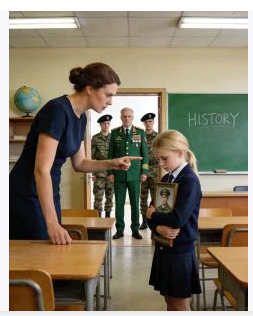
Maya responded by explaining that her statement was truthful. However, the exchange continued, and she was asked to provide proof. In response, she presented a photograph showing her family together at a formal event, with her father in uniform.
Despite this, the situation escalated further. The photograph was reportedly dismissed, and the assignment itself was torn. The action occurred in front of others in the classroom, drawing attention to the interaction and increasing the emotional impact on the student.
Following this exchange, Maya was instructed to leave the classroom and go to the principal’s office. According to reports, she was told to explain that she had disrupted the class. This development marked a transition from a classroom disagreement to an administrative matter.
In the principal’s office, the initial response appeared to rely on the teacher’s account of events. Maya was reportedly asked to rewrite the assignment and apologize. At that stage, her explanation had not yet been independently verified.
The situation took a significant turn shortly before 10 a.m., when a call from the front office indicated that a visitor had arrived at the school. The individual was identified as General Marcus Carter, Maya’s father, whose presence confirmed the accuracy of her original statement.
His arrival shifted the context of the situation. School administrators and staff were then required to reassess the earlier assumptions that had shaped their response. The discrepancy between the initial reaction and the verified information became central to what followed.
General Carter requested to address the matter in the same classroom where the incident had occurred. According to those present, the discussion focused not only on the assignment itself but also on how the situation had been handled.
During the exchange, attention turned to the assumptions that influenced the teacher’s response. The issue extended beyond a simple misunderstanding and raised questions about how perceptions of occupation and status may affect judgment in educational settings.
General Carter emphasized that his wife’s role as a housekeeper was an honest and important form of work. He indicated that the problem was not a lack of information alone, but the underlying belief that Maya’s statement could not be accurate based on her mother’s occupation.
This perspective reframed the incident as a broader issue involving bias rather than an isolated classroom disagreement. It also highlighted how quickly such assumptions can influence authority, credibility, and decision-making.
An apology was later issued to Maya. According to accounts, it came after the situation had been clarified and acknowledged. Maya’s response reportedly focused on a simple expectation—that her statement be believed without requiring further validation.
The incident did not end with the classroom discussion. It prompted a formal review by the school and district. Initial descriptions characterized the situation as a misunderstanding, but further consideration led to a broader evaluation of policies and practices.
As a result, changes were implemented. These included updates to school policies and the introduction of mandatory staff training focused on recognizing and addressing bias. The review process also created an opportunity for additional perspectives to be considered.
Maya’s mother, Elena Carter, also became part of the conversation. She expressed pride in her daughter and addressed the situation by emphasizing that the issue was not simply an incorrect assumption, but the belief that certain combinations of roles and identities were unlikely or invalid.
Her perspective contributed to the broader discussion about how different forms of work are perceived and valued. It also reinforced the importance of treating all students and families with equal respect, regardless of occupation or background.
In the weeks following the incident, Maya returned to class and completed the assignment again. This time, she presented the same information about her parents with confidence. The response from classmates reflected a more supportive and attentive environment.
The event has since been viewed as an example of how everyday classroom situations can reveal larger issues. It illustrates the potential impact of assumptions and the importance of verifying information before drawing conclusions, particularly in educational settings.
It also underscores the role of schools in fostering environments where students feel respected and heard. Ensuring that all students are treated fairly is a key component of maintaining trust within the classroom.
The policy changes that followed demonstrate how institutions can respond to incidents by reassessing their practices. While the situation began with a single assignment, it ultimately led to broader reflection and adjustments aimed at preventing similar occurrences in the future.
More broadly, the incident highlights the importance of maintaining awareness of how bias—whether intentional or not—can influence interactions. It also shows how accountability and corrective action can contribute to positive change.
For Maya, the experience was both challenging and formative. What began as a moment of misunderstanding became part of a larger conversation about dignity, respect, and fairness.
The situation serves as a reminder that honesty and personal experience should be met with consideration, especially in environments designed to support learning and development. It also reinforces the idea that every student’s voice deserves to be heard and respected.
As schools continue to evaluate their policies and practices, incidents like this can play a role in shaping more inclusive and thoughtful approaches to education. The outcome at Northwood Ridge Elementary reflects an effort to learn from the experience and move forward with greater awareness.
Ultimately, the lesson extends beyond a single classroom. It speaks to the importance of treating all individuals with fairness and recognizing the value of every form of work and contribution.

