The Shelter Dog Who Protected a Life Hidden in His Harness
A Routine Morning in an Overcrowded Shelter
The bold red stamp on the clipboard carried an unmistakable meaning for the staff working that morning inside the crowded municipal shelter. It marked another difficult decision in a system already strained by constant intake and limited space. For the team on duty, these decisions had become part of a heavy routine, repeated far too often in environments where time and resources were never enough.
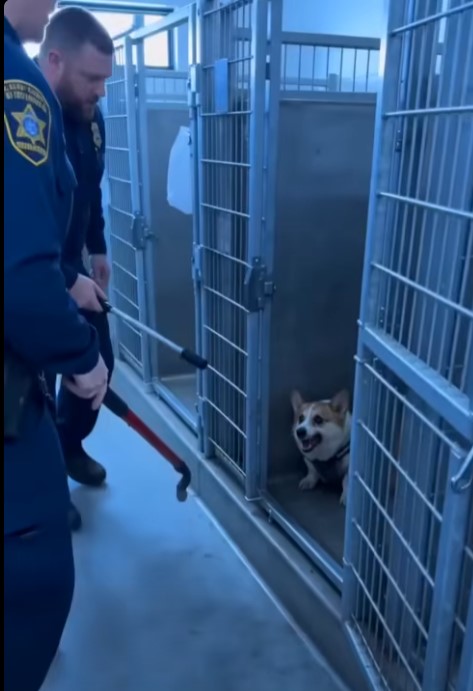
In one of the rear isolation runs, a small Pembroke Welsh Corgi identified only as Tag #842 sat pressed tightly against a cold metal wall. His body trembled continuously, and his short legs were tucked beneath him as if trying to make himself disappear into the concrete behind him. Every sound in the corridor seemed to tighten his posture further, as though the environment itself was closing in.
To many of the staff members who had processed his intake, the dog had already been labeled unmanageable. During arrival, he had snapped at handlers, barked with intensity whenever someone came near, and resisted every attempt at a basic examination. Each interaction reinforced the same conclusion within the intake reports, building a profile that painted him as unpredictable and unsafe to handle.
The Growing Belief of a Dangerous Case
As hours passed and observations accumulated, the consensus became increasingly rigid. The Corgi was considered too volatile for adoption pathways and too stressed to be safely rehabilitated within the shelter’s capacity. The situation appeared, on paper, to have no workable outcome beyond the scheduled procedure set for later that morning.
Yet not everyone saw the situation in the same way. Veterinary technician Sarah Collins had spent years inside similar environments, learning to distinguish between genuine aggression and fear-driven responses. As she reviewed the notes and observed the animal from a distance, she recognized patterns that did not align with calculated hostility. What she saw instead was a creature overwhelmed by panic, reacting to every stimulus as if it were a threat without the ability to process safety.
Each movement, each bark, and each defensive posture appeared reactive rather than intentional. The dog seemed cornered not only physically but psychologically, responding to fear rather than control or dominance.
An Unusual Detail in the Isolation Corridor
As the morning progressed toward the scheduled procedure, Sarah requested one final evaluation before any irreversible action was taken. When she stepped into the isolation corridor, the overhead fluorescent lights flickered irregularly, casting shifting patterns of brightness and shadow across the worn concrete floor.
The moment the Corgi noticed her presence, his entire body flattened further against the wall. His breathing quickened, and his eyes followed every subtle movement she made. It was then that Sarah noticed something that had not been clearly documented in the intake records. Wrapped tightly around the small body was a large black tactical harness.
The equipment stood out immediately. It was not the type of harness used for ordinary companion animals. The material appeared reinforced, with heavy stitching and multiple attachment points designed for utility rather than comfort. Velcro patches, dulled by dirt and exposure, suggested long-term use in demanding environments. The overall construction resembled gear intended for working animals operating under structured conditions rather than shelter intake cases.
The Behavior That Changed Everything
What drew Sarah’s attention even more than the harness itself was the dog’s behavior toward it. He was not attempting to escape the room or the people around him. Instead, his movements consistently positioned his body between the staff and the harness, as though it contained something that required protection.
Each time she stepped closer, he shifted again, lowering his chest and angling himself to block access to the front pouch. The behavior did not resemble self-defense alone. It resembled guarding behavior directed toward an external object rather than himself.
At first, Sarah considered the possibility of an injury concealed beneath the gear. Internal trauma, a mass, or an untreated wound could potentially explain both the aggression and the protective posture. The uncertainty was significant enough to halt any immediate decisions regarding the planned procedure, at least temporarily.
Careful Approach and First Contact
Sarah requested a brief extension of time and slowly entered the space again. She lowered herself to reduce her profile and spoke in a steady, calm tone meant to avoid triggering further distress. The Corgi responded with a low growl, but it lacked strength or confidence. It sounded more like exhaustion than warning, as though even the act of resisting was becoming too difficult to sustain.
Step by step, she closed the distance between them. The dog remained tense, but he did not lunge or attack. Instead, his body trembled, and his eyes narrowed as if bracing for something he expected but could not avoid. When her hands finally reached the harness, she paused for a moment, sensing the level of stress concentrated in the small animal.
Despite the tension, there was no bite or sudden aggression. The dog closed his eyes and shuddered, holding still as if accepting the interaction. That moment allowed her to continue.
The Hidden Movement Inside the Harness
As her fingers traced along the outer pouch of the harness, she noticed an unusual inconsistency in shape. It was not rigid or fixed like scar tissue or a structural injury. Instead, it shifted slightly under pressure, soft in some areas and uneven in others.
Sarah stopped immediately, focusing on the subtle movement she had just detected. She pressed lightly again, confirming that the motion was real. Something inside the compartment was alive.
Her breathing tightened as she carefully unfastened the buckle and opened the pouch. The interior revealed a sight that changed the entire situation instantly.
Inside, curled tightly against the fabric lining, was a tiny newborn kitten no larger than the palm of a hand. Its eyes remained closed, and its body appeared weak and underdeveloped. Its breathing was shallow, irregular, and fragile, suggesting it had endured difficult conditions for an extended period.
A Shift in Understanding
In that moment, the entire interpretation of the Corgi’s behavior shifted completely. The earlier assumptions of aggression and instability no longer aligned with what was now visible. Every defensive action, every warning growl, and every refusal to be handled had been connected to protection rather than hostility.
The dog had not been resisting care. He had been preventing perceived threats from reaching something extremely vulnerable. Even in a state of injury and exhaustion, his focus had remained fixed on safeguarding the fragile life he carried.
When Sarah gently lifted the kitten from the pouch, the Corgi immediately reacted. His posture changed as he leaned forward, eyes tracking the small animal. He sniffed carefully and nudged it with a cautious motion, as though verifying that it was still alive and present.
Medical Emergency and Immediate Response
Staff quickly arrived as the situation escalated into an urgent medical emergency. While one group focused on stabilizing the kitten through warming treatment and neonatal care, another turned their attention to the Corgi’s deteriorating condition.
As the harness was carefully removed for a full examination, a far more serious injury became visible beneath the dense fur on his chest. A deep wound, partially scabbed, had been concealed by the tight pressure of the gear. The compression had slowed bleeding, unintentionally acting as a crude form of stabilization rather than a true solution.
Once the harness was loosened, his breathing changed noticeably. Moments later, his body gave out, and he collapsed. Emergency intervention began immediately to stabilize him and address the underlying trauma.
The Identification That Changed the Case
During inspection of the discarded harness, staff discovered a hidden compartment containing a military identification card. The name printed on it was Captain James Sterling.
The shelter director, upon hearing the identification, reacted with immediate shock. The name was familiar and carried personal significance, connected to her son, a military officer who had gone missing during severe flooding after his vehicle was lost near a collapsed roadway. Search efforts had continued without results until that moment.
A Race Against Time in the Flood Zone
Further analysis of the situation connected the Corgi to a larger unfolding event. The dog, now identified as Barnaby, was understood to have been a trained military working animal assigned to Captain Sterling.
Following the flooding incident, both the officer and the dog had survived the initial impact. Despite serious injury, Barnaby had moved through dangerous terrain under extreme conditions. At some point during that ordeal, he encountered the newborn kitten, likely separated from its surroundings during the chaos, and carried it within the only secure space available—the tactical harness.
Even while injured, he continued moving through hazardous conditions, preserving both the kitten and the identification that would eventually guide rescuers toward his handler.
Using environmental clues and information associated with the harness, search teams were able to significantly narrow their operational area. Within hours, they located Captain Sterling alive, though critically injured and requiring immediate medical evacuation.
Recovery and Reunion
In the following days, both Barnaby and Captain Sterling began recovery under medical care. The kitten survived through continuous neonatal support, gradually stabilizing under specialized treatment.
When Barnaby was brought into the recovery room where his handler was being treated, the atmosphere shifted into silence. The captain, still weak and limited in movement, remained still as the dog entered.
There was no panic or confusion from the animal. Instead, Barnaby paused briefly, then moved forward with measured steps. He placed his head gently against his owner’s hand, remaining still in quiet recognition.
The moment extended without sound, carrying an understanding that did not require expression through movement or voice. Staff present during the reunion later described it as one of the most profound experiences they had witnessed in their professional lives.
The animal once labeled dangerous was now understood in a completely different light. He had not been unpredictable or aggressive in the way he was first perceived. He had been carrying a burden of protection, endurance, and loyalty under conditions that few could comprehend.
A Lasting Lesson
Barnaby’s story remained with everyone involved long after the events concluded. It became a reminder that outward behavior does not always reflect intention, and that fear can often be mistaken for aggression when viewed without context.
Not all defensive reactions represent violence. Not all distress signals indicate danger to others. Sometimes, what appears chaotic on the surface is actually the effort of a determined mind working to protect something fragile until help finally arrives.
