
The veteran paused for a long time before making his decision. It was not an easy choice, and in truth, it was one he had avoided for as long as possible. But on that particular day, the situation had reached a point where he felt he had no alternatives left. His refrigerator had been empty for days, his money had run out, and asking for help was something he simply did not know how to do. Independence had defined his entire life.
He sat in his old wheelchair, its worn wheels squeaking slightly as he moved. Each push forward required effort. Every street felt longer than it once had, every small incline more difficult to overcome. Still, he continued, relying on the same determination that had carried him through much harder circumstances in the past.
There had been a time when his life looked completely different. He had once been a company commander, a man others trusted and followed. He had led from the front, stepping into dangerous situations first and making sure his men were safe before he allowed himself to step back. He had carried injured soldiers to safety, shielded others from harm, and made decisions under pressure that saved lives.
His actions had earned him respect, recognition, and eventually a gold medal for his bravery. But one operation changed everything. An explosion ended the life he had known. When he woke in the hospital, the reality was clear—he would never walk again.
After his discharge, he was thanked for his service and given his medal. There were handshakes and formal words, but little else. The structure that had once defined his days was gone. The sense of purpose that had guided him was no longer there. He returned to civilian life without a clear path forward.
At first, he tried to rebuild. He searched for work, hoping to find a role where he could contribute again. But rejection followed rejection. His disability made employers hesitant, and opportunities became increasingly limited. Over time, he withdrew. Leaving the house became less frequent, and isolation quietly took hold.
The one constant he held onto was his medal. It was more than a symbol of recognition. It represented who he had been, the life he had lived, and the sacrifices he had made. He kept it carefully, protecting it as one of the few remaining connections to his past.
But as the days passed without food or income, survival became the priority. Memories, no matter how meaningful, could not fill an empty stomach.
That morning, he held the medal in his hands for a long time. He traced its edges with his fingers, reflecting on everything it stood for. Then, slowly, he placed it in his pocket. It was a quiet, difficult goodbye, even if he did not say the words aloud.
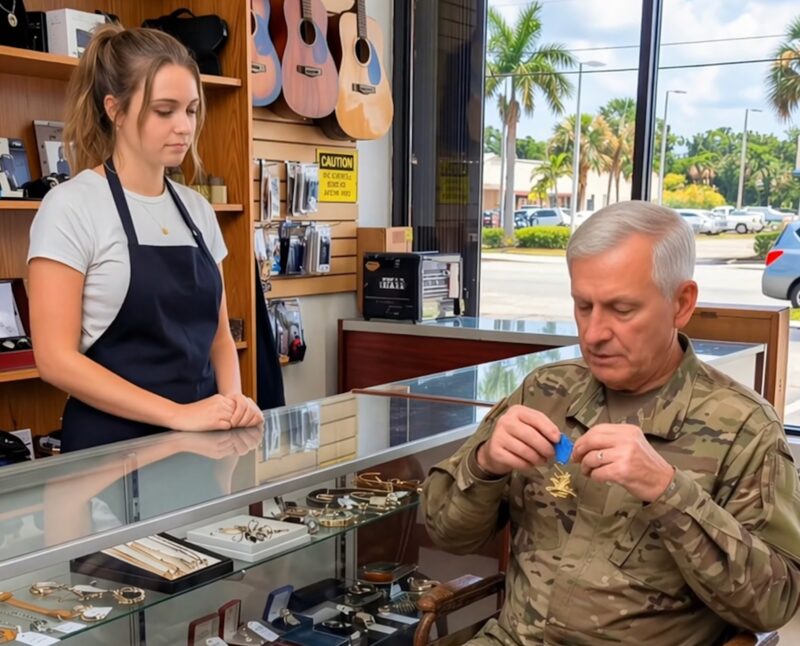
He made his way to a nearby jewelry store. The contrast between his situation and the surroundings inside was striking. The space was clean and brightly lit, filled with polished displays of watches, necklaces, and rings. Everything appeared carefully arranged, distant from the life he was currently living.
A young shop assistant noticed him as soon as he entered. She watched quietly as he approached the counter, observing his movements and the hesitation in his posture.
He stopped in front of the glass display and took the medal out of his pocket. His hands trembled slightly as he placed it down.
“I would like to sell this,” he said softly, avoiding eye contact.
The assistant picked up the medal carefully. She examined it, taking note not only of its condition but also of the man standing in front of her. There was something in his expression—fatigue, yes, but also dignity.
“Is this your award?” she asked gently.
He nodded. “For my service.”
For a brief moment, the atmosphere in the store shifted. The usual quiet of the space became heavier, as if the weight of the moment had settled over everything.
The assistant continued to look at the medal, though her attention often returned to him. She noticed how tightly he held his hands together, how he seemed to shrink slightly under the circumstances.
After a pause, she mentioned a price.
He did not negotiate. At that moment, the amount mattered less than the immediate need it could meet. He simply nodded.
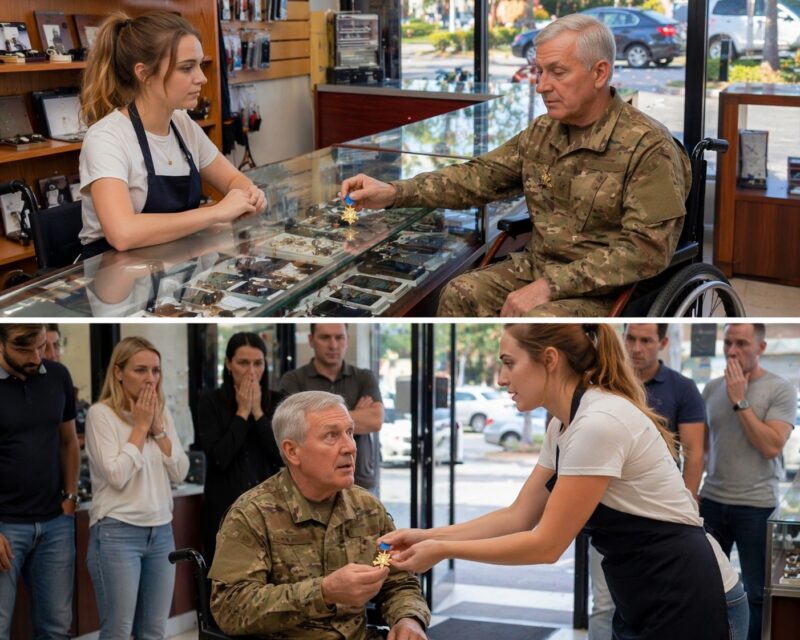
Before finalizing the exchange, he picked up the medal one last time. He held it carefully, running his fingers across its surface as if committing it to memory. His lips tightened slightly, and he exhaled slowly. Emotion surfaced, but he quickly turned his head, unwilling to let it show.
“Alright,” he said quietly.
The transaction was completed. He took the money, folded it neatly, and placed it in his pocket. Without another word, he turned his wheelchair toward the door and began to leave.
He did not look back.
But as soon as he exited the store, something unexpected happened.
The assistant hurried after him.
“Wait!” she called out.
He stopped and turned, surprised.
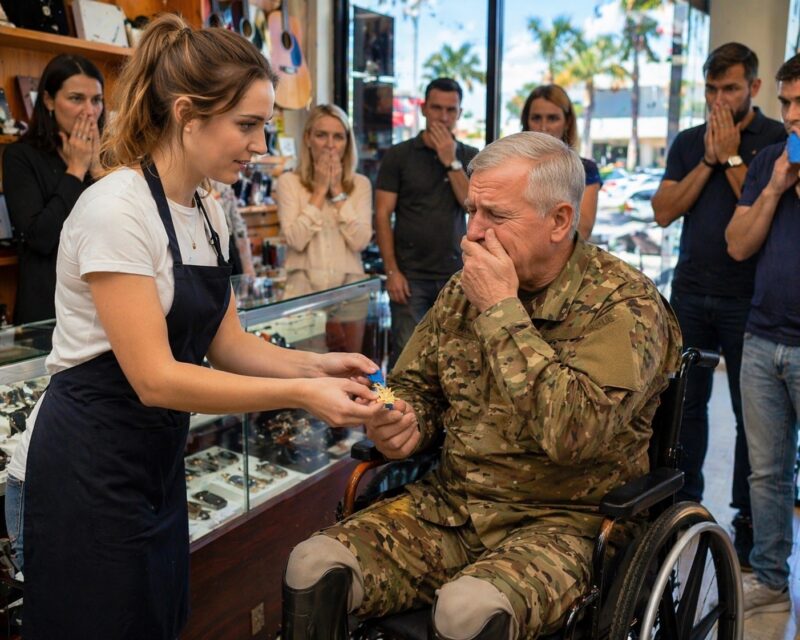
She approached him, slightly out of breath, and extended her hand. In it was the medal.
“Please take this back,” she said.
He looked at her, confused.
“But… the money…” he began.
“The money is yours,” she replied calmly. “This is not a purchase. It is simply help.”
He hesitated, unsure how to respond. His hands trembled again as he reached for the medal.
“I can’t accept this,” he said quietly.
“You can,” she answered firmly, though her tone remained kind. “And you should.”
She paused, then continued.
“I have a brother who runs a small business. He hires people with disabilities. He believes everyone deserves an opportunity to work and rebuild. If you are willing, I can connect you with him.”
The man remained silent for several moments. The situation felt unfamiliar, almost overwhelming. Help, offered without expectation, was something he had not encountered in a long time.
This time, when tears appeared in his eyes, they carried a different meaning.
“Thank you,” he said softly, holding the medal close.
In that moment, something shifted within him. The medal was no longer just a reminder of the past. It became a symbol of possibility—of a future that had not yet been fully written.
The challenges he faced had not disappeared, but for the first time in a long while, there was a sense that change was possible.
Sometimes, the course of a life does not shift through grand events or long-term plans. Sometimes, it changes because of a single decision, a moment of understanding, or an act of kindness offered at exactly the right time.
For the veteran, that moment came outside a small jewelry store, when a simple gesture reminded him that his story was not over.

