
The Growing Popularity of Optical Illusions and Visual Brain Teasers Online
In recent years, optical illusions, visual puzzles, and brain teasers have become a widespread form of entertainment across the internet. From social media feeds to online forums, these types of images regularly capture attention and invite users to participate in simple yet engaging challenges. Their appeal lies in their ability to combine curiosity, observation, and patience into a single interactive experience.
Many individuals find these puzzles enjoyable because they offer a break from routine content while still providing a sense of mental stimulation. At first glance, most illusions appear straightforward, but upon closer inspection, they often reveal layers of complexity that make them far more challenging than expected. This contrast between simplicity and difficulty is one of the main reasons they continue to attract large audiences.
Not everyone, however, finds them easy to solve. Some people naturally struggle with identifying hidden elements or recognizing patterns within visually complex designs. For those individuals, these puzzles can feel more frustrating than entertaining. Yet even then, the curiosity they generate often encourages viewers to keep trying.
For example, many people recall encountering similar puzzles during childhood, often in activity books designed to “train the brain.” While these books promised fun and improvement in observation skills, they were not always as approachable as they seemed. In many cases, such books were left unfinished, only to be revisited years later with the same sense of challenge still present.
Despite these experiences, the broader appeal of visual puzzles remains strong. One reason is the way they encourage interaction among users. On platforms where content is easily shared, these illusions invite people to compare their observations and discuss their interpretations. This social element plays a significant role in their continued popularity.
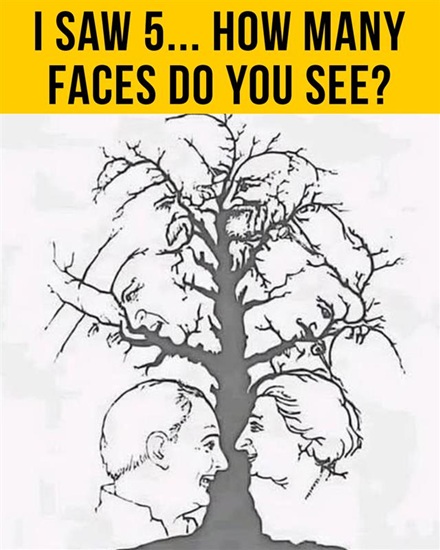
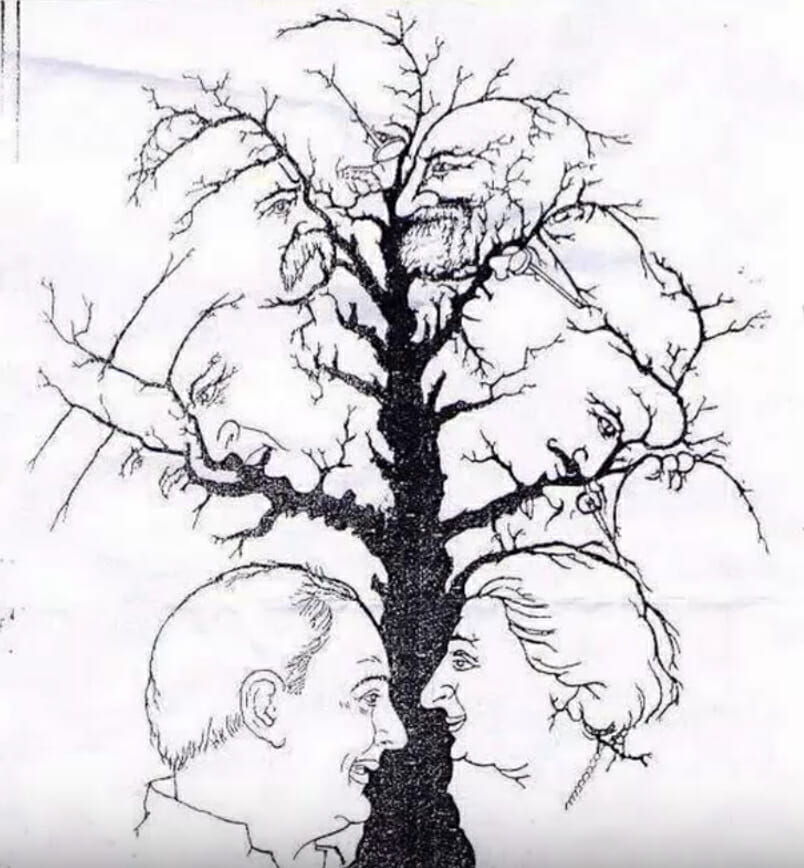
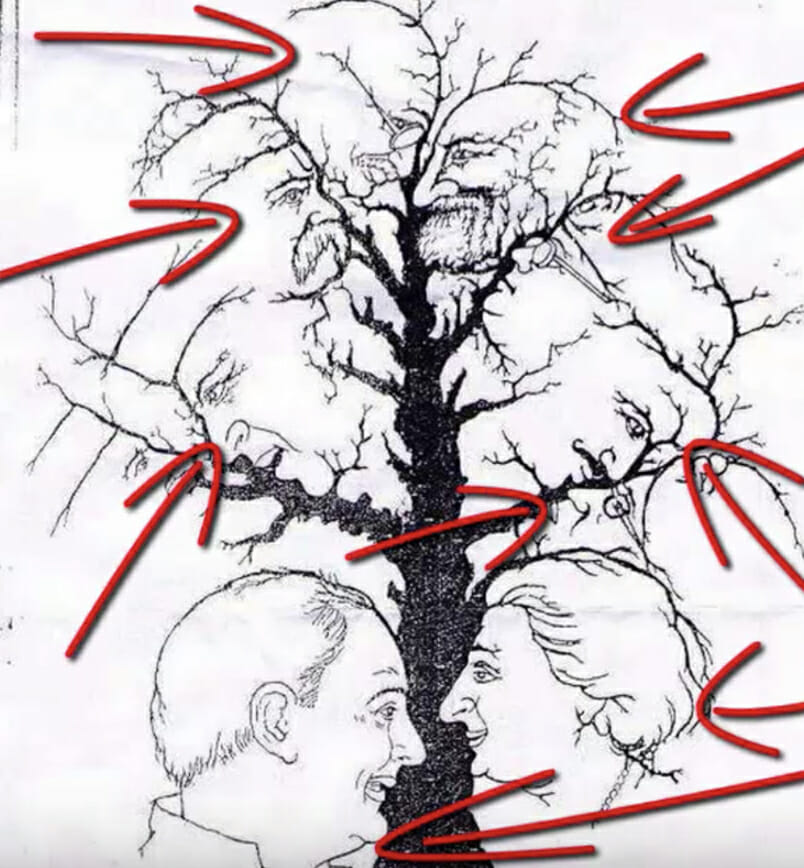
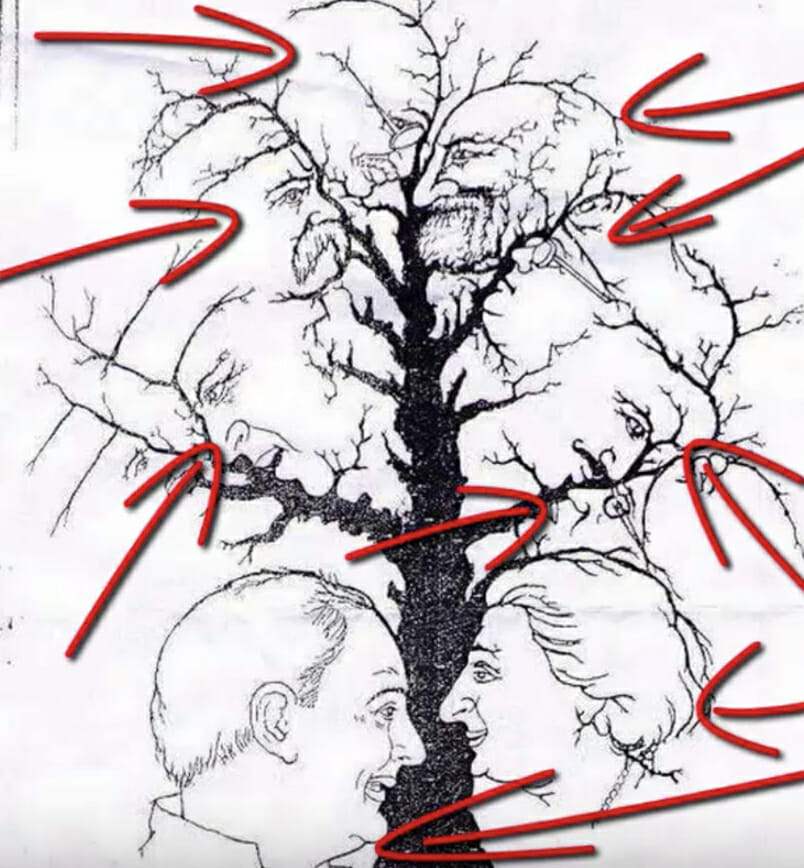
A notable example that has recently gained attention is a visual puzzle often referred to as the “National Leaders Tree.” This particular image stands out because it combines artistic design with hidden imagery, creating an engaging challenge for viewers. Within a single illustration of a tree, multiple human faces are subtly embedded throughout the structure.
At first glance, most viewers tend to notice only a small number of faces. These are typically located in more obvious areas, such as the lower portion of the tree or along clearly defined shapes. However, the true challenge lies in identifying the additional faces that are blended into the branches, leaves, and natural contours of the design.
This type of puzzle encourages careful observation rather than quick judgment. Instead of relying on initial impressions, viewers are prompted to examine each part of the image in detail. This process can be both engaging and time-consuming, depending on how deeply one chooses to analyze the illustration.
It is important to understand that puzzles like the “National Leaders Tree” are created for entertainment purposes. They are not intended to serve as scientific assessments of intelligence, memory, or cognitive ability. While some online posts may suggest otherwise, such claims are not supported by credible research.
Optical illusions are typically designed by artists or illustrators who use visual techniques to influence perception. These techniques may include the use of shadows, outlines, contrast, and negative space. By carefully arranging these elements, designers create images that can be interpreted in multiple ways.
As a result, different individuals may perceive different details within the same image. Some people might quickly identify several hidden faces, while others may only recognize a few. This variation does not indicate any difference in intelligence; rather, it reflects the diversity of visual processing styles among individuals.
There is no single correct method for approaching these puzzles. Some viewers prefer to focus on larger shapes first, gradually working their way toward smaller details. Others take a more systematic approach, scanning the image section by section. Both strategies are valid and can lead to different outcomes.
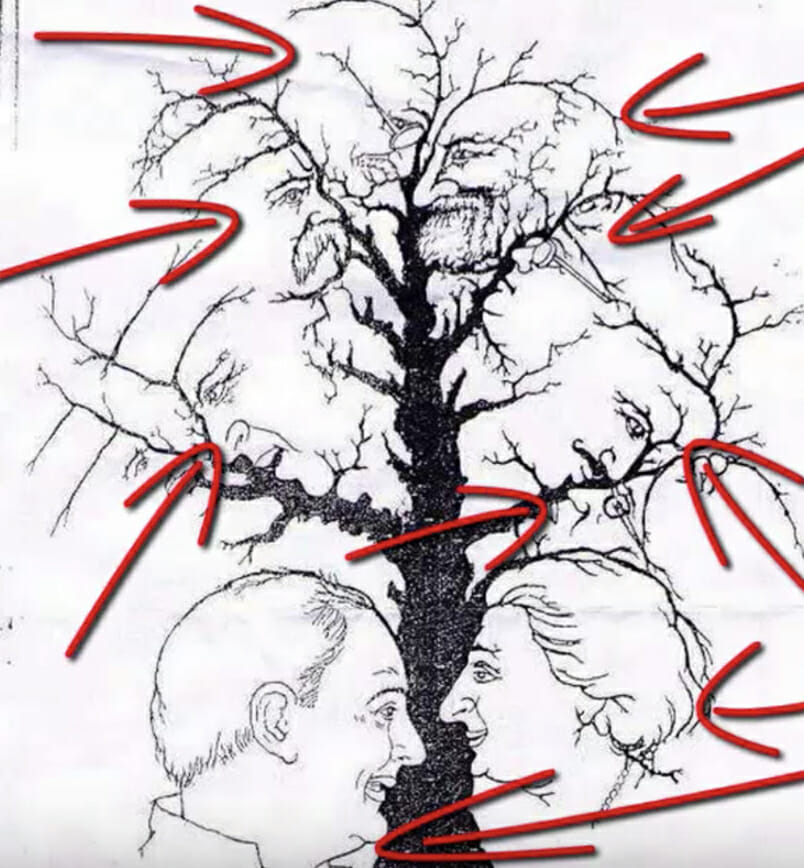
In the case of the “National Leaders Tree,” many of the hidden faces are not immediately obvious because they are not fully outlined. Instead, they are formed through subtle visual cues such as the arrangement of branches or the spaces between leaves. This artistic technique encourages viewers to look beyond what is immediately visible.
The longer a person spends examining the image, the more likely they are to notice additional details. This gradual discovery is a key aspect of the puzzle’s appeal. It creates a sense of progression, where each new finding adds to the overall experience.
However, it is also common for viewers to reach a point where the image becomes difficult to interpret. After extended observation, the brain may begin to overanalyze the visual information, making it harder to distinguish actual patterns from imagined ones. In such cases, taking a short break can be helpful.
Returning to the image with a fresh perspective often allows previously unnoticed details to become more apparent. This highlights how perception can change depending on focus and mental state. It also reinforces the idea that these puzzles are as much about the process as they are about the outcome.
The use of a tree as the central element in this puzzle is particularly effective. Natural forms, such as trees, contain complex and irregular shapes that easily lend themselves to hidden imagery. The branching structure, combined with varying shades and textures, creates numerous opportunities for subtle visual integration.
This complexity allows designers to embed multiple elements without making them immediately obvious. Some faces are intentionally placed in areas where they blend seamlessly with the surrounding design, while others are slightly more prominent. This variation ensures that the puzzle remains accessible to a wide audience.
While many people enjoy sharing their results online, it is essential to remember that there is no universal “score” associated with these puzzles. The number of faces a person identifies does not measure their intelligence or observational ability in any definitive way.
Instead, these puzzles should be viewed as a form of interactive art. They encourage viewers to engage with an image more deeply than they might otherwise. By prompting careful observation, they offer a different kind of visual experience compared to typical digital content.
In some contexts, researchers study visual perception using controlled experiments that may involve similar imagery. However, those studies are conducted under specific conditions and are designed to answer scientific questions. In contrast, online puzzles are simplified and created primarily for entertainment.
As viewers continue to explore images like the “National Leaders Tree,” they may find that their perception evolves over time. Details that were initially overlooked can become more noticeable with repeated viewing. This demonstrates how flexible and adaptive human perception can be.
Different viewing strategies can also influence the outcome. Some individuals prefer to zoom in on specific sections of an image, allowing them to focus on finer details. Others step back and consider the overall composition, which can reveal patterns that are not visible up close.
There is also a strong social component associated with these puzzles. People often discuss their findings with friends, family, or online communities. These conversations can be just as engaging as the puzzle itself, as they highlight the variety of interpretations that different individuals can have.
In many cases, the discussion becomes more interesting than the challenge of counting the hidden elements. Each person brings their own perspective, leading to a range of observations and conclusions. This diversity is part of what makes visual puzzles so engaging.
It is also common for individuals to revisit the same image multiple times. With each viewing, they may notice something new, reinforcing the idea that perception is not fixed. Changes in focus, lighting, or even mood can influence how an image is interpreted.
Despite their complexity, these puzzles are designed to be accessible. They do not require specialized knowledge or training. Instead, they rely on basic skills such as attention to detail and patience.
Some viewers approach them methodically, examining each section in a structured way. Others rely on intuition, allowing their eyes to naturally pick up patterns. Both approaches can be effective, depending on the individual.
The “National Leaders Tree” serves as an example of how artistic creativity can be transformed into an interactive experience. By combining visual design with hidden elements, it offers both entertainment and engagement.
The placement of each hidden face is carefully considered. Designers must balance visibility and concealment to ensure that the puzzle is neither too easy nor too difficult. This balance is essential for maintaining interest across a broad audience.
Ultimately, the purpose of such puzzles is not to achieve a perfect result but to enjoy the process of exploration. The act of looking closely and discovering new details is what makes the experience rewarding.
Rather than focusing on the number of faces identified, it is more meaningful to appreciate the creativity involved in the design. These images demonstrate how perception can be influenced by subtle visual cues.
They also serve as a reminder that the human brain does not always interpret images in a straightforward manner. Patterns, expectations, and context all play a role in shaping what we see.
This is one of the reasons why optical illusions continue to fascinate people of all ages. They reveal the complexity of visual perception in a way that is both accessible and engaging.
In the end, the “National Leaders Tree” is simply a visual puzzle created to entertain. Whether a viewer identifies a few hidden faces or many, the experience remains valuable.
The true goal is not to measure ability, but to encourage curiosity and careful observation. By taking the time to look a little closer, viewers can gain a greater appreciation for both the image and the process of perception itself.

