The Training Yard Call That Unraveled a Home and Rebuilt a Father’s Resolve
A Routine Day Interrupted by a Disturbing Phone Call
Outside Tulsa, Oklahoma, Caleb Morrison stood near a fenced training field where a young shepherd dog moved through an obstacle course. Dust lifted lightly with each stride, and trainers called commands in the background. It was a normal working afternoon, shaped by discipline, repetition, and focus.
Everything changed the moment his phone rang.
“Dad?”
The voice belonged to his eight-year-old daughter, Maddie, and it immediately broke through the noise around him.
Caleb straightened, sensing something wrong in her tone.
“Maddie? What’s wrong?”
A pause followed, filled with a shaky breath that made the situation feel heavier than words.
Then she said softly, “I can’t hold him anymore.”
Caleb froze for a split second, trying to understand what she meant. Then a baby’s cry came faintly through the line, sharp and distressed.
His son, Owen, was in the background.
“Where’s Jenna?” Caleb asked.
There was another hesitation before Maddie answered.
“She said the house has to be clean before she comes back.”
Caleb’s grip tightened around the phone as concern turned into urgency.
“Put Owen somewhere safe, sweetheart. Right now.”
Maddie’s voice broke as she responded.
“I tried,” Maddie whispered. “But he keeps crying. She said if he cries, it’s my fault.”
Without waiting another second, Caleb moved toward his truck, already abandoning everything else in his mind except getting home.

The Race Back and the First Signs of Trouble
The drive that normally took about half an hour felt endless. Caleb pushed beyond the usual limits, focused entirely on the urgency of his daughter’s voice still echoing in his mind.
His retired search dog, Ranger, sat alert in the passenger seat, unusually tense and quiet as the vehicle sped down familiar roads.
When they finally arrived, the house looked ordinary from the outside. A clean porch, closed windows, and a quiet suburban calm gave no indication of what was happening inside.
But Ranger stopped at the steps and gave a low warning sound.
Caleb opened the door.
The smell hit immediately—cleaning chemicals mixed with sour milk and something burnt. It was the kind of combination that suggested chaos behind closed doors.
From the kitchen came the faint sound of scrubbing.
What he saw next made him stop completely.
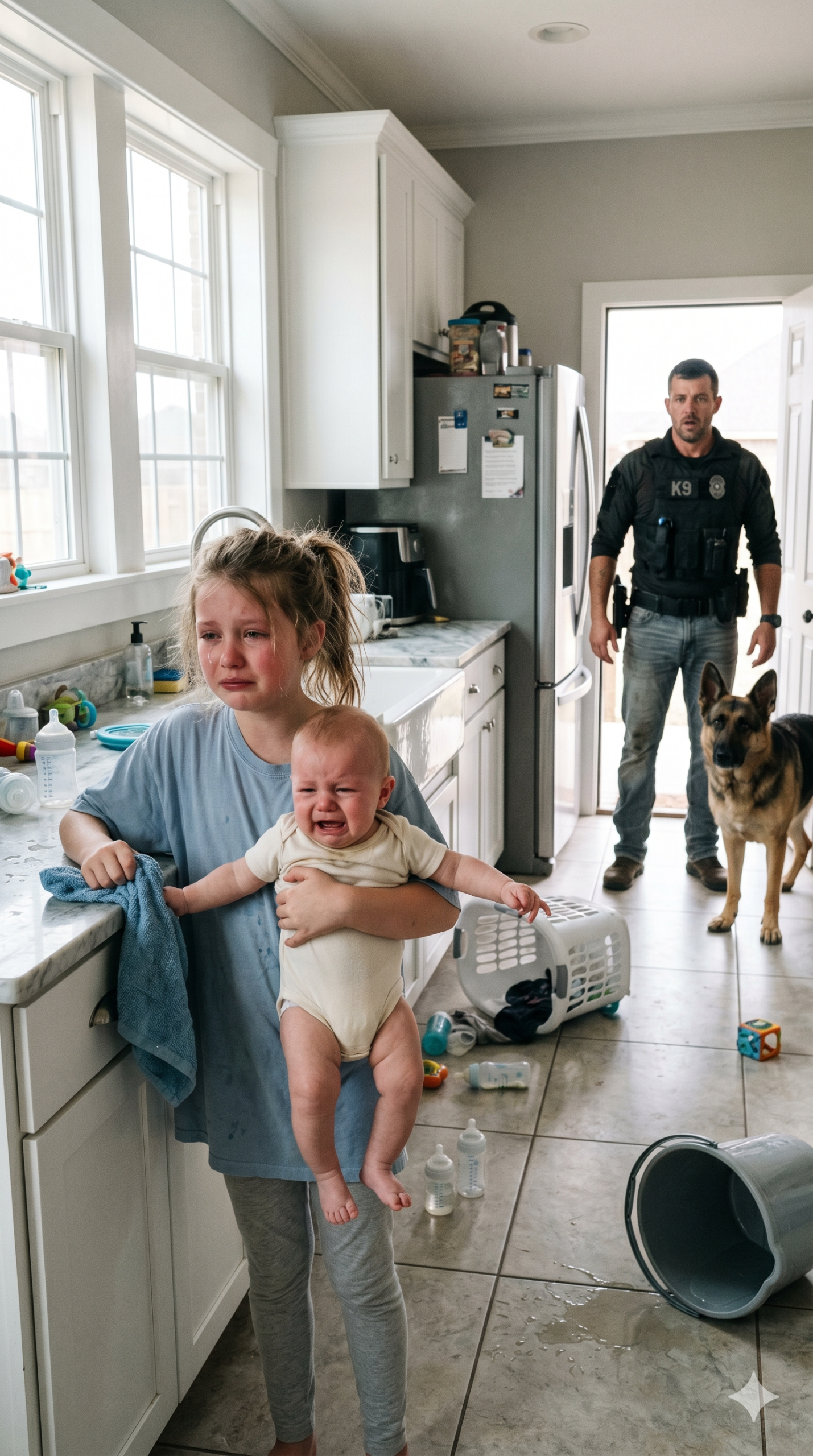
Maddie was on her knees on the floor, her small hands red and tired. A baby carrier was strapped unevenly across her body, and Owen cried weakly beside her.
A pot sat on a warm stove nearby, and broken glass glinted on the floor.
Caleb stepped forward slowly.
“Maddie,” Caleb said.
She looked up and immediately flinched instead of running to him.
“I’m sorry, Dad. I’m almost done.”
Caleb felt something inside him tighten painfully.
“You are not in trouble,” he said, his voice unsteady. “Do you hear me? You are not in trouble.”
Maddie hesitated, tears gathering in her eyes.
“But the floor…”
“I don’t care about the floor.”
She started to explain, her voice shaking.
“She said I couldn’t eat unless—”
Caleb closed his eyes briefly, then immediately called emergency services.
What the House Revealed
At the hospital, doctors confirmed that both children were physically stable, though clearly strained by recent conditions. Maddie had been carrying responsibilities far beyond what any child should handle, while Owen showed signs of dehydration and fatigue.
Caleb stayed with them through the night, refusing to leave their side.
The next morning, after speaking with authorities, he returned to the house to collect essential items.
Ranger moved through the rooms ahead of him and led him toward a nightstand drawer.
Inside was a hidden folder and a second phone.
The documents inside included passports, financial records, and account activity. Caleb slowly realized that significant funds had been moved without his knowledge.
Then he found something even more troubling—a policy document listing Maddie’s name.
His breathing slowed, not from calmness, but from the weight of realization.
On the phone, messages revealed planned actions and discussions about leaving with Owen. One message referred to Maddie in a way that made Caleb sit down heavily on the bed.
Caleb turned to the officer nearby and said firmly,
“She planned this.”
Confrontation at the Hospital
Authorities advised Caleb not to confront Jenna directly. When she arrived at the hospital later, officers were already present nearby.
She rushed in, her expression emotional and controlled at the same time.
“Caleb!” she cried. “Where are the kids? Are they okay?”
Caleb responded calmly, though his voice carried firmness.
“Owen is safe,” Caleb said. “Maddie is safe.”
Her expression shifted quickly, not into relief, but tension.
“I need to see my son,” she said.
Caleb stepped in front of her.
“No.”
Her frustration rose immediately.
“You can’t keep him from me. I’m his mother.”
Caleb replied steadily,
“You lost the right to say that when you left my daughter alone with a baby, a stove, and a list no child should ever have to finish.”
Officers moved in as the situation escalated, and Jenna was taken aside as the investigation continued.

A Safe Place Begins to Take Shape
In the following days, investigators and medical staff worked together to understand the full situation. It became clear that Maddie had been forced into responsibilities that no child should bear, including caregiving and household control under pressure and fear.
Caleb focused entirely on stability for his children. He avoided anger in front of Maddie, instead offering reassurance at every opportunity.
He repeatedly told her simple truths:
“Thank you for telling me.”
“That should not have happened.”
“You are safe now.”
He later made the difficult decision to sell the old family home, not out of defeat, but to remove any emotional connection to the environment where the trauma occurred.
In its place, he found a smaller house with a red door, a fenced yard, and bright natural light in the kitchen.
Ranger inspected every room before Maddie stepped inside.
She paused at the doorway and asked quietly,
“Is it safe?”
Caleb knelt down beside her.
“Yes, sweetheart. It’s safe.”
“Do I have to clean the kitchen?”
“No.”
“Do I have to make Owen’s bottles?”
“No.”
“What if he cries?”
Caleb answered gently,
“Then I take care of him. That’s my job.”
Maddie slowly stepped inside for the first time without fear.
Rebuilding Trust and Moving Forward
Over time, legal proceedings confirmed the evidence collected from messages, records, and testimony. The case moved through the system as investigators pieced together the full timeline of events.
Caleb did not celebrate the outcome. Instead, he felt a quiet sense of relief that the children’s situation had been acknowledged and addressed.
At home that evening, Maddie sat at the kitchen table drawing. Owen played nearby in a high chair, and Ranger rested by the door.
Maddie looked up and asked softly,
“Is it over?”
Caleb placed his keys down.
“Yes. It’s over.”
“She’s not coming back?”
“No.”
She returned to her drawing, which showed a house, a family, and a dog resting nearby.
That night, before bed, Maddie asked one final question.
“Dad?”
“Yeah, bug?”
“When I called you… were you mad?”
“Never at you.”
“I was scared you wouldn’t come.”
“I will always come.”
“Even if I make a mistake?”
“Especially then.”
“Even if someone says not to tell?”
“Then you tell me anyway.”

Conclusion
The following morning, Maddie’s quiet humming filled the car ride to school, a sound that had been missing for too long. Caleb listened without interruption, holding onto the moment as something fragile but real.
What had begun as a desperate phone call ended as the beginning of recovery, safety, and rebuilding trust within a family.
A child’s voice had revealed a hidden crisis. A father’s response transformed fear into protection. And step by step, a new life began to take shape—one grounded not in control or silence, but in safety, presence, and care.
