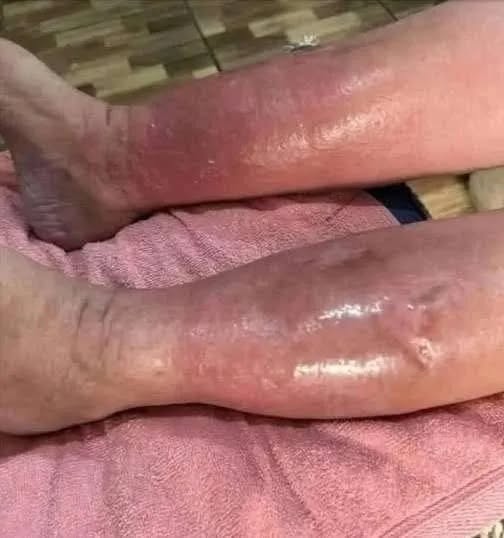
Severe Bilateral Lower Leg Redness and Swelling: Clinical Overview, Possible Causes, Treatment Approaches, and Emergency Warning Signs
Clinical Presentation
The presentation described involves extensive redness affecting both lower legs, accompanied by significant swelling and a stretched, glossy appearance of the skin. These findings suggest substantial inflammation and fluid accumulation within the tissues of the lower extremities.
When a patient develops this degree of bilateral leg involvement, healthcare providers must determine whether the underlying problem is primarily infectious, vascular, circulatory, or related to fluid retention caused by dysfunction in major organ systems.
The presence of widespread erythema and edema can result from multiple medical conditions that may appear similar on visual inspection. For this reason, identifying the correct cause is essential before treatment is initiated.
A careful evaluation focuses on factors such as skin temperature, tenderness, circulation, progression of symptoms, and the overall health status of the patient.
The main diagnostic challenge is distinguishing between a local infection, chronic venous disease, and systemic fluid overload, as management strategies differ substantially among these conditions.
Venous Insufficiency and Stasis Dermatitis
One of the most likely explanations for severe redness and swelling affecting both legs is venous insufficiency with associated stasis dermatitis.
This condition develops when the valves inside the veins of the legs no longer function effectively. Under normal circumstances, these valves help move blood upward toward the heart. When they weaken or fail, blood can accumulate in the lower extremities.
The resulting increase in venous pressure causes fluid to leak from blood vessels into surrounding tissues. Over time, this persistent fluid accumulation produces chronic swelling.
As the swelling continues, the skin becomes irritated and inflamed. The inflammatory process can produce extensive redness, skin discoloration, and discomfort.
In more advanced cases, the skin may appear shiny because it is stretched by the large volume of retained fluid. The surface can also become tight and fragile.
Chronic inflammation may further compromise the skin barrier, increasing the risk of additional complications.
Because both legs are commonly affected in venous disease, bilateral involvement often raises suspicion for this diagnosis.
The combination of swelling, redness, and long-standing fluid retention makes venous insufficiency a significant consideration whenever both lower legs are involved.
Bilateral Cellulitis
Another possible cause is cellulitis, a bacterial infection that affects the deeper layers of the skin and underlying tissues.
Cellulitis is most commonly associated with bacteria such as Staphylococcus and Streptococcus species. These organisms may enter through small breaks in the skin that are sometimes difficult to detect.
Once bacteria gain access to deeper tissues, an inflammatory response develops. The affected area may become red, swollen, warm, and painful.
In many cases, cellulitis affects only one leg. However, involvement of both legs can occur under certain circumstances.
Bilateral cellulitis may be more likely when the skin barrier has already been weakened by chronic edema or other underlying conditions.
The redness associated with infection often appears more aggressive and may spread over a relatively short period.
Patients frequently experience tenderness and localized heat in the affected areas.
Because untreated cellulitis can progress and lead to serious complications, prompt recognition is important.
Differentiating infection from noninfectious causes of redness remains a critical step in determining appropriate treatment.
Systemic Fluid Retention and Organ Function
Severe swelling of both legs can also result from systemic fluid overload.
This process occurs when the body retains excess fluid because major organ systems are not functioning efficiently.
The heart, kidneys, and liver play important roles in maintaining fluid balance. When these systems become impaired, fluid may accumulate throughout the body.
Gravity causes a significant portion of this excess fluid to collect in the lower extremities, particularly in the legs.
As fluid continues to build within the tissues, the skin stretches and swelling becomes increasingly pronounced.
When the edema reaches a substantial degree, secondary inflammation may develop.
This inflammatory response can create redness that resembles infection even when bacteria are not present.
The resulting condition may be associated with stasis erythema, where severe swelling contributes to visible skin inflammation.
Because the underlying problem originates from fluid regulation rather than infection, management focuses on addressing the cause of fluid retention.
The Importance of Accurate Diagnosis
Although these conditions may appear similar at first glance, their treatments differ considerably.
For that reason, an in-person medical evaluation is necessary before selecting a treatment plan.
A physical examination helps determine whether redness is associated with infection, circulatory impairment, or systemic edema.
Clinicians often assess localized warmth, tenderness, swelling characteristics, and circulation within the legs.
Peripheral pulses are also evaluated to ensure adequate blood flow.
Because certain therapies that benefit one condition may be inappropriate for another, proper diagnosis remains the foundation of effective care.
Attempting treatment without determining the underlying cause can delay recovery and potentially worsen the condition.
Treatment of Venous Insufficiency and Stasis Dermatitis
When the redness and swelling are attributed to venous insufficiency and stasis dermatitis, treatment focuses on improving circulation and reducing fluid accumulation.
Compression therapy is considered a central component of management once arterial disease has been excluded.
Specialized compression stockings or compression wraps help encourage blood flow back toward the heart and reduce pooling in the legs.
By improving venous return, compression can gradually decrease swelling and relieve pressure within the tissues.
Leg elevation is another important intervention.
Patients are commonly instructed to elevate their legs above heart level multiple times throughout the day.
This position helps reduce hydrostatic pressure and assists with fluid movement out of the lower extremities.
Topical dermatologic treatment may also be used.
High-potency topical corticosteroids can be prescribed for short periods to reduce inflammation and interrupt the inflammatory cycle affecting the skin.
In addition, heavy moisturizers and emollients may be recommended to support restoration of the skin barrier and reduce irritation.
Treatment of Cellulitis
When cellulitis is identified as the cause, the treatment strategy changes significantly.
The primary objective becomes eliminating the bacterial infection.
Systemic antibiotic therapy is initiated as quickly as possible.
Depending on the severity of the infection, treatment may involve oral medications or intravenous antibiotics.
Careful skin management is also important during recovery.
Keeping affected areas clean and dry helps support healing and reduces the risk of further complications.
Healthcare providers may outline or mark the borders of the redness to monitor whether the infection is improving or continuing to spread.
This allows clinicians to evaluate the effectiveness of treatment over time.
Compression therapy is generally avoided when an active and unmanaged infection is present, as the priority remains controlling the infectious process.
Treatment of Systemic Volume Overload
When excessive fluid retention is responsible for the swelling, treatment focuses on removing excess fluid and improving underlying organ function.
Diuretic medications are commonly used for this purpose.
These medications help the kidneys eliminate additional fluid from the body through increased urine production.
As fluid levels decline, swelling in the lower extremities may gradually improve.
However, reducing edema alone is not sufficient.
The underlying cause of fluid accumulation must also be addressed.
Management may involve optimizing cardiac, renal, or hepatic function depending on which system is contributing to the problem.
Successful treatment often requires ongoing medical supervision and monitoring.
Addressing the source of fluid retention is essential for achieving lasting improvement.
Emergency Warning Signs
Certain symptoms indicate that immediate medical evaluation is necessary.
The presence of systemic fever may suggest a significant infection requiring urgent attention.
Chills and sudden episodes of intense shaking or rigors are also concerning findings.
Rapid progression of redness over a matter of hours represents another important warning sign.
Fast-moving inflammation may indicate an aggressive process that requires prompt intervention.
The development of blisters, also known as bullae, should not be ignored.
Similarly, open weeping sores or areas of skin breakdown may signal worsening disease.
Dark discoloration or necrosis of the skin is especially concerning because it may indicate tissue damage.
A sudden increase in pain or tenderness is another reason for urgent medical assessment.
Any combination of these findings warrants immediate evaluation to determine the cause and begin appropriate treatment without delay.
Conclusion
Severe redness and swelling involving both lower legs can arise from several different medical conditions, including venous insufficiency with stasis dermatitis, bilateral cellulitis, and systemic fluid overload.
Although these disorders may produce similar visual findings, the mechanisms behind them are very different.
Accurate diagnosis requires a thorough physical assessment and careful consideration of clinical findings.
Compression therapy, antibiotics, or diuretic treatment may each be appropriate depending on the underlying cause.
Because the management strategies are fundamentally different, determining the correct diagnosis remains the most important step in achieving effective treatment.
Prompt recognition of emergency warning signs and timely medical intervention can play a critical role in preventing complications and improving outcomes.
