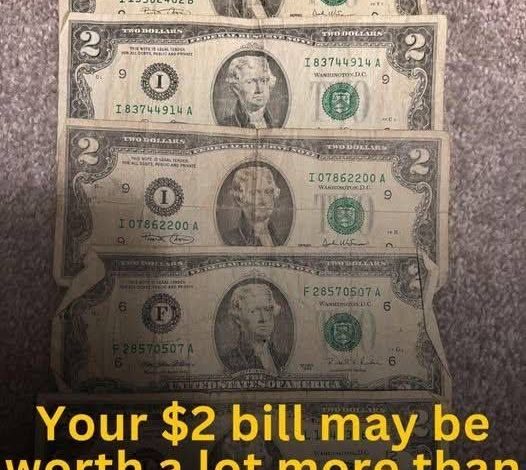
The Overlooked $2 Bill in Your Wallet Could Be Worth Much More Than You Think
A Piece of Currency Many People Ignore
For most Americans, the $2 bill is an unusual sight. It appears so infrequently in daily transactions that many people rarely think about it at all.
When one does show up, reactions are often the same. Some people set it aside as a novelty, others keep it as a lucky token, and many simply tuck it away in a drawer or old wallet.
Because it is not commonly seen in circulation, countless individuals assume every $2 bill is rare.
The reality is more complicated.
While many $2 bills are worth only their printed face value, certain examples can attract significant attention from collectors.
Under the right circumstances, a bill that appears ordinary at first glance may be worth far more than two dollars.
The key lies in understanding which details collectors look for and why some notes become highly desirable.
Why Certain $2 Bills Attract Collectors
Collectors evaluate paper currency based on a variety of factors.
Unlike everyday cash users, they examine notes closely for features that separate common bills from uncommon ones.
Small details can dramatically influence a bill’s appeal.
Printing dates, condition, serial numbers, production anomalies, and unique markings all play a role in determining value.
A bill that looks unremarkable to the average person may contain characteristics that make it especially interesting within the collecting community.
Because of this, experienced collectors often inspect every detail before deciding whether a note deserves further attention.
What appears to be a simple piece of currency can sometimes reveal a much more interesting story.
The Importance of Printing Dates
One of the first things collectors examine is the year associated with a bill.
Older notes often generate greater interest because fewer examples may remain in excellent condition.
Bills produced during earlier decades can carry historical significance and may have survived years of circulation.
However, age alone does not automatically guarantee value.
A very old note that was produced in large numbers may be less desirable than a newer bill that possesses uncommon characteristics.
This is why experienced collectors rarely focus on the date alone.
Instead, they consider age as one factor among many.
The combination of rarity, preservation, and unique features typically has a greater influence on value than age by itself.
Condition Can Make a Major Difference
The physical condition of a $2 bill is another critical factor.
Collectors often place a premium on notes that have remained crisp and well preserved.
A bill that shows minimal signs of handling generally attracts more interest than one that has been folded, torn, stained, or heavily worn.
Uncirculated notes are especially appealing because they retain much of their original appearance.
Sharp corners, clean surfaces, and strong color can significantly enhance a bill’s desirability.
Even when two bills share the same printing date and design, differences in condition can lead to very different valuations.
This is why many collectors store valuable notes carefully to protect them from damage.
Preservation can be just as important as rarity.
The Fascination With Serial Numbers
Among currency collectors, serial numbers often generate considerable excitement.
Every bill carries a unique sequence of numbers and letters, but some patterns are far more desirable than others.
Collectors frequently search for unusual combinations that stand out from standard numbering sequences.
Low serial numbers are often popular because they are relatively uncommon.
Sequences featuring repeated digits can also attract attention.
Other collectors seek ladder patterns, where the numbers progress in a distinctive sequence.
Unique arrangements and visually striking combinations often generate additional interest.
Because serial numbers cannot be duplicated on identical notes, certain patterns become highly sought after within the hobby.
A bill’s serial number may appear insignificant to most people, yet it can dramatically affect collector demand.
When Printing Mistakes Become Valuable
In many industries, production errors are considered flaws.
In the world of collectible currency, mistakes can sometimes become valuable features.
Printing errors are among the most closely watched aspects of paper money collecting.
Because currency production follows strict quality standards, mistakes that reach circulation are often unusual.
Collectors actively search for bills displaying noticeable printing anomalies.
These may include alignment problems, ink issues, missing design elements, duplicated printing, or unusual numbering errors.
What appears to be a defect to one person may be viewed as a rare and desirable characteristic by another.
The scarcity of such mistakes often contributes to their appeal.
As a result, certain error notes can command substantial interest within collector circles.
Common Types of Error Notes
Several categories of printing mistakes are particularly well known among collectors.
Misaligned printing occurs when parts of the design do not appear in their intended position.
Ink-related anomalies can create unusual visual effects that differ from standard production.
Some bills may be missing seals or other design elements entirely.
Double-printing errors can cause portions of the design to appear more than once.
Fold-over mistakes can occur during production, creating unusual design distortions.
Incorrect serial numbering can also attract attention when it differs from standard expectations.
Each type of error offers something distinctive, which helps explain why collectors often examine bills carefully before dismissing them as ordinary currency.
Rarity Often Matters More Than Age
Many people assume the oldest notes are automatically the most valuable.
While age can certainly contribute to collector interest, rarity frequently plays a larger role.
A bill produced decades ago may be relatively common if large numbers were printed and preserved.
Meanwhile, a more recent bill with an unusual characteristic could attract greater attention.
This principle surprises many people who are unfamiliar with currency collecting.
Collectors generally seek items that are difficult to find.
The fewer examples available, the more interest a bill may generate.
As a result, rarity often becomes one of the most important factors influencing demand.
Why Some Bills End Up Hidden for Years
Many collectible notes spend years unnoticed.
Some are tucked inside books, envelopes, and family keepsakes.
Others remain hidden in old desk drawers, storage boxes, or inherited collections.
Because people rarely examine $2 bills closely, potentially interesting examples may sit untouched for long periods.
A bill received as a gift years earlier might eventually be rediscovered during a household cleanout.
An old wallet stored away for decades could contain a note that was forgotten long ago.
These situations contribute to the excitement many collectors feel when searching through old belongings.
You never know what might be waiting in an overlooked corner of a home.
The Risk of Spending a Collectible Note
Every year, collectible bills likely return to circulation without their owners realizing what they possess.
A note with unusual characteristics may be spent just like any other piece of currency.
Because many people focus only on face value, important details often go unnoticed.
A bill that attracts collector interest can easily be used in an ordinary purchase if no one takes the time to inspect it.
Once it reenters circulation, tracking it down becomes significantly more difficult.
This possibility is one reason collectors encourage careful examination before spending unusual notes.
A quick review of a bill’s features may reveal something worth investigating further.
Features Worth Examining
Anyone curious about a $2 bill can begin by reviewing several key characteristics.
The printing date is often the first place to start.
From there, attention can shift to the serial number.
Patterns, repeated digits, and other unusual combinations may stand out.
Collectors also look for star notes, which feature a star symbol within the serial number.
These notes often attract interest because they differ from standard production runs.
The condition of the bill should also be evaluated carefully.
Crisp notes with minimal wear generally appeal more strongly to collectors.
Finally, any unusual printing features or production anomalies deserve closer inspection.
Even small differences can sometimes prove significant.
A Growing Interest in Collectible Currency
The hobby of currency collecting continues to attract people from a wide range of backgrounds.
Some enjoy the historical aspect of paper money.
Others are fascinated by production techniques, serial number patterns, or rare printing errors.
For many collectors, each note represents a small piece of history.
The search for uncommon examples adds an element of discovery that keeps the hobby engaging.
Because $2 bills are less frequently encountered than many other denominations, they often inspire additional curiosity.
This curiosity encourages people to look more closely at notes they might otherwise overlook.
Sometimes that closer inspection reveals unexpected value.
The Value of Taking a Second Look
Most people view a $2 bill as exactly what it appears to be: two dollars in spending power.
For collectors, however, the story may not end there.
A note’s true appeal can depend on factors that are invisible at first glance.
Details such as rarity, preservation, serial number patterns, and printing characteristics can transform an ordinary-looking bill into something much more interesting.
This is why collectors often emphasize the importance of careful examination.
What seems insignificant today may reveal unexpected potential upon closer inspection.
A few moments spent checking the details could uncover a hidden collectible that has been sitting unnoticed for years.
Final Thoughts
The $2 bill remains one of the most intriguing pieces of American currency.
Its relative rarity in everyday transactions has helped create an enduring sense of curiosity around it.
While many examples are worth only their printed value, certain notes possess characteristics that make them highly attractive to collectors.
Printing dates, condition, serial numbers, star notes, unusual seals, and production errors can all contribute to a bill’s desirability.
Because these details are often overlooked, valuable examples sometimes remain hidden in plain sight.
The next time a $2 bill comes your way, it may be worth taking a closer look.
What appears to be an ordinary piece of currency could hold far more interest than its face value suggests.
In the world of collecting, sometimes the smallest details make the biggest difference.
