
A Girl’s Five-Dollar Decision That Changed More Than One Life
The dog did not look like he had much time left.
That was the impression given by the man who owned him, standing near a worn-out barn and speaking about the animal with a kind of detachment that suggested he no longer saw it as something worth saving. Tied to a leaning fence post in thick mud, the dog appeared severely undernourished, exhausted, and weakened by neglect.
When thirteen-year-old Lily Harper saw him, she stopped immediately.
The animal resembled a German Shepherd, though its condition made that difficult to recognize at first glance. Its ribs were clearly visible beneath its fur, one front leg appeared injured and bent unnaturally, and its coat was dull and matted from exposure to rain and dirt. Nearby, an empty feeding pan and a dirty water bowl confirmed what was already evident.
But what affected Lily most was not just the physical condition.
It was the expression in the dog’s eyes.
There was no excitement, no aggression, no visible expectation of help. Only a quiet, worn-out stillness that reflected deep fatigue.
Her grandfather, Amos, who had raised her since she came to live on his farm in Tennessee, urged her to walk away. He understood the risks. The dog would require medical attention, time, and resources they did not have. It might not survive.
Lily listened—but she did not leave.
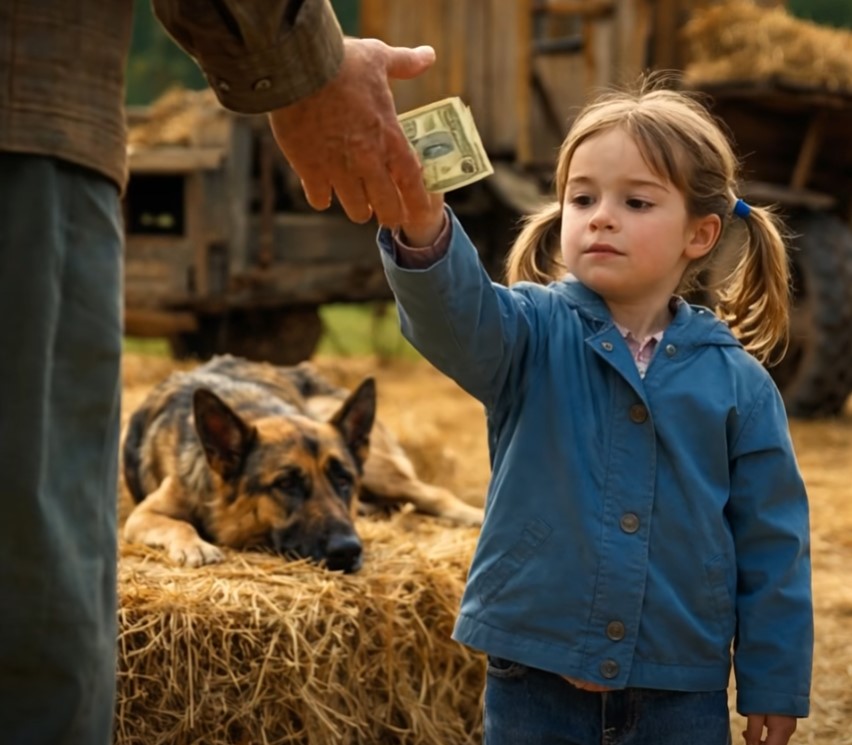
Instead, she reached into her pocket and pulled out the five dollars she had saved over months. It was all she had.
Without hesitation, she handed it to the man and asked to take the dog.
He accepted.
A Difficult Beginning
The dog struggled to stand once the rope was removed. Lily approached slowly, speaking softly to avoid frightening him. At first, he flinched at her touch, uncertain and guarded. But he did not resist.
With Amos’s help, they managed to get him moving.
The walk back to their farm took nearly an hour. Several times, it seemed as though the dog would collapse before they reached shelter. When they finally arrived, they prepared a space for him in the tack room beside the barn, using old quilts to create a warm resting place.
Lily named him Bruno.
That first night, he barely ate. He remained still, conserving what little energy he had. Lily stayed beside him, talking quietly, offering reassurance even though she did not know if he understood.
Before leaving, she placed a small toy near him—something simple, but comforting.
Gradual Recovery
Over the following days, Bruno began showing small signs of improvement.
He drank more water. He accepted soft food. He started standing on his own, though only for short periods. He watched Lily carefully each time she entered the room, slowly becoming accustomed to her presence.
Lily remained consistent in her care. She visited him before school, returned immediately after, and spent evenings sitting beside him while doing homework or reading aloud.
Each small step forward felt significant.
By the fourth day, he finished a full meal. By the fifth, he stood without assistance. By the sixth, something unexpected happened.
When Amos gave a simple verbal command, Bruno responded immediately.
The reaction was precise, controlled, and clearly trained.
Amos recognized it at once.
This was not an ordinary abandoned dog.
An Unexpected Discovery
Concerned, they contacted the local veterinarian, Dr. Eliza Bennett. During her examination, she confirmed that Bruno had older injuries that had not been properly treated. His condition suggested a more complex past.
Then she scanned for a microchip.
The information linked not to a typical pet registry, but to a government database associated with military working dogs.
The discovery changed everything.
Bruno had once served in the military.
His training became even more evident in the days that followed. When a loud noise startled the area, Bruno instinctively positioned himself between Lily and the source of the sound. His reaction was not random—it was protective and deliberate.
Even in a weakened state, he was still operating under instincts shaped by prior training.
A Defining Moment
Shortly after the discovery, Bruno demonstrated those instincts in a critical situation.
While Lily was walking in a field near the farm, a wild animal suddenly charged toward her. She had little time to react.
Bruno intervened immediately.
Despite his injuries, he placed himself between Lily and the threat, creating enough time for Amos to arrive and drive the animal away safely.
Bruno was injured again during the encounter, but Lily was unharmed.
From that moment, the bond between them deepened. What began as an act of rescue became a relationship built on mutual trust.
A Connection to the Past
News of the discovery eventually reached the appropriate authorities. A former military handler, Adrian Cross, arrived at the farm after learning about the dog.
When he called out the dog’s original service name, the reaction was immediate.
Bruno was identified as Ranger V-12, a military working dog previously believed to have died several years earlier.
Instead, he had survived, disappeared, and eventually ended up in neglect.
The reunion was emotional. For Adrian, it meant finding a partner he had lost. For Lily, it confirmed that the dog she had saved had once lived a very different life.
Finding a Permanent Home
Once Ranger’s identity was confirmed, discussions began regarding his future.
The decision required careful consideration. He had a history of service, but also a new bond with Lily and her family.
Observers noted his behavior closely. He consistently stayed near Lily, responded to her presence, and showed a clear sense of comfort around her.
Ultimately, the decision was made to allow Ranger to remain with Lily under proper supervision and support.
He was officially retired from service.
A New Purpose
As the story became known within the community, support for the Harper family grew.
What started as concern for a single dog evolved into something larger. The farm began receiving assistance from individuals and organizations interested in supporting the care and rehabilitation of working dogs.
With time, the property developed into a place where other dogs with similar backgrounds could receive care, training, and a second chance at life.
The initiative became known locally as a place of recovery and transition for working animals.
A Lasting Impact
Ranger continued to improve physically and emotionally.
He regained strength, though some scars remained. Loud noises still affected him, and certain reactions reflected his past experiences. However, he adapted to a more stable and peaceful life.
He was later formally recognized for his service, correcting the earlier record that had listed him as deceased.
For Lily, the experience changed her understanding of what it means to help.
What began as a simple decision—to stop, notice, and act—led to outcomes she could not have predicted. The dog she saved became part of her life in a lasting way, while also influencing the lives of others in her community.
Conclusion
The story began with five dollars and a moment of choice.
It grew into something far more meaningful through care, patience, and responsibility.
At its core, it reflects how one decision, made without expectation, can lead to lasting change—not only for one life, but for many.

