
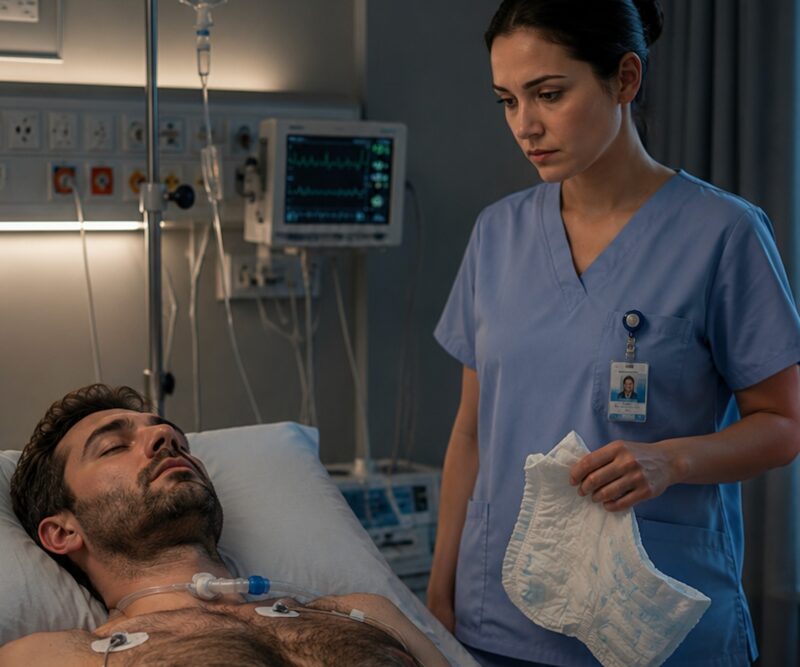
Nurse’s Persistence Leads to Remarkable Recovery for Comatose Millionaire
A Difficult Job Accepted Out of Necessity
A young nurse facing serious financial hardship accepted a position that many others had refused.
The assignment involved caring for a wealthy businessman who had spent more than two years in a deep coma.
His condition required constant attention, and the responsibilities were physically and emotionally demanding.
Many healthcare workers declined the opportunity after learning the extent of the daily care involved.
For the young nurse, however, turning down the job was not an option.
Following the death of her mother, she had been left with substantial medical debt. At the same time, she was helping support her younger brother’s education.
When she learned how much the position paid, she understood that accepting the role was the only realistic way to manage her financial obligations.
Although she knew the work would be difficult, she agreed to take the assignment.
A Patient Everyone Had Given Up On
Several days later, the nurse arrived at the private medical facility where the patient was being treated.
The room was unlike a typical hospital ward.
Expensive furnishings filled the space, and advanced medical equipment surrounded the bed.
A security guard remained stationed outside the room at all times.
The patient was a millionaire whose medical condition had attracted significant attention.
Despite the resources dedicated to his care, little had changed during the previous two years.
He remained unconscious and completely dependent on medical support.
Doctors had repeatedly concluded that the chances of recovery were extremely low.
As time passed, many people came to view him as a man whose life continued only because of modern technology.
Few believed he would ever regain consciousness.
Settling Into a Routine
During her first weeks on the job, the nurse focused on providing the best care possible.
Each day followed a strict routine.
She monitored vital signs, changed intravenous lines when necessary, repositioned the patient to prevent complications, and carried out a variety of hygiene and medical procedures.
The work demanded patience and attention to detail.
Although the patient showed no signs of awareness, she treated him with dignity and respect.
Over time, she developed a habit that some of her coworkers considered unusual.
She spoke to him.
While performing her duties, she would tell him about her day, describe ordinary events, and occasionally offer words of encouragement.
She understood that he might not hear any of it.
Still, the conversations made the room feel less empty.
To her, it seemed wrong to treat him as though he were not there.
An Ordinary Morning Becomes Extraordinary
Nearly a month passed without any significant change.
Then one morning, during a routine hygiene procedure, something unexpected happened.
The nurse was carrying out a task she had already performed many times before.
Everything seemed completely normal.
As she adjusted the bedding and continued her work, a slight movement caught her attention.
At first, she thought she had imagined it.
Out of the corner of her eye, she believed she had seen one of the patient’s fingers move.
The motion was so subtle that it could easily have been overlooked.
She immediately stopped and focused her attention on his hand.
For several seconds, nothing happened.
Then she saw it again.
The movement was small, but unmistakable.
One finger appeared to twitch.
A Concern Dismissed
The nurse completed her task and quickly contacted the physician on duty.
The doctor examined the patient briefly and offered a simple explanation.
He believed the movement was nothing more than a reflex.
Such reactions occasionally occurred in patients with severe neurological conditions and were not necessarily a sign of improvement.
The explanation satisfied others, but not the nurse.
By that point, she had spent weeks observing the patient every day.
She knew his condition better than most people.
In all that time, she had never witnessed anything similar.
The movement felt different.
Before leaving the room, she quietly spoke the patient’s name once more.
Moments later, she noticed another slight twitch.
This time, her doubts grew even stronger.
Watching for a Pattern
Rather than dismissing the incident, the nurse began paying even closer attention.
Over the next several days, she carefully documented everything she observed.
Gradually, a pattern began to emerge.
Whenever she spoke to the patient or touched his hand, subtle changes appeared on the monitoring equipment.
His heart rhythm occasionally shifted.
At times, small finger movements followed.
None of the reactions were dramatic.
Most people would likely have missed them entirely.
Yet the consistency of the observations convinced her that something significant might be happening.
She became increasingly certain that the patient was responding in some way.
Determined not to ignore the possibility, she raised her concerns repeatedly.
Fighting for Another Evaluation
The nurse requested additional testing and a more thorough evaluation of the patient’s condition.
Initially, her suggestions received little support.
Previous examinations had consistently produced discouraging results.
Many medical professionals believed there was no reason to pursue further investigations.
Additional procedures would be costly and time-consuming.
From their perspective, the chances of discovering anything new were extremely small.
Despite the resistance, the nurse refused to abandon her concerns.
She continued presenting her observations and arguing that the patient deserved another chance.
Eventually, her persistence led to a compromise.
The clinic agreed to consult a respected neurosurgeon from another medical facility.
The specialist arrived several days later.
After reviewing the patient’s history, the neurosurgeon ordered a diagnostic examination that had never previously been performed.
Unexpected Findings
The results surprised everyone involved.
The examination revealed a previously undetected problem.
A rare complication from an earlier operation had created significant pressure on a specific area of the patient’s brain.
The condition had contributed directly to his prolonged coma.
More importantly, advances in modern neurosurgery offered a potential solution.
For years, medical teams had focused on managing the patient’s condition rather than searching for additional explanations.
Because recovery seemed unlikely, no one had considered investigating this possibility.
The new findings changed everything.
For the first time in years, there was a realistic treatment option.
Doctors quickly began preparing for surgery.
A High-Stakes Operation
The procedure was scheduled only a few days after the diagnosis.
Medical staff understood that the operation represented the patient’s best opportunity for recovery.
The surgery lasted nearly eight hours.
Throughout the process, specialists worked carefully to address the pressure affecting the brain.
When the operation concluded, the outcome remained uncertain.
Even with a successful procedure, recovery could take time.
No one knew whether the patient would respond.
The medical team could only wait.
Signs of Improvement
The first indications of progress appeared approximately two weeks later.
Staff members noticed subtle changes in the patient’s responsiveness.
Then came a breakthrough.
For the first time in more than two years, the man opened his eyes on his own.
The development generated excitement throughout the clinic.
Doctors continued monitoring his condition closely.
Over the following days, additional improvements emerged.
His awareness increased.
His ability to respond gradually returned.
One of the most emotional moments occurred when he gently squeezed the hand of the nurse who had fought for his reevaluation.
The gesture lasted only a moment, but its significance was impossible to overlook.
Learning the Truth
As his recovery continued, the millionaire slowly learned what had happened during the years he spent unconscious.
He was informed about the examinations, the surgery, and the events that led to his treatment.
Most importantly, he learned about the nurse who had refused to accept that his condition was hopeless.
When he discovered that she had been responsible for pushing for another evaluation, he remained silent for a long time.
The realization appeared deeply emotional.
He understood that without her determination, the critical diagnosis might never have been made.
The opportunity for treatment could easily have been missed.
Eventually, he expressed his gratitude.
He acknowledged that many people had stopped believing recovery was possible.
Yet one person had continued searching for answers.
A Reminder of the Importance of Persistence
For the young nurse, the experience became one of the defining moments of her career.
She had accepted the difficult position because she needed financial stability.
What began as a practical decision ultimately transformed a life.
A movement so small that most people would never have noticed it became the clue that changed everything.
Her willingness to pay attention, trust her observations, and advocate for her patient created an opportunity that otherwise might never have existed.
The millionaire’s recovery demonstrated how important persistence can be in medicine.
Even when circumstances appear hopeless, careful observation and determination can sometimes reveal possibilities that others overlook.
Had the nurse ignored that tiny movement of a finger on an otherwise ordinary morning, the patient’s condition might have remained unchanged forever.
Instead, her actions helped provide one final chance at recovery—and that chance ultimately made all the difference.

