Viral Tattoo Sparks Global Debate After Blurry Image Creates Online Confusion
A Simple Image That Turned Into a Worldwide Puzzle
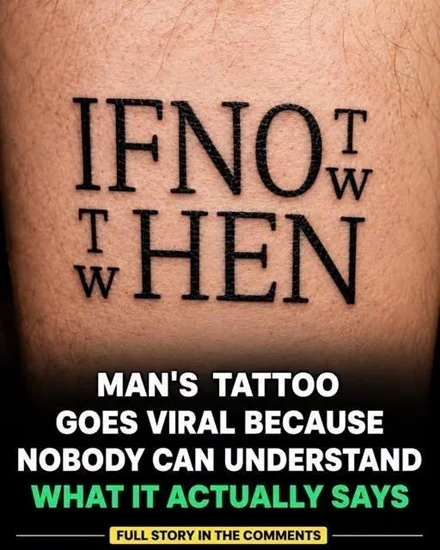
A wave of confusion spread across social media after a blurry photograph of a tattoo began circulating online and quickly captured global attention. What initially appeared to be a straightforward piece of body art soon transformed into a widely discussed mystery as users attempted to interpret the unclear design.
The image, which showed a tattoo on a man’s forearm, prompted thousands of viewers to zoom in, crop sections, and analyze the distorted lettering. Despite these efforts, the content remained difficult to read, leading to ongoing disagreement about what the tattoo actually said.
As more people engaged with the image, the uncertainty surrounding it only increased. Instead of a single interpretation emerging, multiple competing versions of the text began to circulate, each differing slightly from the others.
The Intended Meaning Behind the Tattoo
The tattoo was originally designed to represent a motivational quote intended to reflect personal growth and decision-making. It was meant to serve as a permanent reminder of the importance of taking action and learning from life choices.
However, the final design suffered from spacing and layout issues that significantly affected readability. The compressed lettering and unclear structure made it difficult to distinguish individual words, altering how the message was perceived once it appeared online.
What was intended as a meaningful statement became visually unclear, creating a gap between the artist’s original intention and the public’s interpretation of the design.
Rapid Spread Across Social Platforms
Once the photograph was shared online, it spread quickly across multiple social media platforms. Users began engaging with the image almost immediately, attempting to decode the text hidden within the blurred and tightly packed lettering.
Different viewers focused on different parts of the tattoo, isolating fragments of letters in an effort to reconstruct the message. Despite widespread attention and repeated attempts at interpretation, no consensus was reached.
The uncertainty surrounding the tattoo transformed it into a digital puzzle, encouraging continued discussion and repeated analysis as users tried to make sense of what they were seeing.
Conflicting Interpretations and Growing Debate
As interest grew, users began offering competing interpretations of the text. Some claimed to recognize partial words, while others suggested that the lettering might be poorly executed or even meaningless in its final form.
The lack of clarity fueled further engagement, as each new interpretation added to the ongoing discussion. Rather than resolving the confusion, the debate expanded as more users contributed their own readings of the image.
This growing disagreement turned the tattoo into a shared online challenge, with many people returning to the image multiple times in an effort to uncover a definitive explanation.
A Shift From Tattoo to Symbol
Over time, the tattoo began to take on a symbolic meaning beyond its original purpose. It was no longer viewed simply as body art, but as an example of how visual communication can break down when design elements fail to support clarity.
Many observers noted that the intended motivational message had become visually distorted, creating an impression of confusion rather than inspiration. The image was increasingly seen as an example of how presentation can significantly impact understanding.
This shift in perception turned the tattoo into a broader reflection on how meaning can be affected by design choices and visual structure.
The Emergence of an Accepted Interpretation
After extensive discussion, a widely accepted interpretation of the tattoo eventually emerged. The phrase was understood to read “If not now, then when.”
This expression is commonly associated with motivation and self-improvement, encouraging immediate action and discouraging delay. It is often used as a reminder to make decisions without postponing important steps.
Even after this interpretation gained traction, many viewers still found it difficult to visually confirm the phrase within the original image. The ambiguity of the lettering continued to generate discussion despite the proposed explanation.
The contrast between intended meaning and perceived readability remained a central point of interest throughout the conversation.
How Miscommunication Became the Focus
The situation highlighted how easily communication can become distorted when visual clarity is compromised. What was meant to be a simple and powerful motivational message instead became a subject of widespread confusion.
The tattoo demonstrated how design limitations can interfere with interpretation, leading to multiple readings of the same visual information. In this case, the issue was not the message itself, but how it was presented.
This disconnect between intention and perception became the defining feature of the viral discussion, shaping how the image was understood across different audiences.
Public Reaction and Collective Interpretation
As the conversation continued, many users reflected on why the image generated such strong engagement. The fascination appeared to stem from its universal relatability, as misunderstandings and misinterpretations are common experiences in everyday communication.
The tattoo became a point of collective interpretation, with individuals projecting their own assumptions and expectations onto the image. This process contributed to the variety of meanings attributed to it.
Over time, the image evolved into more than just a tattoo. It became an example of how online communities can collectively shape meaning through shared analysis and discussion.
The Role of Viral Amplification
The rapid spread of the image demonstrated how quickly small details can become widely discussed topics in the digital environment. A single unclear photograph was enough to generate global attention and sustained debate.
This amplification highlighted how online platforms can transform minor visual imperfections into major points of discussion. The tattoo’s visibility increased not because of its design quality, but because of the uncertainty surrounding it.
What might have remained a personal design became a widely shared topic simply through exposure and repetition across social networks.
From Confusion to Reflection
As interest gradually faded, the tattoo remained a recognizable example of online interpretation dynamics. While the intensity of discussion decreased, the image continued to circulate as a reference point for similar debates.
The conversation shifted from attempting to decode the exact wording to reflecting on how meaning is constructed and perceived. The tattoo became a case study in how visual information can be interpreted differently depending on the viewer.
Beyond the initial confusion, some observers viewed the situation as a reminder that communication depends not only on intent but also on clarity and execution. Even simple messages can lose their impact if presented in a way that limits understanding.
A Lasting Example of Perception and Meaning
In the end, the tattoo itself remained unchanged, but its significance evolved through collective interpretation. What began as a personal motivational phrase became a widely discussed example of visual ambiguity.
The discussion surrounding it highlighted how meaning can shift once an image is shared with a broader audience. Individual interpretation, combined with digital amplification, transformed a simple design into a complex topic of conversation.
The story of the tattoo ultimately illustrates how perception plays a central role in communication. Even when intentions are clear, the final meaning can depend entirely on how information is seen, understood, and shared by others.
What remained was not just a blurred tattoo, but a broader reflection on how easily clarity can be lost and how meaning can evolve once it enters the public eye.
